Monthly Archives: October 2012

Plant of the day: California white oak

The changing leaves of the oaks are another sign of the shift in seasons. Brown is quickly overtaking green, especially in the drier hills. Only the large, lobe-leaved oaks are deciduous–the species with small leathery foliage hang on to their leaves year-round.

California white oak (Quercus lobata) has lobed leaves that are paler beneath and rich, shiny green above. Their acorns are slim, with a large cap-shaped cup that resembles a Rastafarian’s hat. They can be distinguished from their cousins that also have pale underbellies because blue oak has–wait for it–a blueish cast to the upper surface of the leaf. And Oregon oak has a furry coat on its underside (as well as plump, squat acorns). I use the memory-trick that Oregon oaks need such things to grow in the chilly north, whereas Californian oaks have no need for extra insulation.

Identifying oaks can be notoriously tricky, since they cross with one another easily and the results have a mixed blend of characteristics. I tend to stick with the Marin Flora and that keeps me happy. The California white oak pictured here, for example, has shallower lobes than the classic examples. But lobes aren’t an issue in the Marin Flora–so I can happily feel comfortable with my ID.
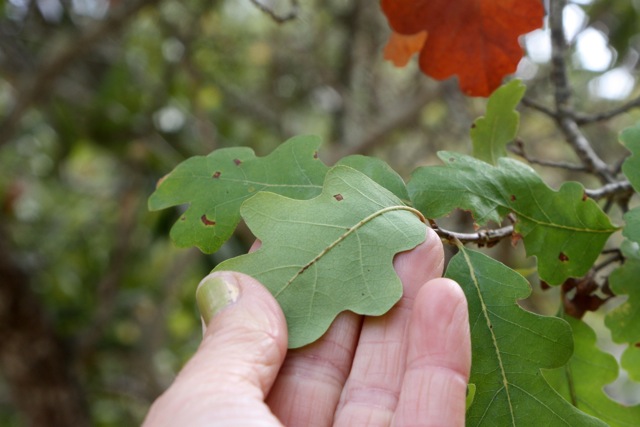
Note the pale underside of the leaf

Leave a comment

Filed under Edible, Native, Plant of the day

Plant of the day: coffee fern

A brown scrap of leaves clings to a rocky cliff, strung together on threadlike stems. Though this little fern looks thoroughly dead in the last gasp of autumn heat it’s actually still alive. The green leaves of this perennial fern turn brown in late summer, giving coffee fern or coffee cliffbrake (Pellaea andromedifolia) its common name.

You can tell this fern from the similar-looking birdfoot cliffbrake because it has rounded leaves, rather than leaves that come to a point. When the leaves are not dried out, you can see that each leaflet rolls under at the edges (shown in the photo, below).

Pellaea_andromedifolia2

Coffee fern in winter lushness

Leave a comment

Filed under Native, Plant of the day

Plant of the day: dallisgrass

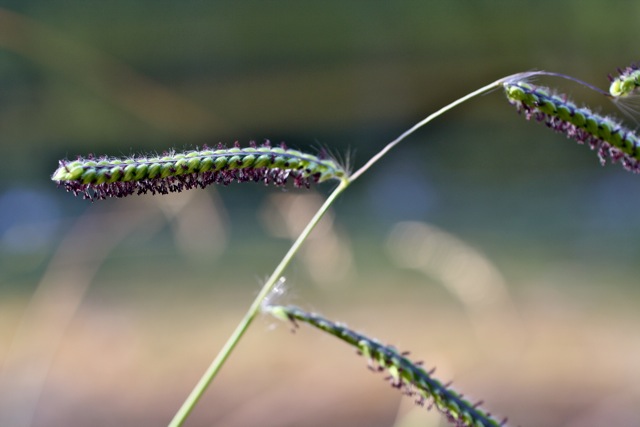
Dallisgrasslooks rather like a centipede when in bloom–except much more lovely. Each drooping raceme of resembles a segmented body, and the dark purple threadlike flowers that dangle beneath could look like the insect’s tiny feet.

This showy grass was introduced from Brazil and Argentina, and is found growing throughout much of California–often in weedy places along roads and trails. The photos here were taken alongside the Bon Tempe reservoir. Though widespread throughout Marin, it isn’t considered an invasive. But it has naturalized throughout much of the US, and elsewhere it is considered a problematic weed. Dallisgrass (Papsalum dilatatum) looks a lot like its native cousin knotgrass, which is used as forage for cattle. But dallisgrass is less palatable since it hosts a fungus that is toxic to livestock. Despite its attractive flowers, its habit of showing up as stiff clumps in lawns and golf courses also has made it unpopular. Look for 3-5 centipedes of flowers to distinguish dallisgrass from knotgrass (which generally only has 2 flowers per stalk).

Incidentally, while researching this plant is the first time I’ve heard the term “cultural control” used to define the alternative to “herbicide control”. Basically it means digging the plant out or using other manual, non-chemical means to get rid of it. But for a minute I daydreamed that cultural control might mean eating hors d’oevers or playing Pavarotti really loud on a stereo to make any nearby weeds shrivel up…

Leave a comment

Filed under Non-native, Plant of the day

Plant of the day: pepperwood

Scrappy and graceful, the pepperwood (Umbellularia californica, or California bay laurel) is often overlooked and underappreciated, but it’s one of my favorite trees. It can take on all sorts of forms, from skinny trunks packed close together in the understory to stoic ancient giants. Near the coast they can become windswept, so an entire stand of trees melds together into a single undulating canopy of green. They host many other species–from birds and beetles to the moss and ferns that grow on their trunks. Pepperwood often are full of cavities where critters roost or nest, and if you climb them often–as I did as a kid–you quickly learn to check the crooks of the branches for racoon scat.

This slideshow requires JavaScript.

Right now the nuts of the pepperwood are beginning to ripen; inch-long orbs of green or purple or yellow peek out from among the leaves. In the early winter, tiny pale yellow flowers will begin to bloom. They are easy to miss, but worth looking for: each tiny blossom is an intricate display (see the photos above). I particularly love the decorative dots of pollen arranged on spatula-shaped stamens. The leaves are wonderful too, both to look at and eat: the distinctive peppery aroma adds a nice flavor to beans or tomato sauce.

Recently pepperwood has gotten a bad rap because it’s a vector for sudden oak death but doesn’t die from it. Some people advocate cutting down pepperwoods to protect their oaks. Perhaps this method might slow the spread of the disease–but it won’t stop it. Personally I’d rather keep the mature pepperwoods around then have to start a forest over from scratch.

I should note that pepperwood is the less-used name for this tree; but personally I think it’s much better than the staid and unevocative bay laurel. I also like the heritage of the word–it’s what my grandfather always called it, and those who use it nowadays tend to be old-time Californians. A tribe I’m happy to be in.


Leave a comment

Filed under Edible, Good for gardens, Native, Plant of the day

Plant of the day: madrone

The bright red-orange berries of madrone trees are ripening, giving hillsides and forest canopies a crimson tint. This tree is a stunning sight at any time of year, with large dark-green leaves, crooked trunks and smooth, rust-colored bark. But right now the madrones are particularly gorgeous as they add their brilliant berries into the mix. And there are a lot of them! Each tree is decked with so much fruit that it takes on a reddish glow. 

This slideshow requires JavaScript.

Look for madrone (Arbutus menziesii) as one of the many species growing in mixed hardwood and conifer forests. You can see them even while driving: look for bursts of red scattered across the dark green wallpaper of a forested hillside. It often is found growing along with Doug fir, tanoak and other oaks–usually on well-drained, rocky soils.

Madrone berries are edible, and were used widely by Native American tribes such as the Miwok and the Salinan. The fruits were eaten raw–but in small quantities. Sometimes they were chewed for flavor, but not swallowed. They were more often eaten cooked or dried, or made into unfermented cider (water used to make the cider was boiled by adding hot rocks to a watertight basket, and stirring them so they wouldn’t burn through).

Berries were also made into necklaces, and used for bait in fishing. The leaves were chewed to treat stomachache and cramps, or used to make a wash for poison oak.

1 Comment

Filed under Good for gardens, Native, Plant of the day

Plant of the day: bigleaf maple

The subtle colors of California fall are washing across the landscape. The scattered patches of yellow you see starting to show up in the forest are probably bigleaf maple, or Acer macrophyllum. This native tree drops its  leaves in the fall, and it is one of the few species around here that turns yellow before it turns brown.

This slideshow requires JavaScript.

Bigleaf maple is found along the west coast from central California to the Alaska panhandle. The sap can be made into maple syrup–but this isn’t done often since the yield is lower than from the eastern sugar maple. The timber is harvested commercially. The largest known bigleaf maple is eight feet in diameter.

This tall tree drops piles of soft leaves, and is used for wildlife habitat year-round. Bugs live in its furrowed bark, and birds (including harlequin duck and pileated woodpecker, where they occur) sometimes nest in the bigleaf maple–as does the dusky footed woodrat. Deer forage and bed down in the understory of the mixed forest that this tree generally grows in.

Leave a comment

Filed under Good for gardens, Native, Plant of the day

Plant of the day: dune goldenrod

Nature lies disheveled, pale,
With her feverish lips apart,—
Day by day the pulses fail,
Nearer to her bounding heart;
Yet that slackened grasp doth hold
Store of pure and genuine gold;
Quick thou comest, strong and free,
Type of all the wealth to be,—
Goldenrod!
(by Elaine Goodale)


Solidago spathulata

Late-blooming goldenrod flowers are rooted so deep into cultural consciousness (witness the somewhat overwrought poem, above, and many more like it) that I”ve always assumed that they are more common than they actually are in these parts. But here in Marin, the three species of goldenrod only appear occasionally, singly or in patches that are so sparse that they don’t really deserve the name. Yet in other parts of the country, the hundred or so species  that go by this name are weedy and abundant, washing fields and roadside ditches with yellow. Goldenrod is the state flower of Nebraska, Kansas, South Carolina, Delaware, and (formerly) Alabama.

But back on the bluffs of Point Reyes, a goldenrod sighting is more likely to mean a tattered straggler like the one pictured here. This is dune goldenrod, or Solidago spathulata. It has leathery, slightly sticky leaves and a small spike of the characteristic yellow flowers. It is found growing near the coast, in rocky or sandy soils.

Leave a comment

Filed under Native, Plant of the day

Plant of the day: umbrella sedge

Long ribbons of leaves dangle off a central stalk like the naked ribs of an umbrella that has had the fabric torn off.

This is the aptly named umbrella sedge, or Cyperus involucratus. It’s often grown as a garden plant but occasionally seeds from this east-African native escape the yard and grow in the wild. This plant is said to be a close relative of Egyptian papyrus. It generally likes to grow in boggy areas and wetlands.

You can tell this plant from the other triangle-stemmed sedges around because of the many leaves, which grow beneath delicate clusters of flower spikes. But FYI, the leaves are technically bracts, with the actual leaves existing only as tiny nubs around the base of the stem.

Leave a comment

Filed under Non-native, Plant of the day