Category Archives: Native

Plant of the day: Western larkspur

Larkspur is always lovely, with its hood-shaped flowers in vivid colors. Western larkspur (Delphinium hesperium) has an affinity to dry, serpentine grassland hillsides.

This slideshow requires JavaScript.

You can recognize this species by its crowded spikes of blue flowers and slightly furred seed-pods. But look close, because there are many other species of blue larkspur in the area!

1 Comment

Filed under Native, Plant of the day

Plant of the day: Marin dwarf flax

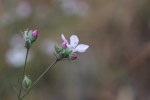
Sprays of delicate flowers are dense on a grassy hillsides of Ring Mountain. Pink buds open into slightly disheveled white flowers–the petals are slightly disarranged and appear delicate, as if loosely attached.

This diminutive beauty is Marin dwarf flax (Hesperolinon congestum), which grows only on the Tiburon Penninusla and the San Francisco Peninsula. It is only found on serpentine soils, and can be distinguished from other local types of dwarf flax because the petals are more than 5 mm long, and the sepals are covered with fine hairs. Leaves are small and needlelike.

Leave a comment

Filed under Native, Plant of the day, Rare

Plant of the day: Tiburon mariposa lily

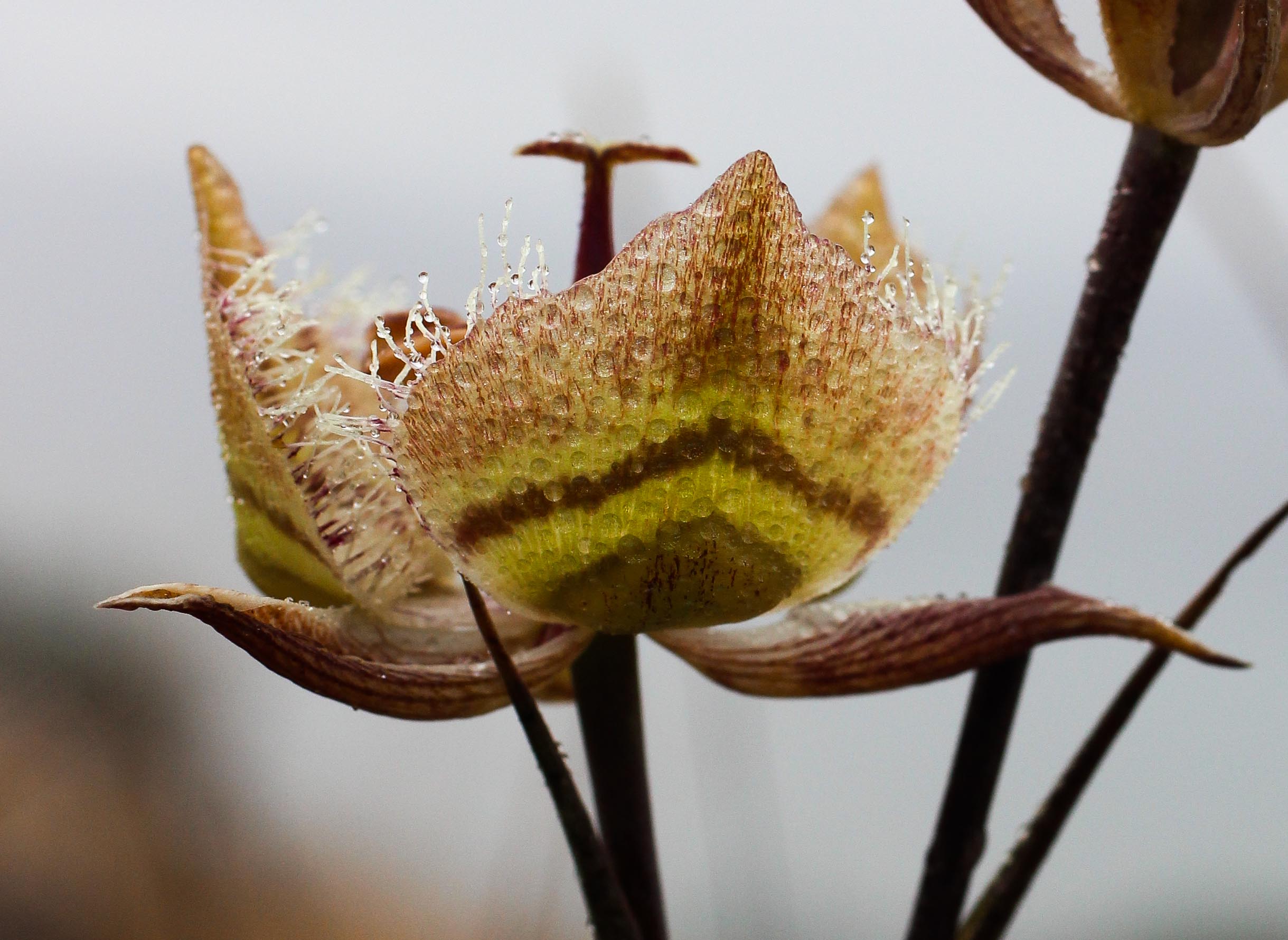
These amazingly beautiful lilies are in full bloom on Ring Mountain right now–catch them before they are gone! Tiburon mariposa lilies (Calochortus tiburonensis) grow only on the Tiburon peninsula–where they weren’t discovered until 1971, and were listed as Federally threatened in 1995. It grows on Ring Mountain along with several other rare species that are associated with serpentine soils.

This slideshow requires JavaScript.

This striking lily sprouts a handful of blooms (2-7) on a single stem with a single leaf. The blooms can be brownish, yellowish, or greenish with dense hairs on the inner surface of its three petals. Darker brown markings decorate flowers.

A good place to see these blooms is along the rocky slopes of the western fork of the Phyllis Ellman trail on Ring Mountain, near point-of-interest marker post #14 (this is the westernmost leg of the loop trail; the right-hand fork if you start from the Paradise Drive parking area).Calochortus_tiburonensis-7

2 Comments

Filed under Native, Plant of the day, Rare

Soaproot update

The beautiful soaproot are in season!

For most of the year, soaproot (Chlorogalum pomeridianum) is simply an innocuous tuft of leaves growing from the ground. But at this time of year, it shoots a long stalk of starry white flowers. Best of all, these blooms only open in the late afternoon and evening–for most of the day, you can walk past them without even noticing the wiry gray stalks. When I do see them it feels like a special treat.

This slideshow requires JavaScript.

It’s worth it to try to find a field where soaproot is in bloom–en masse these are spectacular. Because the stems are so tall and yet nearly invisible, the flowers seem to hover in the air like real stars.

Also known as amole, star lily, soap lily, or soap plant, it contains saponins and was traditionally used as its name suggests. The crushed bulb foams up nicely and was used to wash hair, bodies and anything else. The plant was also used in fishing, since saponins are toxic to ichtyoids. The crushed bulb would be tossed into a stream, and soon the hapless fish could be scooped out!

 

1 Comment

Filed under Native, Plant of the day

Plant of the day: coastal tidy tips

Layia_platyglossaCoastal tidy tips (Layia platyglossa) are eye-catching, with their buttery yellow centers and white petal tips. But keep a sharp eye out because there are two other and very similar looking species in Marin. You can tell this one apart because the plant is glandular, has fragrance, and the hairs on the stems rise out of dark spots.

These ones were seen blooming on the bluffs of Steep RavineLayia_platyglossa-2

1 Comment

Filed under Native, Plant of the day

Plant of the day: false babystars

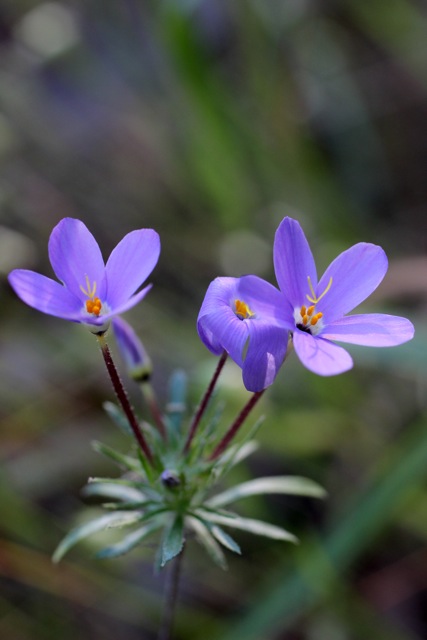
Leptosiphon_androsaceus1Elegantly colored clusters of flowers sprout from a prickly head of leaves. This is false babystars (Leptosiphon androsaceus), one of the many similar-looking species in the area. I tend to call them all “linanthus”, the groups former scientific name which doubles as a common name for some species.

False babystars grow in shallow and serpentine soils and is particularly fond of rocky canyonsides. Blooms can be lavender, pink, or white–but most commonly are lavender petals with a purple throat, as shown here. The long threadlike stalk between the leaves and the flower is actually part of the blossom itself–the technical term for this flower shape is “salverform.”

The easiest way to tell false babystars apart from its closest lookalike, L. parviflorus, or variable linanthus, is because the foliage is hairy but not glandular. Also the petals lobes (the part that look like petals, not the skinny tube below) are somewhat larger, usually greater than 8 mm. Leptosiphon_androsaceus2

Leave a comment

Filed under Native, Plant of the day

Plant of the day: Pacific rhododendron

As sunbeams filter through the redwood canopy, the understory lights up with flares of pink. This is Sonoma county’s Kruse Rhododendron State Park, and I was lucky enough to find myself there last week with the rhododendrons (Rhododendron macrophyllum) in full bloom. It’s a surprisingly beautiful sight to be in a forest of these tall shrubs when they are heavy with their large pink flowers. The effect is lovely and somehow festive–as if the woods had been decorated for a girl’s birthday party.

This slideshow requires JavaScript.

Pacific rhododendron can grow to 12 feet tall, and are found from British Columbia to Monterey; they are the state flower of Washington. They usually grow in under conifer forests, but you can also sometimes find them in the chaparral, according to the Marin Flora.

This plant is not edible, but it was used ceremonially by west coast tribes. The Karok used it in a sweathouse ceremony designed to bring luck; the Kashaya and Pomo people use the flowers to make dance wreaths.

Leave a comment

Filed under Good for gardens, Native, Plant of the day

Plant of the day: foothill penstemon

Penstemon_heterophyllus1Bushes of beautiful blue-purple snapdragon flowers thrive on a dry, rocky cliff. Inside are four pale stamens, two of which curl charmingly against the tube of petals. This is foothill penstemon (Penstemon heterophyllus).

This California endemic is popular for gardens as it is deer resistant, drought tolerant, hardy, and attracts butterflies, hummingbirds and other pollinators. The narrow, opposite leaves are quite attractive too. Plus, one source says that these plants can live up to thirty years! Amazing.

It is also known as bunchleaf penstemon.Penstemon_heterophyllus

1 Comment

Filed under Good for gardens, Native, Plant of the day

Plant of the day: bluehead gilia

Long stems bearing balls of pale blue flowers grow on a hot, rocky hillside. Narrow, fernlike leaves grow up each stalk. This is bluehead gilia (Gilia capitata), a hardy native to California and most other western states.

Bluehead gilia is good for sunny native plant gardens, where it self-sows and attracts bees, butterflies, and other pollinators. A member of the phlox (Polemoniaceae) family, it is also known as blue field gilia, globe gilia, and blue thimble flower.

Leave a comment

Filed under Good for gardens, Native, Plant of the day

Plant of the day: one-leaf onion

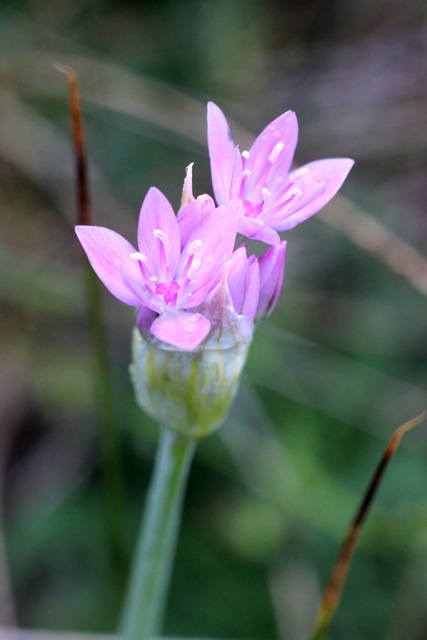
Allium_unifolium1The browning grass of Potrero Meadow has a few bright splotches of color. The pale purple blossoms of one-leaf onion (Allium unifolium) are held a few feet high atop a fleshy, leafless stem; two or three linear leaves grow from the base (I’m not sure where the name “one-leaf” came from).

One-leaf onion is found in coastal counties from central California to southern Oregon. Look for it in moist clay or serpentine soils, especially along grassy streambanks.

Native onions, including this one, were an important food source for indigenous Californians. According to the Native American Ethnobotany Database, one-leaf onion bulbs were traded for other goods such as skins, baskets, or pottery. Bulbs were eaten raw, roasted, or fried, as well as used for seasoning (though I would want to do more research before eating it, since the Mendocino Indians considered it poisonous, and the California Poison Control database lists it as minorly toxic). Allium_unifolium2

Leave a comment

Filed under Native, Plant of the day