Category Archives: Native

Plant of the day: footsteps of spring

This is one of my favorite-named plants. Footsteps of spring (Sanicula arctopoides) is a colorful, low-growing little plant that begins to bloom quite early in the season. As its brilliant yellow-and-green mounds spread across the warming landscape, it is easy to whimsically imagine them as footsteps left by this gracious season. Sanicula_arctopoides
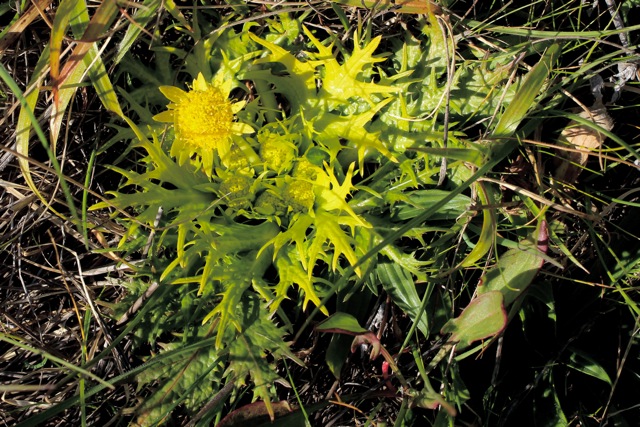
The entire plant is saturated in color, with the leaves ranging from brilliant green at the edges  into yellow toward the center. The buttonlike pad of yellow flowers is surrounded by a long fringe of yellow bracts. The whole thing has the look of a lovely, wild, painterly creation. Hurray for spring!

Leave a comment

Filed under Native, Plant of the day

Plant of the day: California buttercup

Ranunculus_californicusThe shiny, sunny blooms of buttercups are starting to show up–a sure sign that spring is coming. California buttercup (Ranunculus californicus) is a common sight in much of California. Look for the bright flowers with many petals (between 7 and 22 of them) atop slim, straight stems with deeply divided leaves.

Buttercups were one of my favorite flowers as a kid, mostly because of a silly game my parents would play. If a buttercup placed beneath your chin made your skin looked yellow, then you liked butter. I loved butter, and thought the game was great fun–though now it seems that was the point, since the trick would work on everyone. It turns out that this game goes back a long ways, as it is listed as a traditional use of the plant by the Kashaya, Pomo and other native tribes in this part of the world. Indigenous people made bread and porridge from a flour of dried, pounded seeds of California buttercup.

This flower can grow in low moist fields and streambanks, in forest understory, and on shrub-covered hillsides. It likes meadows and wetlands, and is equally likely to grow in wetlands and non-wetlands. Unlike some types of buttercup, this one is happily lacking in stickery, spine-covered seeds.

Leave a comment

Filed under Native, Plant of the day

Plant of the day: Pacific pea

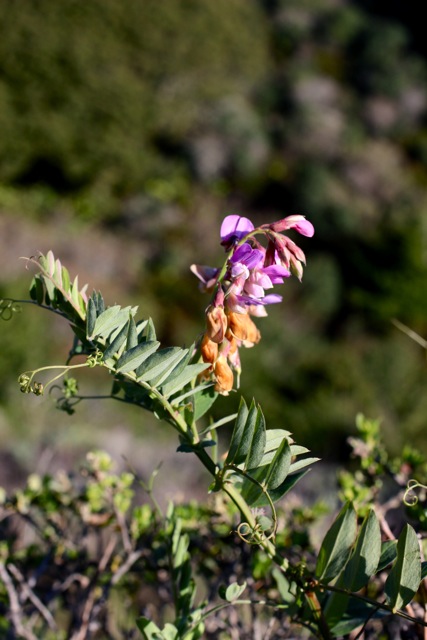
Lathyrus_vestitusA banner of pink flowers flies above a coastal sage bush. This is Pacific pea (Lathyrus vestitus), which has clambered to this high perch using twining, curling green tendrils.

Pacific pea is a California native that can be pink, white or lavender and often appears yellowish as it ages. The stem is sharply angled but not actually winged as many species in the Lathyrus genus are. The roots, seeds and leaves of this plant are edible, and tincture made from the roots was used by Native Americans as a general healing remedy and to treat internal injuries.

You can tell Lathyrus species from the often similar looking vetch species most easily because the flowers are generally larger–greater than one centimeter. But also tug on the petals; if the upper (wing) petals are partly joined to the lower (keel) petals then you have one of the large vetch species, not a pea.

Leave a comment

Filed under Native, Plant of the day

Plant of the day: hairy woodsorrel

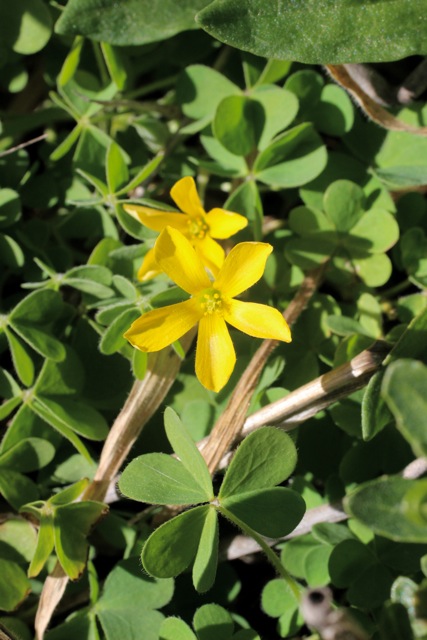
Oxalis_albicans2A stroll along the coastal bluff reveals little yellow flowers peeking from beneath the sagebrush and scattered across the grassland. Each handful of blossoms is scattered across a mounded patch of three-parted (cloverlike) leaves. This is hairy woodsorrel, or Oxalis albicans. The lemon-yellow petals splay outward around a hub of stamens like stout spokes on a cart wheel. If you nibble a leaf you’ll find the refreshing tartness that is characteristic of the sorrels.

Even the petals of hairy woodsorrel have a few minute hairs, and the leaves are distinctly hairy. This little flower is a native that is found only in coastal California–but it has a similar-looking cousin (O. corniculata) which is non-native and invasive; a common garden weed. Recognize the native hairy woodsorrel, which likes to grow near the coast, because it has slightly large petals  (8-12mm long). O. albicans also does not grow roots at the leafy nodes of its stems, and its taproot is woody instead of fleshy (another name for our native is radishroot woodsorrel). Oxalis_albicans1

Leave a comment

Filed under Native, Plant of the day

Plant of the day: Wallace’s spikemoss

Selaginella_wallacei1A small, spiky, green tendril creeps across a vertical slab of rock. It looks like a tiny conifer, crawling across the rock. This is Wallace’s spikemoss, or Selaginella wallacei and I was delighted to see it growing near Carson Falls. For reasons I can’t explain, the spikemosses have been one of my favorite types of plants since I first learned about them in my undergraduate botany classes.

Selaginella species reproduce via spores, as ferns do. Unlike ferns, the spores are produced from “spore cones” that are often found paired at the tip of the branches. Wallace’s spikemoss likes to grow on rocks. It can form into mats in sunny spots, but it is also found in a sparser form in the shade. It is widespread–throughout Northern California, and north into BC and Montana–but not common. You have to keep your eyes peeled for this little charmer!Selaginella_wallacei2

Leave a comment

Filed under Native, Plant of the day

Plant of the day: buck brush

Ceanothus_cuneatus1A small spray of purple flowers reaches across the trail beside Carson Falls, startling for being out so early in the year. This is buck brush (Ceanothus cuneatus, or wedgeleaf ceanothus), an early blooming shrub of the chaparral. It can sometimes cover wide swathes of hillside in color, and is charmingly described as “gregarious” in the Marin Flora. I love the thought of a cheerful, sociable hillside of buck brush.

Various indigenous Californian tribes prized the new twigs of this shrub for basket-weaving material. Miwoks would even groom the plants by trimming and training them to guarantee that they would produce plenty of new shoots. Buck brush wood was also used to make arrows, digging sticks, and ear-piercing needles.

It grows quickly and readily, and so is handy as a revegetation species–but be aware that deer love it as well, if you’re using it in an ornamental or garden setting. Buck brush has nitrogen-fixing nodules in its roots, so it naturally improves poor soils and makes them more suitable for other plants to thrive on. In a given year, an acre of ceanothus can fix approximately 54 pounds of nitrogen.

Leave a comment

Filed under Good for gardens, Native, Plant of the day

Silk tassel extravaganza

I stumbled across a single coast silk tassel in the forest above Tomales Bay recently (Garrya elliptica, first written about in this blog here). The small tree was little more than a single lean branch sprawling across the trail–but it was laden with long, creamy white flowers.

This slideshow requires JavaScript.

The longer I looked at these intricate blooms the more I was enthralled. They dangle from tiered bracts, six delicate flowers emerging from the side of each furred sheath. The petals are mere ribbons, fused at their tips and bowing open at the center to frame each delicate anther on this male tree. I indulged myself with taking many, many photos of this nearly unbelievably pretty display.

Leave a comment

Filed under Native, Plant of the day

Plant of the day: climbing bedstraw

A diminutive,  climbing herb has wrapped itself through the branches of a coastal sagebrush on the bluffs of Point Reyes. Elsewhere it can be seen sprawling across the forest floor. This is climbing bedstraw (Galium porrigens), and once you start seeing it you will find it is fairly common.

There are many species of bedstraw–both native and non-native–in the Bay Area. All are distinguished by having leaves that radiate out from the stem like spokes on a wagon wheel. G. porrigens has tiny, yellowish flowers and leaves that come in whorls of four. The leaves feel sandpapery and slightly sticky to the touch; it climbs by latching on with minute, recurved hairs. Despite being so little it is a perennial, found growing in both California and Oregon.

Leave a comment

Filed under Native, Plant of the day

Plant of the day: serpentine springbeauty

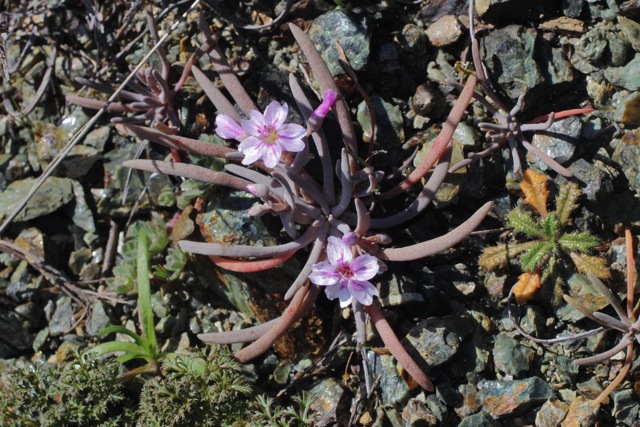
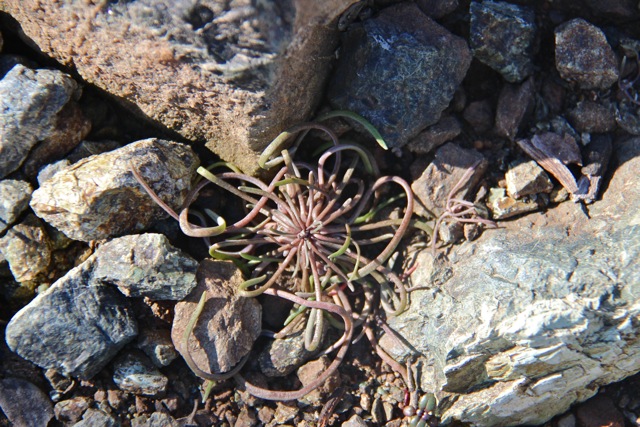
Claytonia_exigua1Clusters of tiny pink flowers grow on the bare rock and dirt beside the trail. If you don’t look close you might not see it at all–it is that small, and blends in with the reddish hue of the rocks. The flowers rise from a nest of long, strap-like leaves. Where found flowerless, the leaves look rather like a sea anemone with lean, purple-tinged arms.

This is serpentine springbeauty (Claytonia exigua), a diminutive plant that is adapted to survive in the harsh chemistry generated by this type of soil. It can be found on rocky slopes of serpentine, shale and sandstone.

Serpentine springbeauty is actually a cousin of the common (and tasty) miner’s lettuceClaytonia_exigua2

Leave a comment

Filed under Native, Plant of the day

Plant of the day: deer fern

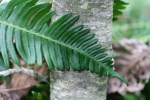
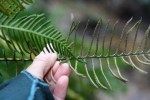
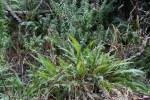
This shy little fern isn’t very common in Marin, but it’s a lovely one to get to know–and where it does grow it’s often abundant. It looks sort of like a small, lean, blunted sword fern–though when you look close it’s really quite different. Deer fern (Blechnum spicant) is interesting because each plant has two different types of fronds–a handful that are fertile, with spores underneath, and the rest which are sporeless and sterile.

The fertile fronds have much narrower leaflets, pared down like the skeleton of a fish. Two rows of deep brown spores coat the underside of the leaflets. Each plant throws up several of these fertile fronds, rising upright above the drooping mound of sterile fronds. These leaves have thick, rounded leaflets that are a bright, darker green above and a paler, duller green beneath.

Leave a comment

Filed under Native, Plant of the day