Category Archives: Native

Plant of the day: wild ginger

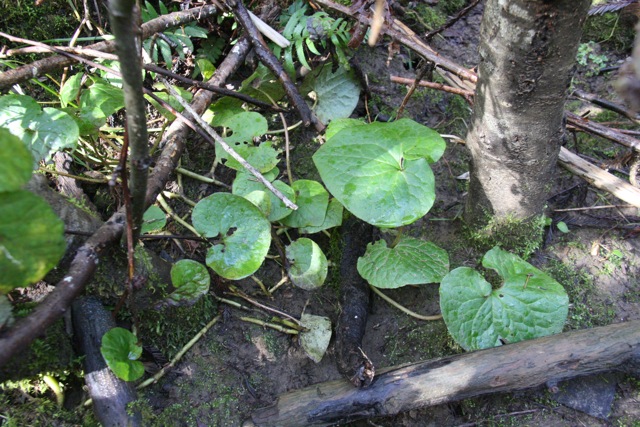
PAsarum_caudatum2alm-sized, heart-shaped leaves grow in a thick patch under a grove of alders on the river bank. This is wild ginger, or Asarum caudatum. The leaves and root, when crushed, release a sweet spicy smell; to me it’s not quite ginger-like but others disagree. In the old days the root was used as a substitute when ginger couldn’t be found.

Wild ginger root can be harvested year-round, but is supposedly best in the fall. The leaves can be made into a tea. Leaf and root were used both internally and externally  to treat headache, joint pain, indigestion and head colds. It was also used as a laxative, and a poultice of warmed leaves was applied to toothaches and boils.

Though these little plants are low-growing and seem fragile, they are actually an evergreen. They spread by rhizome in moist areas, forming clonal patches that are actually all one plant. This dense growth makes wild ginger a good groundcover for shady, moist native gardens–but it spread slowly, so is only for those with patience.

Asarum_caudatum1

Plucked wild ginger leaves showing a chunk of underground stem, or rhizome

There are several other species of wild ginger,  all in this genus, that grow elsewhere in California, but this is the only one in the greater Bay Area. It also goes by the common names of longtail wild ginger and creeping wild ginger. It can be distinguished from its cousins in several ways, such as its small reddish-brown flower whose three petals have a long, dramatic taper like a showman’s waxed moustache.
Leave a comment

Filed under Good for gardens, Medicinal, Native, Plant of the day

Plant of the day: red flowering currant

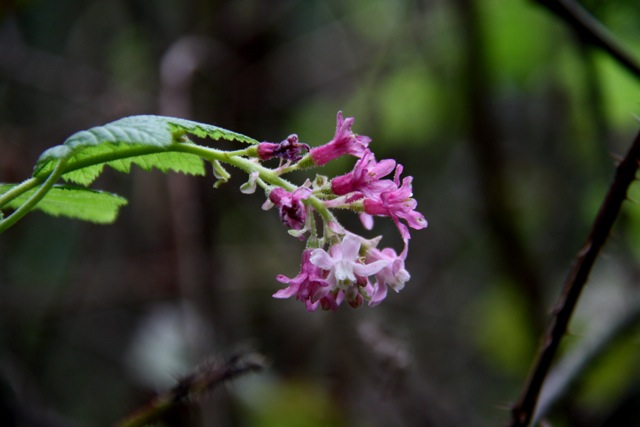
Ribes_sanguineum1Pink cascades of flowers dangle from the nearly-bare branches of a tall shrub. This is red flowering currant, or Ribes sanguineum, an early bloomer that usually blossoms from January on throughout the spring. Up to 20 small flowers unfurl from each raceme, varying shades of pink near the end of each branch where last year’s brown twig has given rise to a new shoot of green.

The blue-black berries of this shrub are edible but not particularly tasty.


Leave a comment

Filed under Native, Plant of the day

“Plant” of the day: old man’s beard

Usnea1Lichens litter the forest floor, shaken loose from the upper limbs of the trees by the winter storms. Old man’s beard is one of the most recognizable: a pale greenish tuft of long hair-like tendrils. My favorite thing about this lichen are the flat, fringed discs that are  some tufts. These are the apothecia, or fruiting bodies–I think they look like amoebas, or maybe stars, or maybe confetti. Delightful either way.

Old man’s beard is actually a generic name for the various members of the Usnea genus–which can be hard for a layperson to tell apart. But the genus itself is readily distinguished from others that look similar because it has a tough central cord running down each strand. If you gently tug on a piece of Usnea, the green outer covering cracks and separates, revealing the interior white cord which stretches like a bungee cord.

Usnea has long been used medicinally–as a bandage and antibiotic for rustic wound treatment, as sanitary napkins and in baby’s diapers. Western tribes such as the Makah used it to make mattresses in their seasonal camps. Modern herbalists have used it to treat lung and respiratory tract ailments. Usnea2

Leave a comment

Filed under Medicinal, Native, Plant of the day

“Plant” of the day: yellow coral mushroom

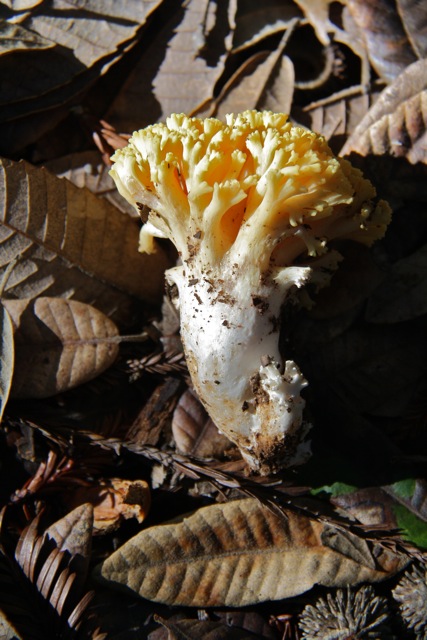
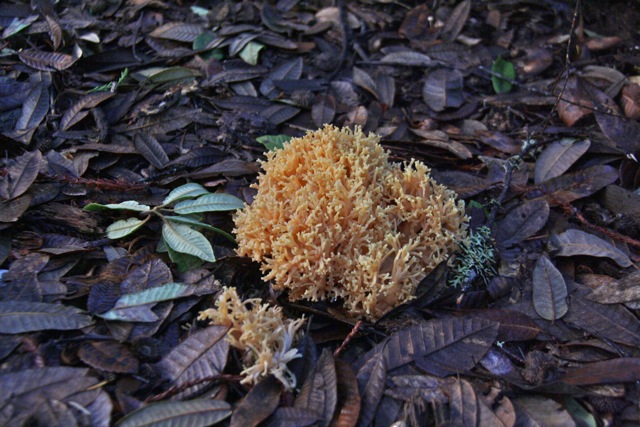
Ramaria_rasilispora1This fungus looks like a discarded bit of sea sponge or foam rubber was left lying on the forest floor. Upon closer inspection, it looks exactly like its name: yellow coral-like arms diverge and split into ever smaller branches.

Yellow coral mushroom (Ramaria rasilispora) is the most common fungus to meet this description—though there are several others. Its lower branches and “trunk” are white, don’t stain green or brown when bruised, and are solid rather than gelatinous. It’s common throughout the west, and in our area is mainly found under tanoaks or live oaks. Interestingly this preference changes with region and elsewhere it is most often found beneath conifers, according to my field guide.Ramaria_rasilispora2

Leave a comment

Filed under Native, Plant of the day

“Plant” of the day: candy cap

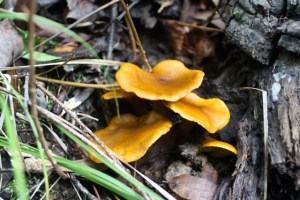
Lactarius_fragilis2This little dusky orange mushroom has a persistently sweet odor when cooked or dried. I’m not generally what mycologists call an “eater”–I tend to be extremely conservative when a mistaken ID can lead to, you know, death. But according to mushroom expert David Arora’s book, the sweet odor of the candy cap (Lactarius fragilis) is oddly persistent. It will linger in your house for days, and if you eat enough of them, your body will even start to exude the maple-syrup-like aroma!! But even though this is nifty, I DON’T recommend eating this little guy since it can mingle with other similar mushrooms, including some that are poisonous. I prefer to admire it in situ and move on.

An interesting trait of the Lactarius genus is that they often emit a white, gluey goo when you break the cap. This goo, called latex, can be a lot of different colors–though in the candy cap it is either absent or a prosaic white. Lactarius_fragilis1


Leave a comment

Filed under Native, Plant of the day

Plant of the day: manroot

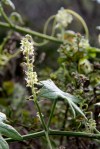
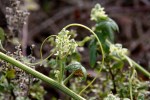
A tangle of twining vines sprawls over a nearby bush; pale green climbing tendrils form tightly wound curlicues until they find something to wrap around.  Whether it trails along the ground or sprawls across its neighbor, each branch throws carefree spires of small white flowers into the sunshine and the wind.

This is an early-blooming manroot, or wild cucumber. There are two common species of manroot in the area: California manroot (Marah fabaceus) and coast manroot (M. oreganus). California manroot, pictured here, has greenish flowers with a round ovary, leaves that are generally less than 10 cm wide, and rigid spines on its gourd-like fruit. Coast manroot has white flowers with a beaked or pointed ovary, larger leaves, and softer spines.

California manroot is an endemic found throughout much of California. The Pomo and Kashaya tribes would treat baldness with a concoction made from pounded manroot, skunk grease and pepperwood nuts–a cure that may have been worse than the problem. The root was also thrown into the water to poison fish so they could be harvested.

Leave a comment

Filed under Native, Plant of the day

Plant of the day: California nutmeg

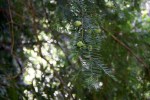
This beautiful, uncommon tree is an endemic that grows only in California. Even here, it is elusive–small groves can be found in the deep woods. The needles look vaguely like redwood needles in the way they grow in a flat plane, but those of California nutmeg are sharply pointed at the tip. It has reddish, shallowly furrowed bark. Male and female trees are separate.

The seeds of California nutmeg are edible, reportedly tasting somewhat like peanuts. An oil derived from the nuts makes a good cooking oil. The tree’s name likely comes from the superficial resemblance the inside of the seed has to nutmeg. The range of California nutmeg  (Torreya californica) has two distinct areas: one in the Coast Ranges and one in the Cascade-Sierra Nevada foothills.

This tree was photographed on the Stairstep Falls trail in Samuel P. Taylor park.

Leave a comment

Filed under Native, Plant of the day

“Plant” of the day: candlesnuff fungus

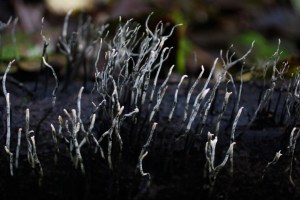
Xylaria_hypoxilon1A tiny forest of wiry, antler-like branches rises up from a rotting piece of wood. This is the candlesnuff fungus, Xylaria hypoxilon. I was delighted to spot this quirky little fungus on a drippy, rainy hike in the woods. I was even more delighted when I learned its name!

You’ll know you’ve found a candlesnuff fungus by its slim, branched appearance and because the lower part is dark while the upper portion is dusted with white. In certain areas it can be found year-round, but it’s particularly common in the fall and winter on oak and tanoak wood. Xylaria_hypoxilon2

1 Comment

Filed under Native, Plant of the day

Plant of the day: oak mistletoe

It is Christmas Eve, and bundles of yellowish-green leaves hang over the doorway–an invitation for lovers and friends to stop and smooch. According to legend, it was actually an obligation to kiss if you met under the mistletoe. A pale white berry would be plucked for each kiss that happened, until the berries were gone and the obligation was ended. Nowadays there seems to be no limit on kisses though–the berry plucking tradition has faded away.

This slideshow requires JavaScript.

Of course, these bundles are mistletoe, a classic holiday ornament. There is no single species of mistletoe–it’s a general name for a group of parasitic plants that grow on trees. In Europe, the smooching mistletoe is generally Viscum album. Here in the California, the native oak mistletoe (Phoradendron villosum) is the most common holiday decoration. You can see it growing on oaks, pepperwoods and other trees throughout California. Look for a round clump of foliage on a tree limb, looking like a nest or a shadow or a strange stuck balloon. If you go closer you’ll see the leather, oval leaves and the pale greenish-white berries. The roots of the plant go straight into the branch of its host tree; the two often seem to be indistinguishable, one merging into the other rather like lovers enjoying a holiday kiss…

HAPPY CHRISTMAS EVE!!! I hope everyone is having a great holiday.

Leave a comment

Filed under Native, Plant of the day

Plant of the day: Monterey cypress

The dark silhouettes of Monterey cypress are a signature of the central California coast; the sweeping limbs and twisted trunks of these beautiful trees seem to physically embody the stark extremes of our climate. Though this cypress has been planted widely throughout the world, it is in some ways a tremendously rare tree–there are only two natural, wild groves, both of which are near Monterey.

This slideshow requires JavaScript.

Yet because it is lovely–and grows fast–there’s no danger that this tree will go extinct. From its humble roots, Monterey cypress (Hesperocyparis macrocarpa, formerly known as Cupressus macrocarpa) has spread to Hawaii, Europe, South America, Africa, Australia and New Zealand. All by the hand of humans, of course. It’s main use is ornamental, but is grown for pulp wood in some of those places.

In California you’ll often see a line of these cypress growing in a seemingly desolate wilderness–this is a sign of a former homestead, where those living in the now-vanished house planted them as a windbreak, and a sign of civilization.

Leave a comment

Filed under Native, Plant of the day