Category Archives: Non-native

Plant of the day: English ivy

It climbs up brownstones and turns fences into bushy green hedges. It also smothers tree trunks and sometimes can carpet large stretches of ground. Wherever you find it, English ivy (Hedera helix) is a vigorous plant. It’s considered a serious invasive; in some places the carpet of ivy is so vast–and uninhabited by other species– that it’s called an “ivy desert”.

Ivy is best known for the strongly lobed, three-pointed leaves it sprouts when young. At first, I didn’t recognize the unlobed, “adult” leaves as the same plant–but they are. Older branches get thick and woody, and can have furrowed bark. Right now these mature vines are sprouting pom-pom-like flower buds; eventually these will give way to clusters of dark purple berries.

When English ivy grows on the ground, it only reaches a height of 8 inches or so as the single leaves reach toward the sky. But once it reaches something to climb, it can easily ascend 90 feet into the air, clinging to root-like structures that produce an adhesive glue-like goo. Some particularly robust plants can climb up to 300 feet! Individual plants have been found to be over 60 years old.

I once worked for a restoration company where one of our jobs was to clear ivy. One of the best ways to get rid of it where it had covered the ground was to chop into a leading edge with a hoe or shovel, and then roll the whole mass up like a rug. It was hard work but oddly satisfying at the same time.


Leave a comment

Filed under Invasive, Non-native, Plant of the day

Plant of the day: panic veldtgrass

A thicket of green grass in the middle of a dense forest is a strange sight at any time of year but is especially odd now, in late summer. But here it is–going brown at the edges but still distinctly green (not so easy to see in these photos, unfortunately). This is panic veldtgrass, or Ehrharta erecta, which is a nasty invasive. It isn’t picky and can grow in all sorts of places, forming a thick green carpet that smothers a diversity of other more delicate plants. Once you start seeing Ehrharta, you realize that it grows in many parts of Marin. After it gets established it’s tremendously difficult to get rid of, so it’s a good one for homeowners to be aggressive about getting rid of if it shows up on their land.

Leave a comment

Filed under Invasive, Non-native, Plant of the day

Plant of the day: turkey tangle fogfruit

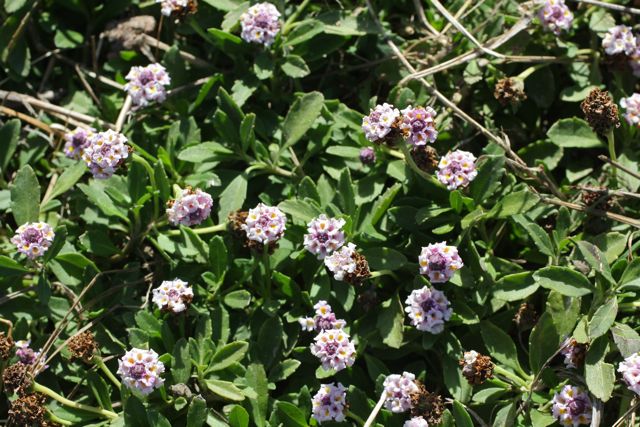
A low mat of green leaves speckled with small purple flowers is growing on the hard-packed soil between the trail and the water. This plant has the wackiest plant name I’ve ever heard: turkey tangle fogfruit! Phyla nodiflora has squat spires of small purple blossoms, each with a pale yellow splotch inside. The lowest parts of the spire bloom first, so as the flowers seem to be set on a ever-expanding brown pedestal as the season progresses. The whole package is only about a half an inch tall.

I’ve only seen turkey tangle fogfruit growing in a few places–always right on the edge of a trail alongside water. These photos were taken yesterday in Inverness, on the bank of Papermill Creek. It also grows along the edge of Bon Tempe lake, but has already finished blooming there. I always thought it was probably an escaped ornamental garden plant, which is exactly what the Marin Flora says that it is. But the CalFlora database lists it as native, and the Jepson lists it as native with the caveat that it is “questionably native” and may have been introduced multiple times from multiple places, including South America. Either way, it’s a quirky little plant to keep your eye out for! The leaves apparently are edible, and can be used to make a tea with a grassy flavor. It is used to treat colds and coughs. The plant is said to have antiparasitic properties and has been used to treat hookworm and other problems.

Leave a comment

Filed under Native, Non-native, Plant of the day

Plant of the day: nasturtium

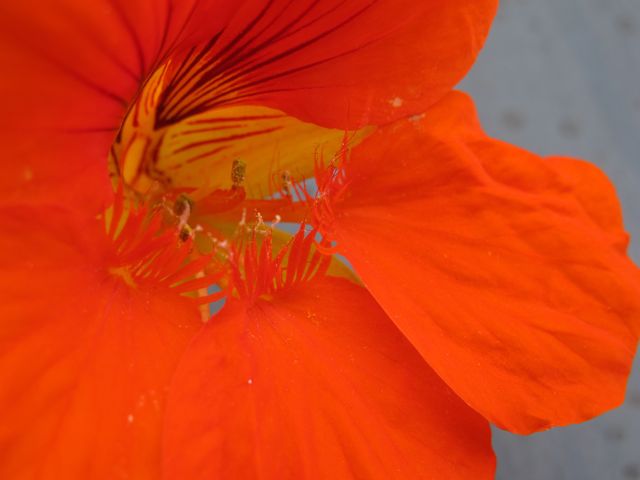
These brilliant orange flowers are so brightly colored they can almost seem to glow. Nasturtium (Tropaeolum majus) is a garden plant that can sometimes escape into nearby forest–usually near the coast. It’s never seen growing far from human habitation.

The flowers are large, edible and very beautiful. They range in color from buttery yellow to pale orange, and the upper petals often have dark stripes that run into the throat of the blossom. The three lower petals are dramatically fringed at the entry to the throat. Each flower has five pale sepals. The upper several sepals are fused into a long spur that extends backwards behind the bloom like a gnome’s cap.

When they are happy, nasturtium plants can grow into dense mats, sprawling across the ground and climbing up fences, buildings and other plants. Fortunately they don’t appear to take over large areas, so gardeners don’t have to feel too guilty about planting this potential invasive.

All parts of the plant are edible, and they have a sweet, spicy flavor that is somewhat like arugula. The seed pods are even spicier–some people harvest them young to use like capers, and others dry the mature seeds and grind them like pepper. I love to nibble the flowers raw or add them to salads. In the Andes, the nasturtium’s native range, they were used medicinally to disinfect and heal wounds, and to treat chest congestion. It is described as having properties that are antibacterial, antifungal, antibiotic and possibly even anti cancer.

Leave a comment

Filed under Edible, Non-native, Plant of the day

Plant of the day: English plantain

English plantain are supposed to be done flowering, but a few are still blooming along the coast. These green grass-like torpedos were one of my favorite childhood plants. You can make a loop out of the stem, and if you slide the flowering stalk through the loop quickly then the head will pop off–a missile to bombard another kid with.

Plantago lanceolata is in the group of low-growing plants known as plantains–and is not at all related to the banana-like plantains. This little herb sprouts a long stalk bearing a single flower, extending up from a low rosette of ground-level leaves. It is not a native to California.

Though technically edible, the leaves are described as fibrous, and removing the fibers is hard work for a somewhat bitter green. The plant is better used medicinally, as it has antibacterial properties. English plantain is used to treat ulcers, rattlesnake bites and myriad other maladies. The seeds are mucilaginous and swell up if eaten–apparently this makes them good as laxatives and treatments for indigestion.

Leave a comment

Filed under Non-native, Plant of the day

Plant of the day: narrowleaf trefoil

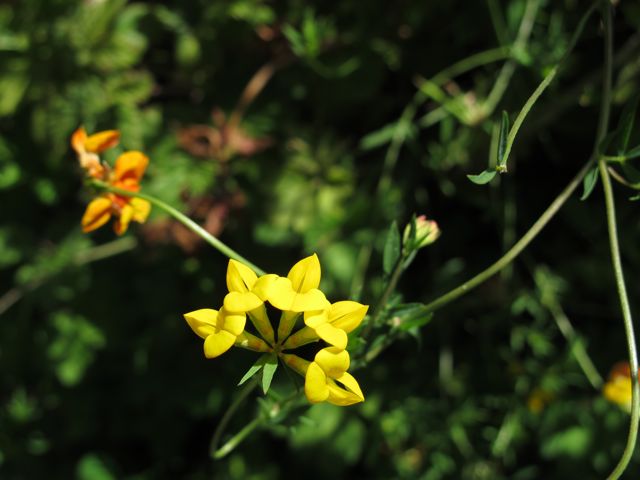
Bright yellow pea flowers grow scattered and in mounds. Narrowleaf trefoil (Lotus tenuis) is an oft-overlooked plant, common to roadsides and meadows. A native to Europe, it escaped from cultivation and is now a common sight in Marin.

Several blooms grow clustered together at the end of low, sprawling branches that are largely leafless. Leaves consist of five leaflets, which can sometimes look like only three since the lowest two grow very close to the stem.

Narrowleaf trefoil is common across most of California and much of the US, particularly on both the east and west coast.


Leave a comment

Filed under Non-native, Plant of the day

Plant of the day: bristly ox-tongue

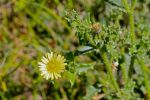
It looks like a dandelion on steroids–a big, mean, nasty dandelion. The flowers are sunny little composites that dry into carefree puffs. But it grows to be six feet tall… and the entire plant is prickly. This is bristly ox-tongue, or Helminthotheca echioides.

One of the most unique aspects of bristly ox-tongue are the pale blister-like bumps on its leaves. I have seen a huge variation in size; often it is only ankle-high, but sometimes (even in the same general area as the smaller versions) the stalks can grow as tall as my shoulder.

This species is a late bloomer, with flowers beginning in June but continuing in places all the way until December. It is native to the Mediterranean but isn’t highly invasive. You will usually see it growing it seasonally wet or damp soils. It has no medicinal or traditional uses that I know of.

Leave a comment

Filed under Non-native, Plant of the day

Plant of the day: woolly mullein

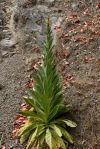
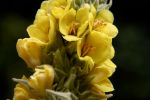
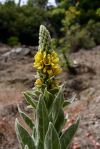
A tall spire of wooly leaves is topped with many bright yellow flowers. Each five-petaled bloom has two lower, straightened stamens and the remaining three are smaller and hairy. This is woolly mullein, or Verbascum thapsus, an invasive species that is now found throughout much of California and the rest of the country.

This plant prefers to grow in dry places, and can grow to more than six feet tall. The leaves are furry like lamb’s ears, and taper progressively smaller towards the top of the stem–giving the whole plant the shape of a narrow christmas tree. In addition to being an invasive, woolly mullein is also a host to insect species that can damage crops. It’s a persistent plant, with seeds that can survive up to 35 years in the soil.

Leave a comment

Filed under Invasive, Non-native, Plant of the day

Plant of the day: pampas grass

Cortaderia jubata

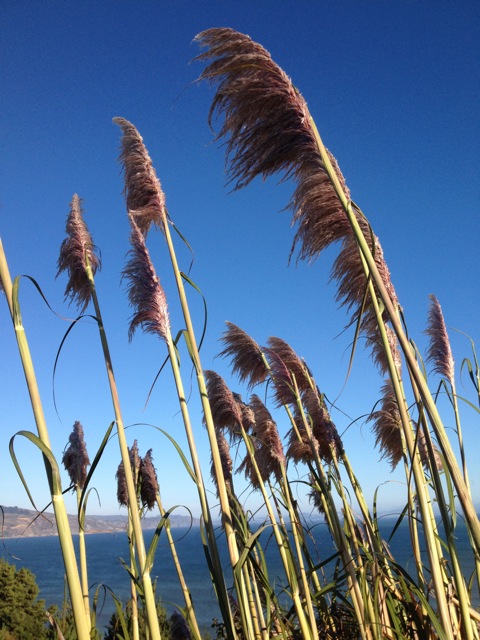
People who don’t know better think that pampas grass is beautiful–and in most ways, it is. The flowers of this gigantic grass are showy plumes that wave in the wind like horses’ manes or pennants. The leaves are long and trailing, and as wide as a large man’s finger. The whole plant, including the lofty bloom, can be up to 20 feet tall.

But this striking plant is also a noxious invasive, imported from Argentina and the Andes. It grows quickly in disturbed areas like cliff faces and road cuts, and forms large patches that crowd out smaller or slower growing native species.

There are actually two species that are commonly called pampas grass–Cortaderia jubata and C. selloana. Both thrive along the coast, but jubata (sometimes also called jubata grass) is restricted to coastal areas, while selloana also grows farther inland. Jubata plumes are purple or lilac, tending towards white as they age. This species can also be distinguished from its cousin because it holds its plumes quite high above the mound of leaves.

Both species of pampas grass bear their male and female flowers on separate plants (the botanical word for this is “dioecious,” as opposed to most plants which are “monoecious” and have their male and female parts on the same plant, often in the same flower). But while C. jubata reproduces asexually and lives for ten years or more, C. selloana can only reproduce if another plant of the opposite sex is nearby.

3 Comments

Filed under Invasive, Non-native, Plant of the day

Plant of the day: naked lady

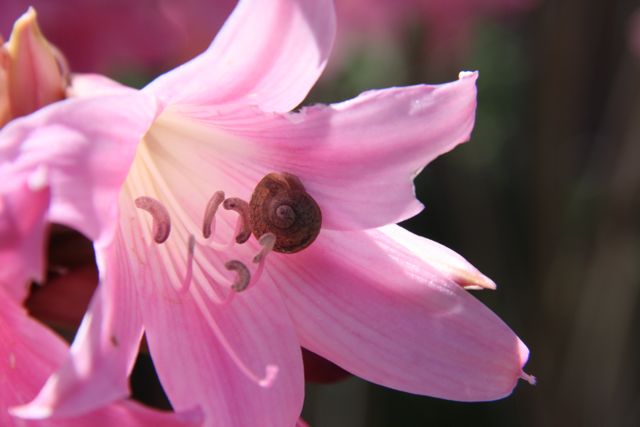
Amaryllis belladonnaTall, garish pink lilies are blooming in the dry grass of hillsides and fencelines. These are naked ladies (also known as pink ladies, Latin name Amaryllis belladonna), which are one of the classic sights of late summer in California. Their name comes from the fact that they don’t flower until after their lush mound of spring leaves have died back and disappeared. Then each single blossom rises on a long naked stalk.

The large horn-shaped blossoms have six pointed petals, six stamens topped with crescent-shaped anthers, and a delicate scent. This non-native lily was planted widely by early settlers, and patches of the flower on remote hillsides can be a clue that a garden or homestead once stood there. They are hardy, handling transplanting well and spreading locally so that eventually a few scattered plants can grow into a dense and colorful patch. Luckily it doesn’t spread widely and so it remains a colorful novelty and not a full-blown invasive species…

3 Comments

Filed under Non-native, Plant of the day