Category Archives: Plant of the day

Plant of the day: sand verbena

Abronia_latifolia1Heads of little yellow flowers decorate the dunes. This is sand verbena, or Abronia latifolia. Its prostrate stems are sprawled like sunbathers across the sand, raising their leaves and blossoms like a lazy wave. The flowers are some of the showier native dune blooms, and have a lemon-verbena scent. The succulent, scalloped leaves are pretty in their own right–especially when lightly dusted with sand.

You can find this little flower on the dunes and strand, and in coastal scrub, from Santa Barbara to Washington State. Its long, stout roots are edible and somewhat sweet. They were usually harvested in the fall by coastal tribes.

I saw spotted this verbena on the white sands of Asilomar during EcoFarm–a great conference, and a lovely state park and beach to visit at any time! Asilomar1

Leave a comment

Filed under Edible, Native, Plant of the day

“Plant” of the day: cramp balls

Annulohypoxylon_thouarsianum1This vividly-named fungus is common on dead or dying oak trees–a nearly ubiquitous sight these days thanks to Sudden Oak Death. Cramp balls (Annulohypoxylon thouarsianum) look like a lump of black charcoal popping from the bark of the tree trunk. If you split one open, though, it is grey-brown and woody.

There are similar-looking fungi in the Daldinia genus, but cramp balls can be distinguished from these by the presence of tiny chicken-skin bumps.

These fungi are a telltale symptom that the tree is ill or dying; it’s often a symptom of advanced Sudden Oak Death, but can also be present on uninfected trees.

Leave a comment

Filed under Plant of the day

Plant of the day: fetid adder’s tongue

After a month of keeping my eyes peeled, I finally found a patch of this little brown-striped lily. Fetid adder’s tongue (Scoliopus bigelovii) is easy to miss–it grows low to the ground, with flowers that blend in with the duff. But up close, it is spectacular! The three showy petal-like sepals are delicately striped with brown and white; they arch backward away from the three actual petals that rise upward like slim prongs. At the center of this confection is the three-pointed star of the pistil, and three purplish nubs of stamens which are nestled closely above each sepal.

This slideshow requires JavaScript.

I don’t actually think fetid adder’s tongue smells all that bad–but it certainly has a reputation for being stinky. Its fragrance is musty, like old mushrooms and forest floor. Which is exactly suited to the purpose of attracting the fungus gnats that are its pollinators. Each gnat rummages toward the smell, covering its head in pollen in the process. You can easily watch these little flies as they doze and flit among the flowers.

This plant is also sometimes called slink pod, because as the seeds develop the weight of the pod causes the stem to droop. Eventually it touches the ground, and often will root there–giving rise to a new plant.

The two leaves of fetid adder’s tongue also are distinctive–these pointed green ovals rise from the duff as the flower is blooming, often unfurling after it is past its peak. Once they emerge you can recognize them even without the flower present, since they are blotched all over with purple bruise-colored spots.

Scoliopus with pollen-decked fungus gnat

Scoliopus with pollen-decked fungus gnat


Thanks to Amelia and Doreen for giving me tips on where to find these!

1 Comment

Filed under Good for gardens, Native, Plant of the day

Plant of the day: star lily

These little lilies bloom in the dappled sun of an oak-covered hilltop. They are one of the earliest flowers to bloom, with their creamy star-shaped flowers opening above trailing ribbons of green leaves. But don’t be tricked by its beauty: the star lily (Toxicoscordion fremontii) is also known as death camas, and with good reason–it is highly poisonous.

This slideshow requires JavaScript.


Leave a comment

Filed under Native, Plant of the day, Poisonous

Plant of the day: Indian warrior

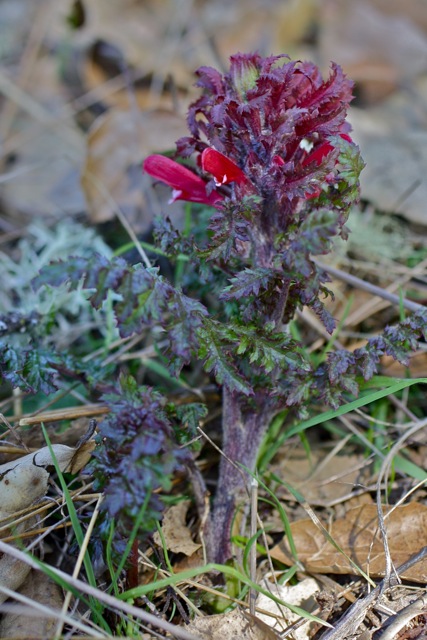
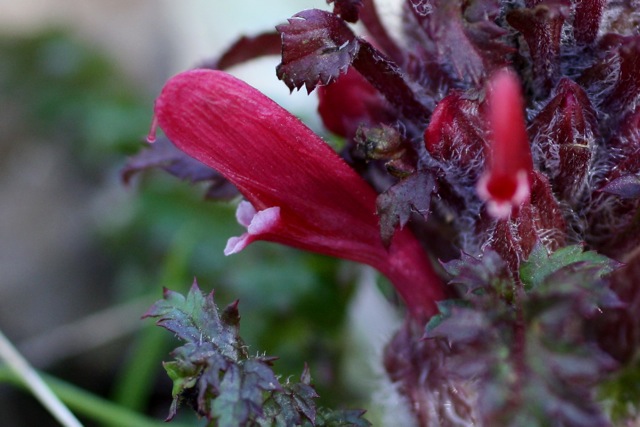
Pedicularis_densiflora1Low spears of ruffled purplish leaves sprout from the dappled forest floor of an oak woodland. Small burgundy flowers peer from among the leaves, each shaped like a flattened hood. Three diminutive lip-like petals open upward on the lower edge of the hood, and a strange little proboscis dips downward–shaped like a single eye-stalk from a snail. This is Indian warrior, or Pedicularis densiflora, a common sight blooming in woods and chaparral from January through early spring.

Other cousins of this little flower also have strange appendages on their blossoms; most notable are two species of elephant’s heads that grow in the eastern part of the state–their flowers truly resemble the flared ears and swooping trunk of an elephant. Pedicularis_densiflora2


Leave a comment

Filed under Native, Plant of the day

“Plant” of the day: lace lichen

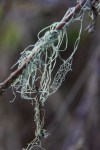
Gray-green draperies of lichen hang from a coastal pine tree. Easily mistaken for old man’s beard, this scruffy lichen is found growing along the coast and in inland areas with fog. If you look close, you’ll see that the strands of lichen are composed of lacy, net-like pieces–instead of single, hair-like strands. This is lace lichen, or Ramalina menziesii.

Though it looks like old man’s beard (Usnea) and Alectoria, the presence of netting–as well as the lack of a springy central cord–are distinctive.

1 Comment

Filed under Plant of the day

Plant of the day: stink bean

Albizia_lophantha1A small tree stands along a trail on the outskirts of town. Though it looks like an acacia tree, with its feathery leaves and yellow tufts of flowers, it’s actually Albizia lophantha. In both types of tree, the yellow tufts are actually composed of many threadlike stamens. But acacia has round balls-like flowers, each less than 1 centimeter across. Stink bean can be distinguished by its spike-like flowers that are about 2.5 centimeters across–and stamens that are united near the base.

This Australian native is also known as plume acacia, a nod to it’s more well-known cousin. It was probably introduced as an ornamental–and though it has spread into the wild, it hasn’t gone far and isn’t listed on California’s list of invasive plants. For this reason you’ll usually see it in “waste places”, the weedy ecological hinterlands that are on the edge of developed or heavily used places.

Leave a comment

Filed under Plant of the day

Plant of the day: sea lettuce

Small succulents with pointy, gray-dusted leaves cling to a rocky bluff above the ocean. This is sea lettuce, or Dudleya farinosa. Also known as powdery dudleya, its leaves can be green or a floured grayish color and often are tinted with red. The blooming flower stalks are also red, while the flowers are a bright yellow.

Various other species of Dudleya were regularly eaten raw by indigenous Californians–but so far I haven’t found any specific references about the edibility of  D. farinosa

Sea lettuce is one of the north coast’s few succulent species.  Dudleya and Sedum are the two main succulent genera around here; Dudleya species are distinguished by generally being unbranched, and by having tubular flowers and larger leaves (<3cm).

Leave a comment

Filed under Native, Plant of the day

Plant of the day: Awned haircap moss

Polytrichum_piliferum1

Haircap moss with small Polypody ferns

Awned haircap moss (Polytrichum piliferum) grows in spiky-looking cushions in dry areas such as sandy slopes, gravel, or on exposed rock faces. Look for small leaves tipped with a long clear point in order to tell it from other species of Polytrichum.


Leave a comment

Filed under Plant of the day

Plant of the day: Sitka willow

One of the early, sweet signs of spring is when the pussy willow buds start to emerge. This fuzzy little nubs pop out on all types of willow branches–look for them in the shrubby thickets of trees that grow along streams.

This slideshow requires JavaScript.

Sitka willow (Salix sitchensis) has broad leaves that are green and leathery on top, netted with a complex tracery of tiny veins. Below they are covered with a fine white fur. Willows are abundant and versatile, and were used extensively by native tribes. Limbs were made into baskets, and bark into string. Willow bark has the same compounds as aspirin, and it was used as a painkiller–both eaten and applied topically as well. Various parts of the tree were used in many ways for cooking, such as  making a fire hearth from willow roots, drying salmon on branches, and wiping up fish slime with leaves. Shredded bark was used in baby diapers. Sitka willow was also a talisman–boughs were tied to boats for safe crossing when river water was high, and the plants were beaten with sticks to call for wind on hot days.

This willow grows throughout the west, north into Alaska and along the California coast as far south as Santa Barbara. It’s one of seven species of willow found in Marin county.

Leave a comment

Filed under Medicinal, Native, Plant of the day