Category Archives: Plant of the day

“Plant” of the day: bull kelp

Long, thick pieces of brownish-green hose have washed up on a steep and rocky beach. As any beachgoer knows, this is bull kelp (Nereocystis luetkeana)–a seaweed that can grow up to 60 feet long. When I was a kid, my friends and I would pretend we were cowboys, using the long “ropes” for lassoes. In Alaska, Native Americans used them as lines for deep sea fishing.

This slideshow requires JavaScript.

Bull kelp looks very plantlike, but it is actually a brown algae and in an entirely different kingdom. In the deep water where it grows, it anchors itself to the bottom with a root-like “holdfast” while the rest of the plant stretches toward the surface, buoyed by an air-filled pocket that grows at its upper end. Sometimes you’ll find the holdfast still gripping tightly to a rock that has washed up along with the plant. More often, you find the upper part–a rubbery length of stem topped by the bulbous float (which looks a lot like a turkey baster…)

This huge algae is an annual, meaning it grows from a tiny spore and lives its entire life span in only one year. Sometimes it can grow up to 10 inches in a single day! Otters, fish, sea urchins, crabs and other sea creatures live in the long ribbon-like leaves that grow from the top of the plant. You can buy edible bull kelp dried at the health food store or hop in a boat to harvest your own (it’s better fresh than after it’s been uprooted and washed up ashore). The leaves are eaten dried, and once washed and peeled the rubbery stalk can be pickled, or used in relish in the same way as cucumbers or tomatoes.
Leave a comment

Filed under Edible, Native, Plant of the day

“Plant” of the day: turkey tail fungus

HAPPY THANKSGIVING!!!

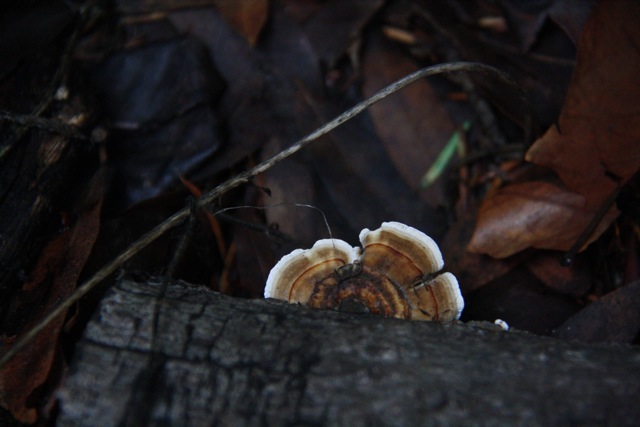
In celebration of turkey day, here is a turkey tail fungus. I saw this beautiful little fan-shaped fungus on a dead tan oak tree, banded with a rainbow of oranges and whites. It really does look quite a lot like the spread fan of a turkey’s tail.

And we should definitely be thankful for this little decomposer, one of the many fungi that breaks down dead wood and keeps our forests clean. The turkey tail grows mainly on hardwoods such as oaks, but can sometimes be found on conifers as well. Its name–Trametes versicolor–comes from the fact that it comes in many different colors, from indigo to orange to black. But not all fan-shaped fungi are true turkey tails; click here for an easy identification key.

Turkey tails have been used medicinally for centuries; earlier this year, western medicine chimed in with a clinical study suggesting that compounds in this fungus help the immune system fight cancer. Click here for a huff post article by mycology giant Paul Stamets.

Leave a comment

Filed under Plant of the day

Plant of the day: Monterey pine

This gnarled and knobby tree is a frequent sight long the bluffs and byways. Though it is the most widely planted pine species in the world, its native populations are confined to only three wild stands–two in California and one in Baja. All the other trees (including in Marin) were planted by people, though they now are reproducing on their own.

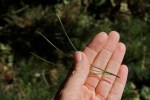
Monterey pine (Pinus radiata) has three bundled needles just like coulter pine, described yesterday. But the scales of its fat, vaguely egg-shaped cone are blunt rather than sharp; and its needles are noticeably shorter.

Because it tends to grow in crooked and twisted patterns, this tree isn’t much valued for timber in the United States, where it’s mostly planted ornamentally and grown for Christmas trees. Yet it is widely used for timber in other nations–though I’m not sure what they see in it that we don’t.

Leave a comment

Filed under Plant of the day

Plant of the day: Coulter pine

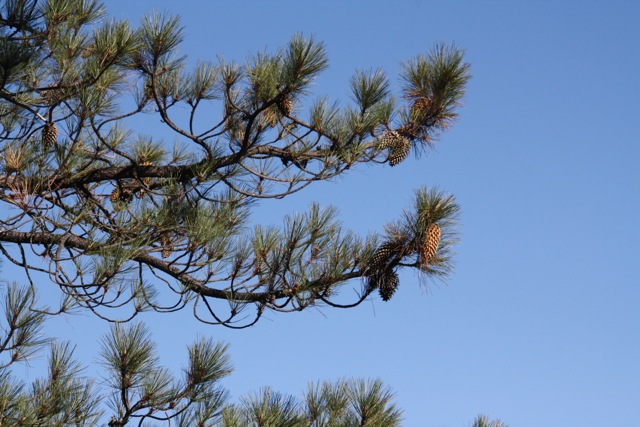
Since we’ve been talking about pine trees this week… Here is Coulter pine (Pinus coulteri, also known as big cone pine), which I saw growing along the road to the east peak of Mt. Tamalpais. You can tell it from other native pines by its looong needles that are bundled in groups of three, and also by its elongated cones that are composed of sharp hook-shaped scales.

This tree is native to California but not to Marin county; its natural range starts just south of here in Contra Costa and extends down to Mexico. It usually is found scattered in chaparral or forest. Native Americans used the needles for making baskets, and one source says that it (the seed?) was also used as a food. It isn’t particularly valued for wood.

Leave a comment

Filed under Native, Plant of the day

Plant of the day: amazing exploding pine dwarf mistletoe

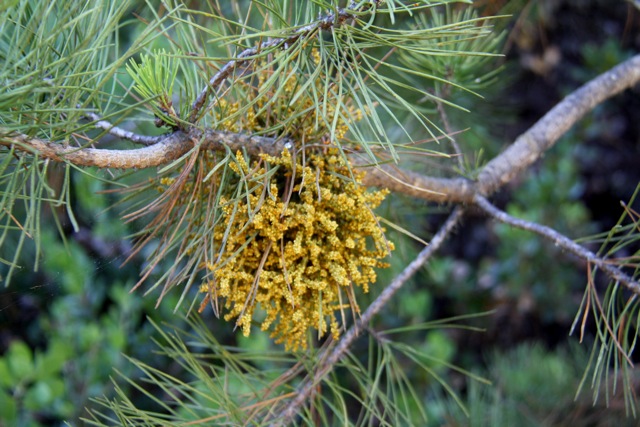
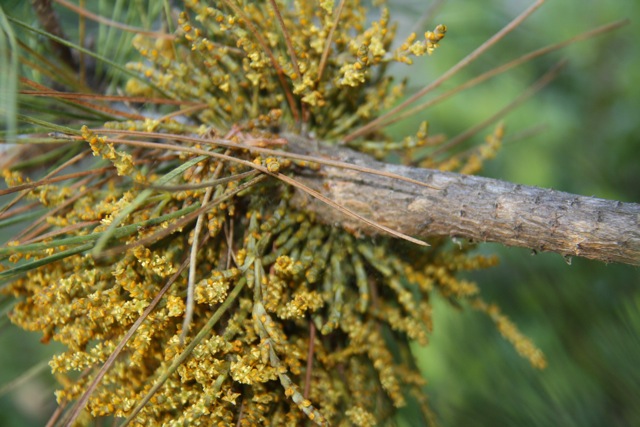
Thanksgiving is almost here–which means that mistletoe is almost seasonal. But did you know that there are many different species of mistletoe? The cute leathery leaves and small white fruit meant to inspire holiday smooches are the most popular. But I spotted a different type, the greenish-orange pine dwarf mistletoe (Arceuthobium campylopodum), growing on a young bishop pine on the Inverness ridge.

The long, slender stems look like mutated pine needles that have grown swollen and deformed, sticking out from the infected tree branch at all angles. Small, scale-like leaves can be green or orange, and look like tiny nubs sticking out of the stem.

Dwarf mistletoe is a creative parasite, burrowing its roots into the branches or trunk of its host tree.  The flowers are pollinated by insects, but can take a year to develop. Once ripe, each berry explodes–firing its single seed up to 30 feet away at speeds that can reach up to 90 feet per second. The tiny seed missile is coated with a sticky goo, so it adheres to whatever it runs into. And if that happens to be a suitable host plant, the cycle repeats itself.

Leave a comment

Filed under Native, Plant of the day

Plant of the day: bishop pine

The Point Reyes Peninsula is geologically and geographically fascinating. It’s a chunk of high-riding land on the Pacific Plate, sandwiched up against the rest of Marin–and the continent–which is on the North American plate. Inch by inch, Point Reyes is creeping northward. The fault runs through the Bolinas Lagoon and created Tomales Bay. Stone and soil have entirely different provenances across the invisible line of the fault. The plants change across the fault as well–and one of the most dramatic of those changes is the abundance of bishop pine (Pinus muricata). This tree has an extremely limited range, and in Marin it mainly grows on Point Reyes, though scattered trees can be seen elsewhere.

Because of this the graceful pine is iconic of the peninsula–especially since the Vision wildfire burned through in 1995. One of the unique things about this tree is that its seeds can only sprout after being heated by fire, so in the last fifteen years a dense and lush forest of young bishop pine trees has grown up in the areas where the fire burned.

You can distinguish bishop pine from other species of Pinus because its needles come bundled in pairs of two.

Leave a comment

Filed under Native, Plant of the day

Plant of the day: cascara

Saplings with large, shiny, deeply creased leaves grow on an old logging road just north of Arcata. This is cascara (Frangula purshiana), another plant of Pacific Northwest affiliation, which can be either a shrub or a small tree up to 30 feet tall. Most of its beauty is in its smooth gray bark and shiny leaves. The spring clusters of greenish-yellow flowers are unobtrusive, but the fruits are also striking–small purplish-black berries that look similar to those of its cousin, coffeeberry.

Native tribes used cascara bark as a laxative, and settlers found it so effective that  in the late 1800s it became the base of a commercial pharmaceutical that was exported to the rest of the US and Europe. For a time it was so heavily harvested that it was almost exterminated from some areas–some say that it still hasn’t fully recovered. In fact, according to Wikipedia (which I hate to quote, but here goes) even in 1999 cascara made up more than 20% of the national laxative market in the U.S., with a total estimated value of $400 million and the bark alone being worth $100 million.

Potential collectors should beware–some reports say that if the bark is handled for long enough, the laxative effects can even pass through the skin! Eaten fresh, or in large quantities, cascara bark is toxic and can lead to severe diarrhea and vomiting. The berries are described as “edible but not incredible.”

Cascara grows from BC to Northern California. It stops short of the Bay Area, but it is found in Sonoma county where it’s been reported from Salt Point, Fort Ross and other places.

Leave a comment

Filed under Native, Plant of the day

Plant of the day: western hemlock

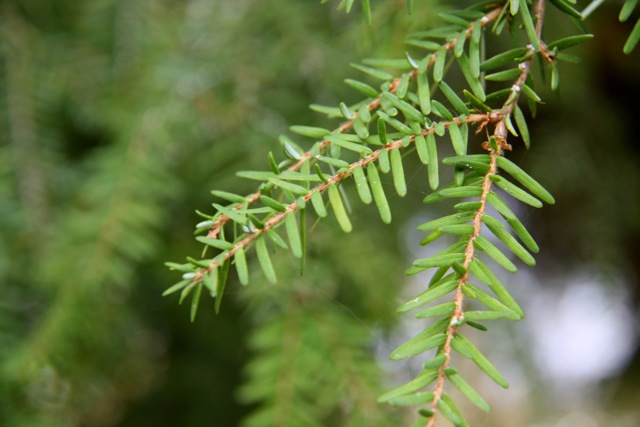
Continuing yesterday’s theme–here is an iconic tree of the Pacific Northwest. Western Hemock (Tsuga heterophylla) is a tall, straight-trunked tree that can be identified at a distance by the way its tip droops sideways rather than standing upright. Up close, look for short, round-tipped needles of irregular length (5 to 20 m) that splay out from the twig in several directions. Ain’t it adorable!!

Western Hemlock was used extensively by the northwestern tribes–for medicine and lots of other stuff besides. For example, you can make a black dye by steeping its bark in urine (left on its own, the bark can make a red dye). It can also be used to tan hides. Wood was carved into paddles, spits, spearshafts and more. Dancers in one tribe made much of their outfits from the boughs.

This tree also forms the densest canopy of any tree in the west, according to Plants of the Pacific Northwest Coast. As a result, not many other plants grow underneath–I saw this recently near Arcata, where nothing grew in the understory except a few patches of false Solomon’s seal.

Sadly (luckily?) you’ll have to travel to see a wild specimen of this tree–the only places it grows in California are Humboldt and Del Norte counties (and possibly Trinity).

1 Comment

Filed under Plant of the day

Plant of the day: tall Oregon grape

I’ve been visiting Seattle this week, a city where I spent my college years and first learned botany. It’s been a treat to revisit the landscape of the Pacific Northwest–including the plants. Some are old friends who I haven’t seen for years; others are common down in California as well.

Tall Oregon grape (Berberis aquifolium) is one that falls in the middle. This scrubby shrub of the forest understory is distinguished by glossy pointed leaflets that grow 5 to 9 in each sprig; in the fall some of them may turn red.

It’s a common sight in the Pacific Northwest. But though it technically grows across most of the west coast (including almost all counties in California, according to CalFlora) I have never seen it in the Bay Area. And Marin is one of the only counties in the state that does not have any records of this species at ALL–though its similar-looking cousin, dull Oregon grape, does grow here. (This species, B. nervosa, has 9 to 19 leaflets).

The purple berries are tart; some people make them into jelly or wine–generally mixed with other (sweeter) fruit. The inside layer of the bark is brilliant yellow and can be used to make a dye.

Leave a comment

Filed under Native, Plant of the day

“Plant” of the day: artists conk

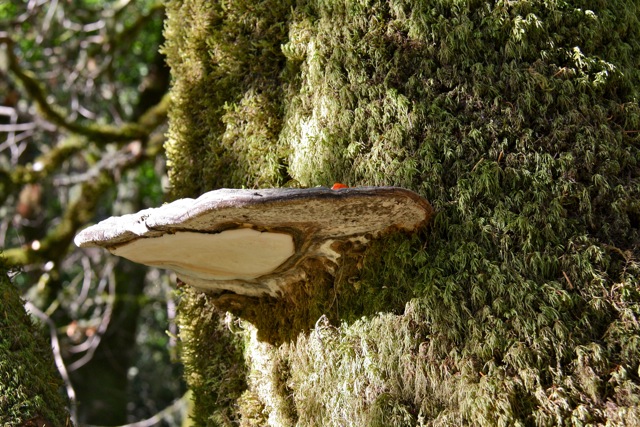
A sturdy, round shelf seems to be hung from the mossy trunk of a pepperwood tree. It’s brown and woody on top, with a creamy white surface below. You could set your drink on it, if you happened to have one with you while hiking. This charismatic fungi is an artists conk (Ganoderma applanatum), earning its name because if you scratch an image into its white underbelly, the depressed area immediately turns dark brown. This ready canvas is tough to resist–but any marks made are permanent, so it’s probably best to hold back and keep graffiti out of the woods.

This woody fungus is in the polypore family. This group tends to be shelf-shaped and also lacks gills; instead spores are released from a minutely pored undersurface. There are a lot of different kinds of shelf fungi, but artists conks are fairly easy to identify. They grow on many different types of trees, but are particularly common on pepperwood (aka bay laurel).

Leave a comment

Filed under Native, Plant of the day