Category Archives: Plant of the day

Plant of the day: mugwort

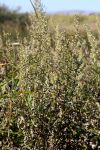
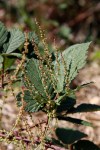
Spires of grayish-green leaves grow on the roadside, each topped with a spike of unassuming pale flowers. This is California mugwort, or Artemisia douglasiana. It’s flowers are rayless aster-type flowers, diminutive tassles of pale beige or yellowish threads. The leaves are velvety with white hairs that are especially dense on the underside. When you rip one in half it clings together with fibrous shreds.
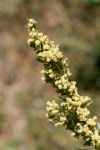
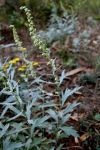
Mugwort can grow to be 8 feet tall according to the Marin Flora, but I’ve usually seen it growing to about knee high. The plant has a pleasant sage-like smell when you crush it—not surprising since it’s a close cousin of California sagebrush. It’s also known as Douglas’ sagewort, or dream plant.

You’ll find mugwort growing in a wide range of habitats—from moist seep springs to toasty hillsides.
Leave a comment

Filed under Native, Plant of the day

Plant of the day: forget me not

I try to keep these posts seasonal, and write about flowers that people are likely to see right now. But this sight was strange enough that I’m going to break this rule.

This slideshow requires JavaScript.

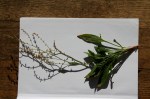
Forget me nots (Myosotis latifolia) are common little weeds in the springtime. Cheerful blue flowers tend to grow in dense patches along moist stream banks and woodland clearings. Though not native to California, the plant has naturalized here and now is ubiquitous. Luckily it doesn’t cause too much ecological damage–as far as I know!

A few days ago hiking along the Arroyo Hondo in Bolinas, I saw several forget-me-nots in bloom. True, it’s shady there, along a canyon with a deep canopy of pepperwood and other trees. But still–I haven’t seen any of these plants for months, and they aren’t due to start blooming again until february. It’s a good reminder that even though there are general patterns to when things blossom, in the end each individual still marches to its own drummer. And there are always outliers…

1 Comment

Filed under Non-native, Plant of the day

Plant of the day: sheep sorrel

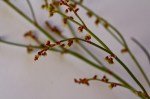
Almost all the year round you can see low green stalks studded with small red flower buds–a splash of color usually growing intermixed with grasses. This is common sheep sorrel, or Rumex acetosella, an invasive species that was introduced from Europe. It usually grows in weedy areas, and has a long bloom period from March all the way through November.

The tart leaves are edible, and taste like redwood sorrel or lemongrass. Try it in salad or steep the leaves for a tea. The acidy-lemon flavor comes from oxalic acid–small doses are fine, but eating a lot of it can lock up calcium and other nutrients in your body.

The root can be dried, ground and made into noodles but this seems like a lot of work and I’ve never heard of anyone actually doing it. The seeds are also edible, but they are so tiny that they also aren’t practical as anything other than a novelty.

Leave a comment

Filed under Edible, Invasive, Non-native, Plant of the day

Plant of the day: Oregon ash

Oregon ash is a stately tree of the riverbanks. It grows tall and upright, creating an umbrella of sweeping branches and bright green leaves. In the late summer the female plants become heavily decorated with winged seed-pods called samaras–these trees are dioecious, meaning each plant is either male or female (instead of both, as most plants are).

This slideshow requires JavaScript.

Right now, the seeds are ripening as the leaves are yellowing and beginning to fall.

The range of Oregon ash (Fraxinus latifolia) is from British Columbia to Riverside County near LA, in a belt along the coast. Look for pinnate leaves, where each “leaf” is composed of five to nine large, paired leaflets. The photos here were taken in Cascade Canyon of Fairfax, and also on the Marin Municipal Water District.

Leave a comment

Filed under Good for gardens, Native, Plant of the day

Plant of the day: beaked hazelnut

Broad, fuzzy leaves are beginning to turn brown on this charming shrub of the understory. In a month or so, the branches will be bare skeletons, ready for the winter.

Beaked hazelnut (Corylus cornuta) is found across the country–except for the south. Around here you usually see it in moist forest understories, shaded canyons or streamsides. It has slim, sometimes drooping branches decked with light green, jagged-edged leaves. The flowers are monoecious, meaning that each flower is either male or female–but both sexes appear on a single plant. The female flowers look like tassels of small crimson threads; the male flowers are drooping pale catkins. But often this plant reproduces clonally, growing in dense clusters that are genetically identical.

Grouse, deer, rabbits, voles, and other critters use these shrubs for food and shelter. The tasty nuts have been compared to filberts, and commercial hazelnuts, and can be eaten raw or cooked. Native Americans wove the slim and flexible branches into baskets and baby carriers.

It’s the only hazelnut found in California.

Leave a comment

Filed under Edible, Good for gardens, Native, Plant of the day

Plant of the day: German ivy

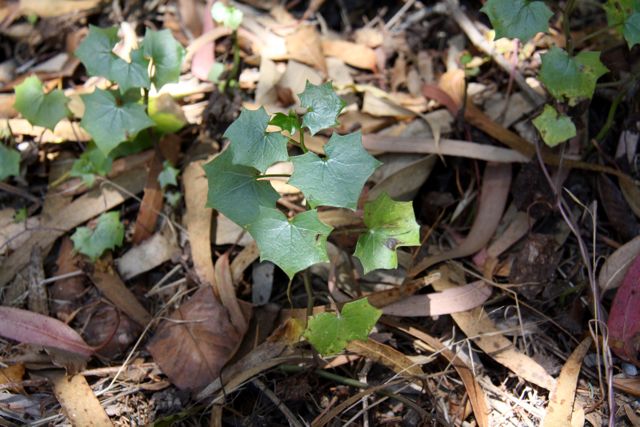
Vines with shiny green leaves–roundish yet spiked with points–grow on a forested bank. This is German ivy, or Delairea odorata, a South African native that is a problematic invasive here in California. It can smother trunks, shrubs and ground cover with its vigorous stems.

It is also known as cape ivy, and is unrelated to the vaguely similar-looking English ivy.

Leave a comment

Filed under Invasive, Non-native, Plant of the day

Plant of the day: mattress vine

Occasionally you’ll see a tree or a fence drenched by a mound of greenery. The small round leaves are delicately suspended on twining, wire-like vines that are dark purplish-brown. This is mattress vine, or Muehlenbeckia complexa. Its other names are wire vine (because of the wiry stems?) and maidenhair vine (because the leaves are similar to those of maidenhair fern?).

This slideshow requires JavaScript.

Mattress vine is a native to New Zealand that occasionally can be seen growing wild here in California. It’s often grown as an ornamental for walls or topiaries, but is considered a problematic invasive in certain places–such as the Golden Gate National Recreation Area. You can see it growing in large mounds at the bunkers on Fort Cronkhite, as well as at Land’s End and the Presidio

Leave a comment

Filed under Non-native, Plant of the day

Plant of the day: California white oak

The changing leaves of the oaks are another sign of the shift in seasons. Brown is quickly overtaking green, especially in the drier hills. Only the large, lobe-leaved oaks are deciduous–the species with small leathery foliage hang on to their leaves year-round.

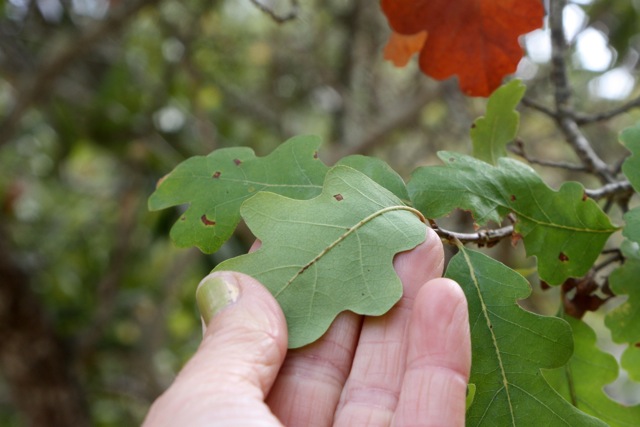
California white oak (Quercus lobata) has lobed leaves that are paler beneath and rich, shiny green above. Their acorns are slim, with a large cap-shaped cup that resembles a Rastafarian’s hat. They can be distinguished from their cousins that also have pale underbellies because blue oak has–wait for it–a blueish cast to the upper surface of the leaf. And Oregon oak has a furry coat on its underside (as well as plump, squat acorns). I use the memory-trick that Oregon oaks need such things to grow in the chilly north, whereas Californian oaks have no need for extra insulation.

Identifying oaks can be notoriously tricky, since they cross with one another easily and the results have a mixed blend of characteristics. I tend to stick with the Marin Flora and that keeps me happy. The California white oak pictured here, for example, has shallower lobes than the classic examples. But lobes aren’t an issue in the Marin Flora–so I can happily feel comfortable with my ID.

Note the pale underside of the leaf

Leave a comment

Filed under Edible, Native, Plant of the day

Plant of the day: coffee fern

A brown scrap of leaves clings to a rocky cliff, strung together on threadlike stems. Though this little fern looks thoroughly dead in the last gasp of autumn heat it’s actually still alive. The green leaves of this perennial fern turn brown in late summer, giving coffee fern or coffee cliffbrake (Pellaea andromedifolia) its common name.

You can tell this fern from the similar-looking birdfoot cliffbrake because it has rounded leaves, rather than leaves that come to a point. When the leaves are not dried out, you can see that each leaflet rolls under at the edges (shown in the photo, below).

Pellaea_andromedifolia2

Coffee fern in winter lushness

Leave a comment

Filed under Native, Plant of the day

Plant of the day: dallisgrass

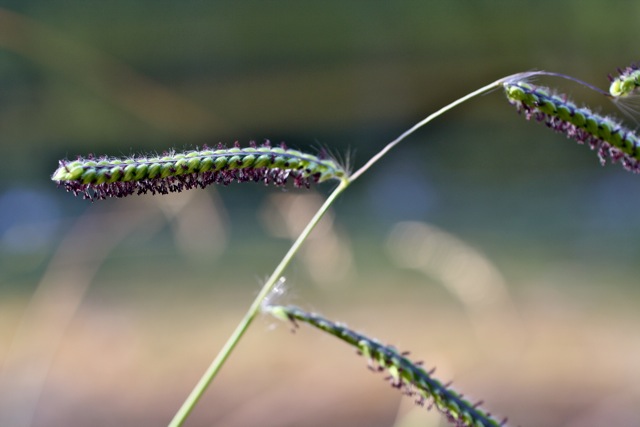
Dallisgrasslooks rather like a centipede when in bloom–except much more lovely. Each drooping raceme of resembles a segmented body, and the dark purple threadlike flowers that dangle beneath could look like the insect’s tiny feet.

This showy grass was introduced from Brazil and Argentina, and is found growing throughout much of California–often in weedy places along roads and trails. The photos here were taken alongside the Bon Tempe reservoir. Though widespread throughout Marin, it isn’t considered an invasive. But it has naturalized throughout much of the US, and elsewhere it is considered a problematic weed. Dallisgrass (Papsalum dilatatum) looks a lot like its native cousin knotgrass, which is used as forage for cattle. But dallisgrass is less palatable since it hosts a fungus that is toxic to livestock. Despite its attractive flowers, its habit of showing up as stiff clumps in lawns and golf courses also has made it unpopular. Look for 3-5 centipedes of flowers to distinguish dallisgrass from knotgrass (which generally only has 2 flowers per stalk).

Incidentally, while researching this plant is the first time I’ve heard the term “cultural control” used to define the alternative to “herbicide control”. Basically it means digging the plant out or using other manual, non-chemical means to get rid of it. But for a minute I daydreamed that cultural control might mean eating hors d’oevers or playing Pavarotti really loud on a stereo to make any nearby weeds shrivel up…

Leave a comment

Filed under Non-native, Plant of the day