Plant of the day: coast redwood

HAPPY 2013!!!! HEY, IS THIS THE FUTURE?!

The bonfire spits and crackles, sending glowing sparks drifting upward. Above and behind these rising embers towers a cluster of dark silhouettes. We are in the middle of a grove of redwoods, ushering the new year in among their timeless company, along with friends and family.

This slideshow requires JavaScript.

This isn’t just a beautiful place–it’s a great spot for the reflections on time that the new year so often leads to. Redwoods (Sequoia sempervirens) are some of the most impressive of all the terrific trees in California, with their tall straight trunks and thickly shaggy red bark. Each tree can live to more than 2000 years old. And they are big; often well over 300 feet tall, and as much as 30 feet in diameter. Redwoods are versatile, surviving even after being burned partially through by fire. When cut down or killed, the stump will still have enough energy to send up sprouts that grow into mature trees of their own. This adaptability lends itself to exploration–you can find trees you can walk through because fire burned through them, or groves tens of feet across that will be genetically the same as the long-vanished parent tree.

These trees are home to abundant wildlife, including pileated woodpeckers, marbled murrelets, and spotted owls–as well as other birds, deer, rodents, salamanders, foxes, and more.  Humans have used redwoods for shelter from tribal times until the modern day. Many of the old houses in San Francisco and throughout California were built with old growth redwood logged in 1800s and into the twentieth century; high-quality redwood is now a pricey and scarce commodity. Settlers would use the cavities created in the trunk by wildfires as livestock pens, particularly for geese–giving these fire scars name “goosepens“.

Redwood leaves are of two dramatically different types–they appear to be from totally different types of tree. The “shade leaves” are flat needles about a half an inch long, that stick straight out from either side of the branchlet. They are often the lowest growing, and are semi-deciduous–the tree sheds them regularly, every few years. The “sun leaves” are small and scaly, pressing closely to the branch. These tend to grow higher on the tree and are shed much less often.

These trees are dependent on the fog and rain coming in from the sea–they only grow in a comparatively narrow band along the coast, growing up to 450 miles inland (but no more) from southern Oregon to Monterey. A lot of their water comes from fog drip, and they prefer moister areas–canyons and rain pockets. All of which begs the question–what will become of these majestic survivors as the climate changes?
2 Comments

Filed under Plant of the day

Plant of the day: blue gum (Eucalyptus)

Tall straight trunks shed shaggy, papery sheaths of bark in the eucalyptus grove. The forest floor is covered with long, sickle-shaped leaves and hard, blue-tinted nuts. Young sprouts–and sprouts from mature trunks–have rounded, blue-gray leaves that are completely from those of mature trees. This is Eucalyptus (Eucalyptus globulus, Tasmanian blue gum): beautiful, flammable and invasive.

This slideshow requires JavaScript.

Blue gum was first planted in Marin as a fast-growing windbreaks and for a brief time as a commercial crop (though as far as I know this never was lucrative). As a native to southern Australia, it thrives in California and spreads quickly. No native plants can grow in Eucalyptus stands–either because the leaf litter is so thick, or because they are killed off by the strong-smelling oils the tree produces. The same oils and abundant shedding of bark and leaves can turn these trees into torches during a wildfire, increasing the danger for homes and people nearby; though they are lovely it’s a good idea to cut them down and stop their spread wherever possible.

There are several other species of Eucalyptus that can be found in Marin, but this is the most weedy and common.

Leave a comment

Filed under Plant of the day

“Plant” of the day: candy cap

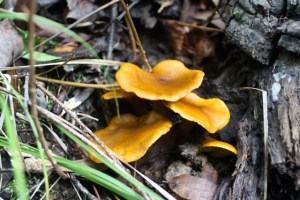
Lactarius_fragilis2This little dusky orange mushroom has a persistently sweet odor when cooked or dried. I’m not generally what mycologists call an “eater”–I tend to be extremely conservative when a mistaken ID can lead to, you know, death. But according to mushroom expert David Arora’s book, the sweet odor of the candy cap (Lactarius fragilis) is oddly persistent. It will linger in your house for days, and if you eat enough of them, your body will even start to exude the maple-syrup-like aroma!! But even though this is nifty, I DON’T recommend eating this little guy since it can mingle with other similar mushrooms, including some that are poisonous. I prefer to admire it in situ and move on.

An interesting trait of the Lactarius genus is that they often emit a white, gluey goo when you break the cap. This goo, called latex, can be a lot of different colors–though in the candy cap it is either absent or a prosaic white. Lactarius_fragilis1


Leave a comment

Filed under Native, Plant of the day

Plant of the day: manroot

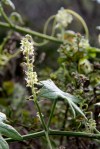
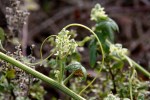
A tangle of twining vines sprawls over a nearby bush; pale green climbing tendrils form tightly wound curlicues until they find something to wrap around.  Whether it trails along the ground or sprawls across its neighbor, each branch throws carefree spires of small white flowers into the sunshine and the wind.

This is an early-blooming manroot, or wild cucumber. There are two common species of manroot in the area: California manroot (Marah fabaceus) and coast manroot (M. oreganus). California manroot, pictured here, has greenish flowers with a round ovary, leaves that are generally less than 10 cm wide, and rigid spines on its gourd-like fruit. Coast manroot has white flowers with a beaked or pointed ovary, larger leaves, and softer spines.

California manroot is an endemic found throughout much of California. The Pomo and Kashaya tribes would treat baldness with a concoction made from pounded manroot, skunk grease and pepperwood nuts–a cure that may have been worse than the problem. The root was also thrown into the water to poison fish so they could be harvested.

Leave a comment

Filed under Native, Plant of the day

Plant of the day: sourgrass

Oxalis_pes-capre1You’ll see it nodding its lemony-yellow flowers along sidewalks and wild trails. Most little kids will recognize the clover-like leaves and smooth green stem. This is sourgrass (Oxalis pes-capre), an invasive with a pleasantly tart and tasty flavor.

Also known as Bermuda buttercup, buttercup oxalis, and yellow oxalis, this little plant was introduced as an ornamental from South Africa and now is found throughout coastal California, as well as in Arizona and Florida. The flowers, stems and leaves are all edible and make a nice trailside snack, or addition to a salad.

Leave a comment

Filed under Edible, Invasive, Non-native, Plant of the day

Plant of the day: California nutmeg

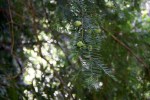
This beautiful, uncommon tree is an endemic that grows only in California. Even here, it is elusive–small groves can be found in the deep woods. The needles look vaguely like redwood needles in the way they grow in a flat plane, but those of California nutmeg are sharply pointed at the tip. It has reddish, shallowly furrowed bark. Male and female trees are separate.

The seeds of California nutmeg are edible, reportedly tasting somewhat like peanuts. An oil derived from the nuts makes a good cooking oil. The tree’s name likely comes from the superficial resemblance the inside of the seed has to nutmeg. The range of California nutmeg  (Torreya californica) has two distinct areas: one in the Coast Ranges and one in the Cascade-Sierra Nevada foothills.

This tree was photographed on the Stairstep Falls trail in Samuel P. Taylor park.

Leave a comment

Filed under Native, Plant of the day

“Plant” of the day: candlesnuff fungus

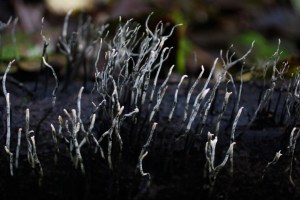
Xylaria_hypoxilon1A tiny forest of wiry, antler-like branches rises up from a rotting piece of wood. This is the candlesnuff fungus, Xylaria hypoxilon. I was delighted to spot this quirky little fungus on a drippy, rainy hike in the woods. I was even more delighted when I learned its name!

You’ll know you’ve found a candlesnuff fungus by its slim, branched appearance and because the lower part is dark while the upper portion is dusted with white. In certain areas it can be found year-round, but it’s particularly common in the fall and winter on oak and tanoak wood. Xylaria_hypoxilon2

1 Comment

Filed under Native, Plant of the day

Plant of the day: Douglas fir

MERRY CHRISTMAS!!

Pseudotsuga_menziesii2When I was a kid we’d go into the forest by our house and cut down our own Christmas tree. It was always a Doug fir–perhaps a little paler, scrawnier and scragglier than the deep green varieties for sale in a lot. But these wild trees were the most beautiful in my eyes.

Douglas fir (Pseudotsuga menziesii) is characterized by branches covered with soft, dense needles. The cones are unique for their “rat tail” bracts, which look like a cartoon silhouette of the legs and tail of a rodent. Young trees have blisters of sap under their thin bark; if you climb them you are likely to get sticky.

This is a versatile survivor of a tree. It thrives in disturbed environments, and can quickly grow to fill meadows and gaps in the forest. It’s the source of the most timber in North America, and is a vibrant part of the ecosystem from BC to central California. The wood is used for  lumber, timbers, and plywood. Great beams are soaked in creosote and used for building piers, pilings, docks and other marine structures. The wood is also made into railroad ties, mine timbers, house logs, posts and poles, flooring, veneer, pulp, and furniture. Birds, rodents, elk, and deer all use Doug fir for food and shelter.

The rat-tail bracts of a Doug fir cone

The rat-tail bracts of a Doug fir cone

Leave a comment

Filed under Plant of the day

Plant of the day: oak mistletoe

It is Christmas Eve, and bundles of yellowish-green leaves hang over the doorway–an invitation for lovers and friends to stop and smooch. According to legend, it was actually an obligation to kiss if you met under the mistletoe. A pale white berry would be plucked for each kiss that happened, until the berries were gone and the obligation was ended. Nowadays there seems to be no limit on kisses though–the berry plucking tradition has faded away.

This slideshow requires JavaScript.

Of course, these bundles are mistletoe, a classic holiday ornament. There is no single species of mistletoe–it’s a general name for a group of parasitic plants that grow on trees. In Europe, the smooching mistletoe is generally Viscum album. Here in the California, the native oak mistletoe (Phoradendron villosum) is the most common holiday decoration. You can see it growing on oaks, pepperwoods and other trees throughout California. Look for a round clump of foliage on a tree limb, looking like a nest or a shadow or a strange stuck balloon. If you go closer you’ll see the leather, oval leaves and the pale greenish-white berries. The roots of the plant go straight into the branch of its host tree; the two often seem to be indistinguishable, one merging into the other rather like lovers enjoying a holiday kiss…

HAPPY CHRISTMAS EVE!!! I hope everyone is having a great holiday.

Leave a comment

Filed under Native, Plant of the day

Plant of the day: Monterey cypress

The dark silhouettes of Monterey cypress are a signature of the central California coast; the sweeping limbs and twisted trunks of these beautiful trees seem to physically embody the stark extremes of our climate. Though this cypress has been planted widely throughout the world, it is in some ways a tremendously rare tree–there are only two natural, wild groves, both of which are near Monterey.

This slideshow requires JavaScript.

Yet because it is lovely–and grows fast–there’s no danger that this tree will go extinct. From its humble roots, Monterey cypress (Hesperocyparis macrocarpa, formerly known as Cupressus macrocarpa) has spread to Hawaii, Europe, South America, Africa, Australia and New Zealand. All by the hand of humans, of course. It’s main use is ornamental, but is grown for pulp wood in some of those places.

In California you’ll often see a line of these cypress growing in a seemingly desolate wilderness–this is a sign of a former homestead, where those living in the now-vanished house planted them as a windbreak, and a sign of civilization.

Leave a comment

Filed under Native, Plant of the day