Plant of the day: harding grass

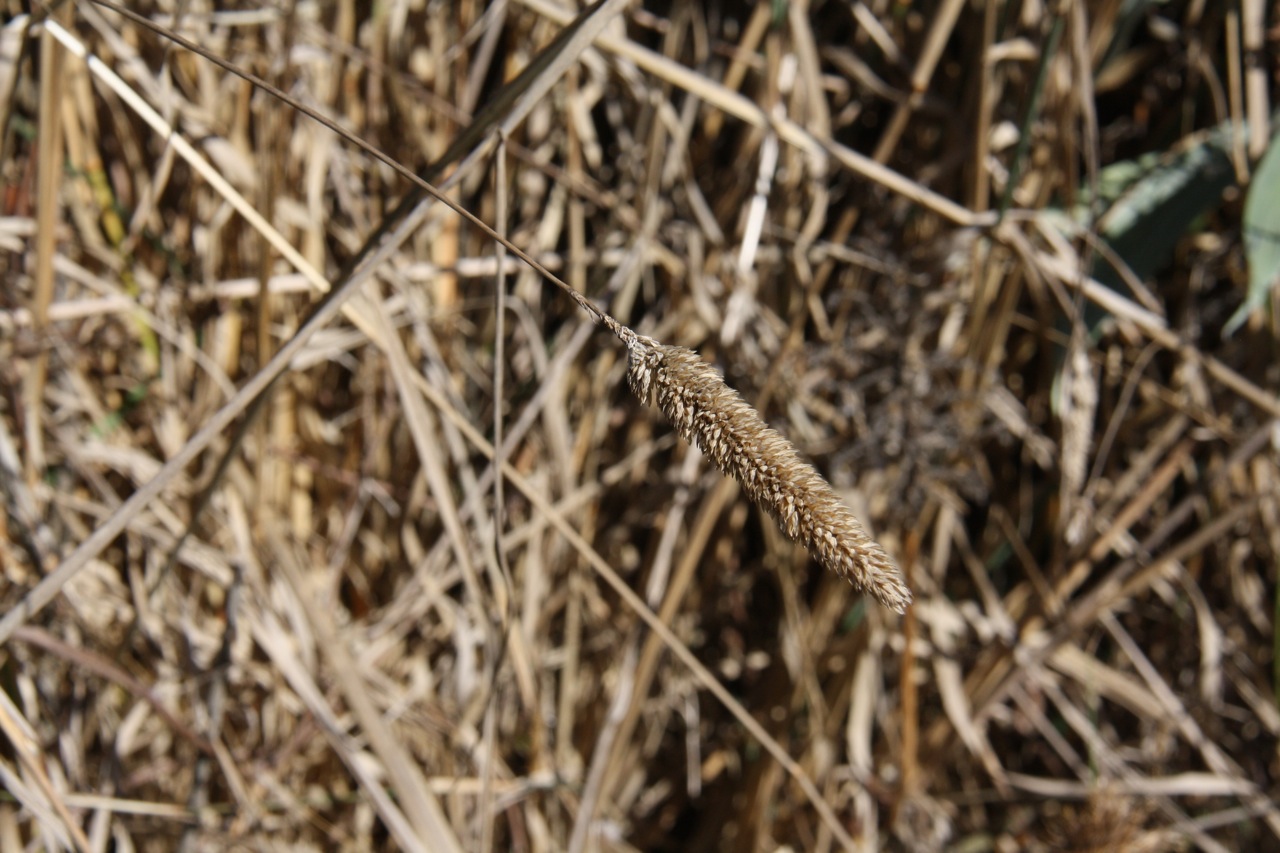
It’s going to be a long day away from the computer, so this one is going to be quick & dirty (hopefully updated later). This is harding grass (Phalaris aquatica), a nasty invasive that not only takes over fields, meadows and lawns but is the bane of hay-fever sufferers’ existence. Luckily it isn’t in bloom right now, but the dried stalks can still be standing tall.

It is another example of human hubris, as it was deliberately introduced to California for forage…

Leave a comment

Filed under Invasive, Non-native, Plant of the day

Plant of the day: fat hen

One doesn’t usually think of a salt marsh as a colorful place. It’s pretty much all green plants and brown mud, right? WRONG. Especially at this time of year. The pickleweed is looking like a Christmas decoration, fat little stems of mottled red and green with the bright orange threads of dodder twining around it. As if this weren’t color enough, great swathes of pink have begun to emerge.

This slideshow requires JavaScript.

Look close and you’ll see sprawling stems with slightly fleshy triangular leaves. Small seeds are also turning rosy, each small and spiky like a tiny spaceship. This is fat hen, or Atriplex prostrata, a non-native weed has naturalized here from Eurasia. The leaves are said to be bland but edible, and the seeds are as well–if anyone cares to take the time to collect them.

Also known as spear-leaved orache, it can be found growing in salt marshes and weedy places throughout the country.

Random fact: it inhibits the growth of potatoes if the two happen to grow near one another.

Leave a comment

Filed under Edible, Non-native, Plant of the day

“Plant” of the day: witch’s butter

HAPPY HALLOWEEN!

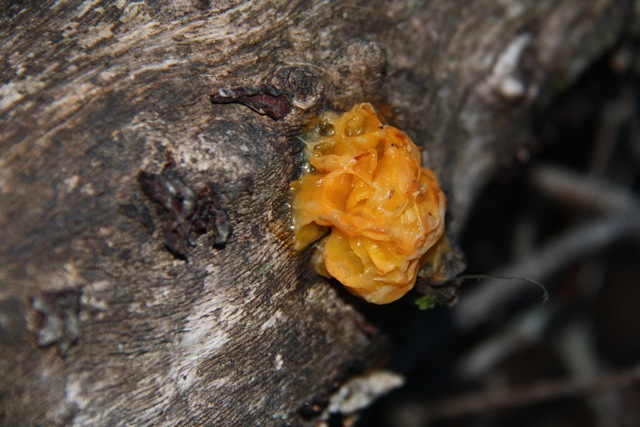
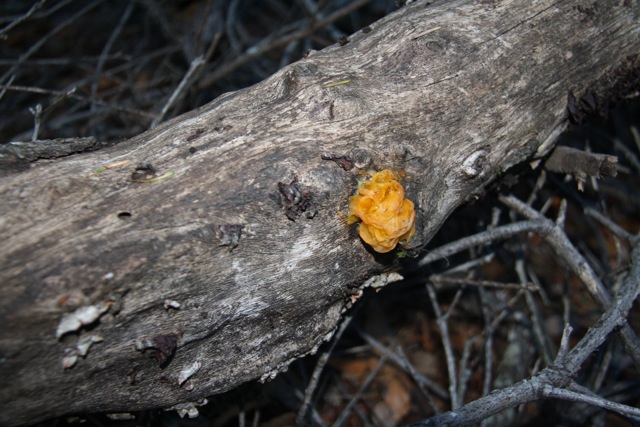
In a deep dark forest, fallen and rotting logs litter the damp forest floor. Everything is still and silent. No birds sing; no deer trot across the path. The only sound is a weak wind that rustles high in the leaves. The branches are so dense that you can’t catch a glimpse of the sky; the only patch of color is a brilliant autumn leaf that has fallen on a nearby log. But wait! What is that? It’s no leaf. It glistens. It jiggles. It looks like a tiny orange brain clinging to the decaying wood.

This is witch’s butter, or Tremella aurantia. It’s a parasitic fungus–but it’s actually not feeding on the wood of the log, but on another fungus (Stereum hirsutumor false turkey tail) which in turn is feeding on the dead tan oak. The legend behind the name is that witch’s butter will grow on your gate if a witch has put a hex on you… in order to break the hex, you have to kill the fungus by poking it with pins. It is described as edible but without flavor–the kind of thing a tasteless witch might eat?

There are a few other kinds of witch’s butter that also grow in the area. The best way to tell them apart is by host and where they grow. The one featured here is found on hardwoods (like tanoak), and feeds on false turkey tails–so you’ll see some of these little fan-shaped fungi nearby on the log. It’s cousin, Tremella mesenterica, also grows on hardwoods but feeds on a spreading mold-like fungus called Peniphora. The third (Dacrymyces palmatus) grows only on wood of conifers.

Usually I’ve seen witch’s butter growing in moist forests; the one described above is a stretch of the International trail, and birds actually sing there quite often… Though you can find a silent moment if you try.

Leave a comment

Filed under Native, Plant of the day

Plant of the day: California fuchsia

It’s a treat to see a whole cliff-full of flowers blooming at this time of year–but that’s just what I found on Mt. Tam the other day. California fuchsia (Epilobium canum) is a late bloomer that you can see in scattered spots throughout the bay area.

Hummingbirds pollinate this flower, attracted by the scarlet, trumpet-shaped blooms. Other common names include hummingbird flower or hummingbird trumpet. It sports these flowers at the end of long stalks densely covered with small, slightly wooly leaves. This perennial plant can be woody at the base (the technical term for this is suffrutescent) but it is usually fairly low growing, with several sprawling stems that are around one foot long. California fuchsia is in the Onagraceae family along with other showy blooms like fireweed, clarkia, and evening primrose.

I saw it growing on a hot, southwest-facing road cut as Pantoll climbs up towards Rock Springs.


Leave a comment

Filed under Good for gardens, Native, Plant of the day

Plant of the day: goldenfleece

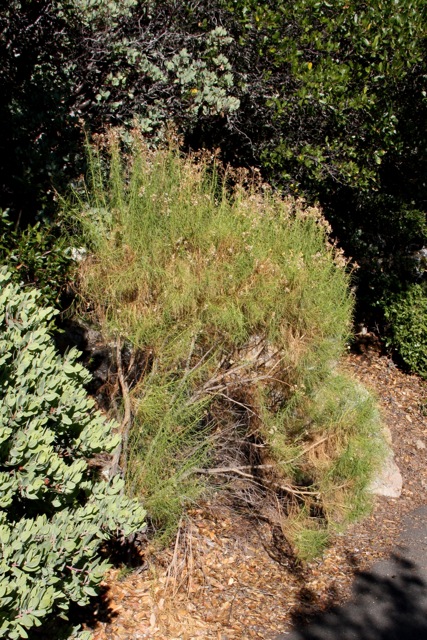
A leggy shrub is common in the scrubby chaparral atop the east peak of Mt. Tamalpais. Right now it is dressed in puffy tufts of seed heads and the last remains of unobtrusive yellow flowers. It has lemony-green, needle-like leaves that release a pungent smell when crushed.

This is goldenfleece, or Ericameria arborescens. It’s endemic to California, and is an important part of the chaparral community, growing up to 9,000 feet.

There is also a near-total lack of information about it. Goldenfleece is one of the few plants that appears to not have been used for much traditionally. “While of no grazing value, its abundance is noteworthy,” one text reports. It has never been investigated for medicinal value. Native Americans bound hot stones and the twigs of closely related species onto sore feet to relieve them; leaves were used to make a plaster for blisters. But no uses are recorded for goldenfleece itself.

Leave a comment

Filed under Native, Plant of the day

Subtle signs of fall

You have to look close to catch the changing seasons here in coastal California. With no snow and a mild climate, each plant dances to its own tempo. So if you aren’t paying attention, you could miss the fact that fall is heavily upon us. The hillsides are still a patchwork of green and brown, like they have been all summer. Plenty of flowers are still blooming in yards and on hillsides.

This slideshow requires JavaScript.

But if you look close, the signs are everywhere. Our deciduous trees are putting on their subtle show, genteelly turning color as leaves drift and pile on the ground. Maple, oak, alder, box elder, Oregon ash, and hazlenut are all going yellow and brown. Poison oak leaves are crimson and yellow, limbs thick with pale berries.  Acorns are heavy on the oaks, and Christmas-ornament sized nuts decorate the naked branches of the buckeye trees. Birds are having feeding frenzies on the sweet, purple coffeeberry fruits, or the orange and red feasts offered up by toyon and madrone.  A few summer blackberries and huckleberries are even hanging on–I ate some the other day and they were delicious.

Even our many evergreens are sporting more spots of color in their lush pelts of green. Red leaves peek from the deep green of toyon, and pepperwoods are speckled with yellow leaves.

In the fields and meadows, the grasses and weeds that grew tall throughout the summer have collapsed under their own weight, dying back into straw-colored heaps. Here the world seems painted from a palette of brown: brown grass, brown thistle heads, brown bracken fern. But California autumn is a confused beast: even here, flowers are blooming, defiant flares of color. Morning glory, Indian paintbrush, nasturtium, wild radish, and more.

In just a few short months, the “early” bloomers will start to flower and the cycle will start all over again.

Leave a comment

Filed under Botany basics

Plant of the day: common velvetgrass

In a sheltered ravine near the coast I find some late-flowering velvetgrass (Holcus lanatus). This invasive grass is a good indicator of a wetland or stream; I saw it growing on the edge of a trail with a seep spring on the uphill side.

This tufted, perennial grass has velvety gray-green leaves and a pretty, purple-tinted grass head (really, clusters of tiny flowers). It is very common near the ocean but less common inland, according to the Marin Flora. Velvetgrass reproduces quickly and grows in dense clusters; it’s a bad neighbor because the roots interweave so tightly that they become impenetrable to any other sort of seed.

Leave a comment

Filed under Plant of the day

Plant of the day: box elder

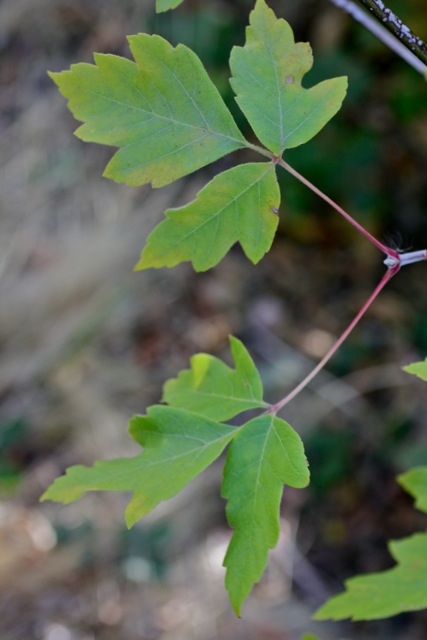
Along streambanks and ponds, the box elder (Acer negundo) is yellowing and losing its leaves–one of the many subtle signs of California fall.

Despite its name the box elder is one of the two maple species growing in our area. Unlike the classic maple, box elder leaves are divided into three–or sometimes more–leaflets; they are also known as cutleaf maple or ash maple. The picture shown here is a single leaf composed of three separate leaflets. The leaves are usually smooth on top, with a velvety fur on the underside. The trees can be low and shrubby or a graceful tree nearly 70 feet tall. They aren’t a common sight, but they are a California native. Keep your eye out for them in the springtime, when abundant drooping racemes of rose-purple flowers appear alongside the budding new leaves.

Cute li’l box elder beetle

incidentally, these trees are host to adorable little red and black box elder bugs which mainly feed on this and other Acer species.

Leave a comment

Filed under Native, Plant of the day

Plant of the day: calla lily

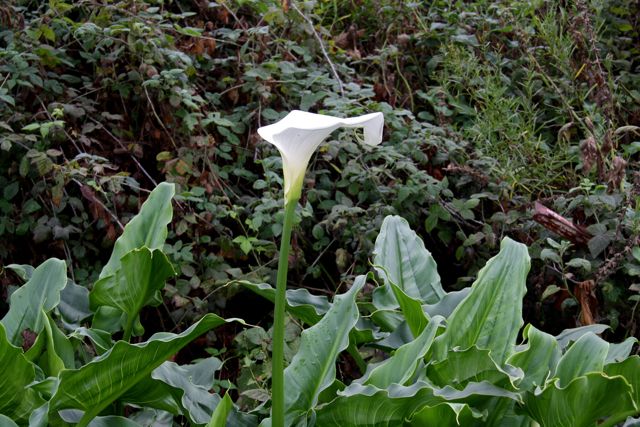
Here is another pretty out-of-season bloom. Calla lilies are a gorgeous sight with large cream-colored blossoms rising from clusters of dark green leaves. They usually flower from May through June, but recently there has been a pretty cluster of them growing near the neighborhood farm stand in Bolinas–is it climate change? Or just the variable microclimates in the Indian summer of California?

The stark white “flower” of the calla lily is actually a spathe, or bract–a leafy appendage below the flower that is usually green. The actual flowers are clustered on a yellow nub that rises from the center of the creamy white sheath. Each spathe is nearly 10 inches across.

This plant is native to east Africa, and grows in scattered locations here in California–usually near places that are (or were historically) inhabited.

Calla lily (Zantedeschia aethicopia) is mildly toxic to eat. It is also called Arum lily and (according to Wikipedia) “varkoor”, which aptly means “pig’s ear” in Africaans.

Leave a comment

Filed under Non-native, Plant of the day, Poisonous

Plant of the day: dusky willow

Dusky willow (Salix melanopsis) has long, narrow, hairless leaves. In general, willows are notoriously hard to identify–mostly because different species interbreed. Despite this confusion, it’s generally easy to tell when you’re looking at some species of willow. They can be shrubs or trees, but they often are found in wet areas–on the edge of wetlands, or along stream banks. They tend to have slim limbs. Most notably they sport small, rounded mini-leaves (stipules) thatgrow at the base of the larger leaf’s stalks. All willows have leaves that are alternate and in the spring they sprout silky catkins.

Willows have a lot of salycilic acid, which is essentially aspirin. You can buy willow bark capsules at health food stores as a more natural alternative painkiller.


Leave a comment

Filed under Medicinal, Native, Plant of the day