
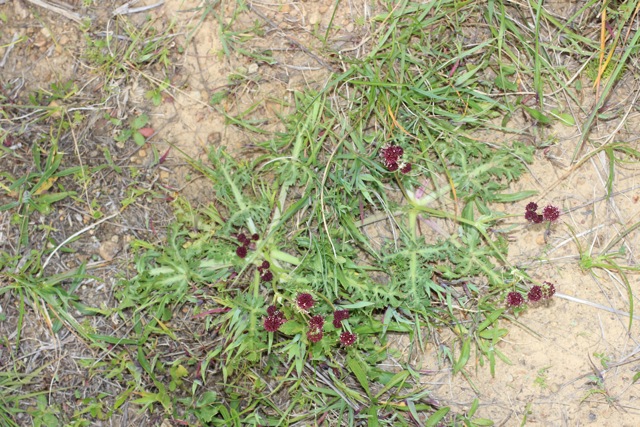
Dark burgandy balls of flowers hover above the trail like tiny, wine soaked pom-poms. A few long yellow-tipped stamens are excerted from the purple ball. This is purple sanicle, or Sanicula bipinnatifida. It’s unobtrusive but nifty.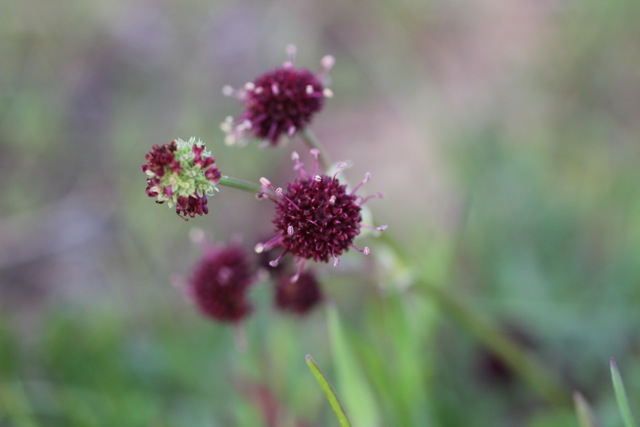
Plant of the day: purple sanicle
Filed under Plant of the day
Plant of the day: narrowleaf mule ears
A large yellow flower blooms on a grassy hillside. The single flower head atop a strong, sturdy stalk looks rather like a small sunflower, with deep yellow ray petals. Leaves are mostly basal, and can be long and skinny or spade-shaped. Both leaves and stalks are slightly hairy and the inflorescence is flanked by many small, hairy bracts.


This is narrowleaf mule ears (Wyethia angustifola) which are somewhat more common than their shorter cousin, Coast Range mule ears. W. angustifolia grow to between 1 and 3 feet tall. It also lacks large, leaf-like bracts surrounding the yellow flower.
The stems and seeds of the plant are edible; they were eaten raw, and the seeds were pounded into a sweetened flour called pinole. The leaves and roots were used medicinally; roots were pounded into a poultice used to draw out blisters or treat lung ailments. A bath made from leaves was used to treat fever.
Narrowleaf mule ears is also known as California compassplant.
Filed under Edible, Medicinal, Native, Plant of the day
Plant of the day: foothill shooting star
 With flowers like tiny art-deco rocket ships, foothill shooting star (Dodecatheon hendersonii) is one of the most beautiful spring blossoms. Backward flung petals start out charcoal, then burn into a thin band of flame-yellow before flaring into pale purple. At the front of the flower, dark and pointed anthers hug a narrow pistil, so the whole group terminates in a single point.
These perennial little plants grow along the Pacific Coast from BC to California. There are many species of shooting star, but only two that are in the SF Bay Area. You can tell foothill shooting star from Padre’s shooting star because its anthers are pointed, not rounded, and lack a yellow spot at their base. Foothill shooting star is also called mosquito bills–a more evocative name.
Filed under Native, Plant of the day
Plant of the day: checker lily
 Chocolate-colored, bell-shaped flowers nod in a meadow full of bunchgrass. Each stem has many six-petaled blooms scattered along its stalk. This is checker lily (Fritillaria affinis), a beautiful native of the west coast. It can be found in forest, brush and grassland.
Checker bloom has purple-brown petals that are mottled with green, and appear slightly frosted or glaucous on the outside. The flower forms a cup around six yellow stamens, and a three-parted pistil whose stigmas are tipped with tiny hairs. There is a rare variety, F. affinis ssp. tristulis, which is only found in Marin and is a special status species. It has less mottling and larger petals ( 2.7 to 4 cm long instead of 1.2 to 2.3 cm long).
Indigenous tribes ate the stems and bulbs of checker lily: roasted, dried, and as flavoring. Often they were boiled or steamed in pits. They are slightly bitter, even when cooked, and often were soaked overnight before cooking to make them more palatable.
Other names for this species include mission bells, chocolate lily, and riceroot (after its bulblets, that look like grains of rice). 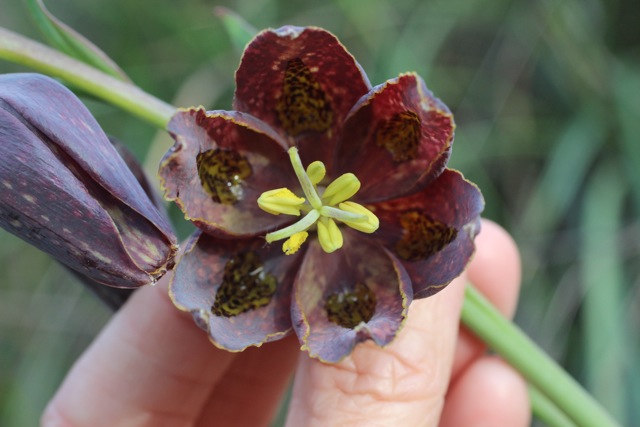
Filed under Native, Plant of the day
“Plant” of the day: caloplaca lichen
 Here is another cool lichen genus! The Caloplaca are orange crustose lichens that forms nubbly patches on exposed rocks. They are nitrogen-loving little organisms, so when you spot some you have a good hint that there is high nitrogen present (or so I learned on a hike last month with lichen expert Shelley Bensen). You might see it on rocks where birds like to perch and deposit their nitrogen-rich droppings. Caloplaca also is abundant along roadsides with heavy traffic, where car exhaust spews out nitrogen oxide as well as other pollutants.
Caloplaca is a crustose lichen; if you see a bright orange foliose lichen, then you’re probably looking at Xantharia. Look close, because the “leaves” of Xantharia might be very small; and they might look nubbly also, due to the presence of raised little fruiting bodies.
Filed under Native, Plant of the day
“Plant” of the day: parmotrema lichen
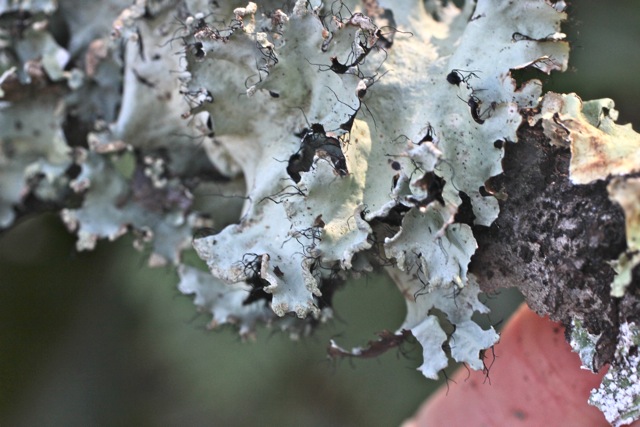 Dead tree branches often bring lichens with them when they fall to the ground; sometimes a single branch will have many different types of lichen all growing close together. One of my favorites looks like papery lettuce-shaped leaves that are pale aqua-gray on top, and dark beneath. A fringe of eyelash-like hairs decorate the edges of the leaves. This is a genus known as parmotrema; there are well over two dozen species of it in the US, according to the USDA PLANTS database.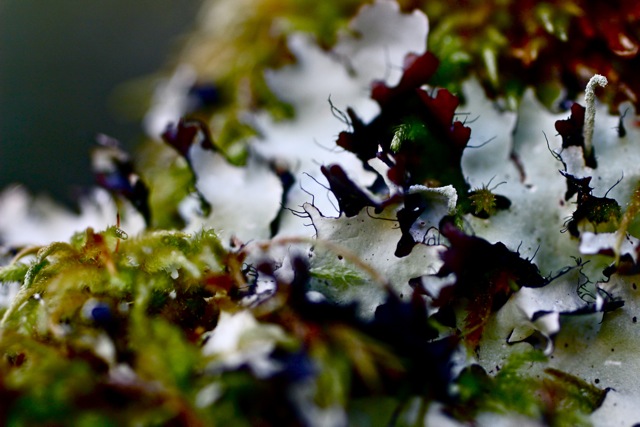
Filed under Native, Plant of the day
Plant of the day: glossyleaf manzanita
Another manzanita to follow on the heels of yesterday’s. Glossyleaf manzanita (Arctostaphylos sensitiva, formerly known as A. nummularia) is a beautiful plant. Small, glossy leaves grow densely along slim branches that are often conspicuously covered in long pale hair. This is the only manzanita in the area to have only 4 petals, and the white lantern-shaped flowers have a paler patch at their base, so the flesh of the petal seems nearly translucent where it joins the stem.
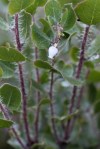


Glossyleaf manzanita is also called shatterberry, because its fruits break into pieces while still on the plant. According to the Marin flora, the long berries look so unlike other (round) manzanita fruits that it was initially thought to be in a different genus entirely.
Filed under Native, Plant of the day
Plant of the day: Eastwood manzanita
A hillside is covered in a thick tangle of shrubs with slim red-barked trunks. These trunks are gorgeous, often growing close together and brilliant in the shadow of the dense foliage above. The deep red bark is so smooth that it looks like an artist has carved it from red clay; the curves and lines somehow remind me of strong human arms.
There are nearly a dozen species of manzanita growing in Marin County alone–and superficially they all look very similar, with red trunks; clusters of small lantern-shaped white flowers; and rounded and leathery leaves. They are a critically important part of California’s chaparral ecosystem.
Eastwood manzanita (Arctostaphylos glandulosa) has little, leaflike bracts that grow interspersed with the flowers of each cluster. This species resprouts after fire (which historically was very common in the chaparral) and at ground level it forms a flattened, platform-like burl which grows as it ages. Though sometimes this feature can be hidden under the duff. And lastly, the leaves have flat margins and look the same on both upper and lower surfaces. If a manzanita has all of these characteristics then you’re looking at an Eastwood. They often are hairy, but the species is very variable and as far as I know this isn’t a diagnostic feature.
Filed under Native, Plant of the day
Plant of the day: English daisy
 You’ve seen them everywhere. Small white daisies that dot lawns and meadows; many narrow white petals surrounding a bright yellow center. Sometimes the petals–each actually a separate ray flower–take on a purplish hue. They grow low to the ground and are perfect for daisy chains.
This is English daisy (Bellis perennis), a widely naturalized species that was originally from Europe. It tends to grow in moist, grassy areas.
Filed under Invasive, Plant of the day
Plant of the day: cretan brake
 “What fern is that?” I thought to myself while hiking on the Steep Ravine trail. It looked sort of like a five finger fern… but without the leaflets. I couldn’t find it in any of my books, so I turned to a botany geek friend–and a day later got an email identifying it as the non-native fern Cretan brake (Pteris cretica) and referring me to the Marin Flora. Which does, indeed, have a reference to one collection of this fern–in 1985, on the Steep Ravine trail.
I guess it’s happy there.
Though this isn’t a plant you’re likely to see often while out hiking, it is an example of how fun sleuthing out plants can be. For tricky species it’s helpful to have a good, diverse collection of field guides (since each gives a slightly different description)–but having other people to consult with is invaluable.
Incidentally, a Cretan is from the Isle of Crete–which this fern may or may not be; the flora says its usual distribution is pan-tropical, and widely cultivated, but that its original range is uncertain. It is not to be confused with the cretin brake, which isn’t from Crete but is just somewhat ill-behaved.
Filed under Plant of the day
 Flowers Of Marin
