Monthly Archives: April 2012

Plant of the day: California goldenbanner

When I first saw the low-growing bush with yellow pea flowers, I thought it might be an odd form of the evil broom. But how wrong I was! Instead, it is Thermopsis californica, or California goldenbanner.

The leaves are what first clued me in that it isn’t a broom. Though they grow in threes, like French broom leaves do, they are much larger than any broom leaf — some as much as a few inches long. All are covered with soft grayish hairs that make you want to pet them, like the ears of some young animal.
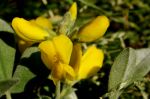
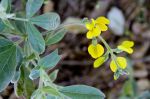
It’s been a while since I looked at a broom flower up close, but at first glance  Themopsis blooms appear very similar. Each flower consists of an upflaring top petal,  two lip-like lower petals, and a third, bottom-most petal like the keel on a ship. Come to think of it, the overall structure is roughly similar to yesterday’s plant, though the details are quite different. In the pea (or Fabaceae) family, lower petals clasp in around the top of the keel, as if in embrace or protection. You can see this similarity in broom, true lupine, and falselupine, among others.  (When it comes to identifying the pea family, keep in mind that the flaglike upper petal can get very large, as you can see in the showy sweetpea).

(note: I originally identified this plant as T. macrophylla instead of T. californica. Thanks to Doreen, below, for correcting me)
1 Comment

Filed under Native, Plant of the day

Pumpkin ridge stroll

If you’re an outdoorsy type who somehow has not been up on the Marin Municipal Water District lands yet, I can’t recommend it enough. If you’ve been to Phoenix Lake or the back side of Mt. Tam, you’ve been on part of their 18,000 acres of watershed land without realizing it. I like to go in the Sky Oaks entrance, where you have the choice of walking by one of the many reservoir lakes, heading down a sociable fire road, or cutting off onto one of the many small trails to be (mostly) alone with some spectacular nature. There are 130 miles of trails and fire roads on MMWD land, so you can spend a LOT of time there. Today I went out the Pumpkin Ridge Trail, which passes in and out of live oak forest that is interspersed with meadows. The forest is in sad shape these days because of Sudden Oak Death, so dead branches litter the

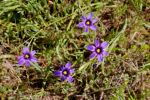
ground. But the understory was still vibrant, with lots of iris and houndstongue. And the meadows are lovely – filled with wildflowers at this time of year. Along the way I embarrassed myself by not being able to remember the Latin names of miniature lupine, blue-eyed grass, or California poppy (which I even wrote about yesterday!). Those are Lupinus bicolor, Sisyrinchium bellum, and Eschscholtzia californica, by the way.

Leave a comment

Filed under TRAIL NOTES

Plant of the day: Chinese houses

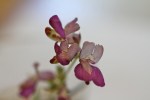
Collinsia heterophylla, or Chinese houses, is a pretty little flower with multicolored purple flowers stacked in whorls. Each flower has two bright purple bottom petals that sandwich a third spurlike petal that points toward the ground like the keel on a ship. This petal is actually a pouch, and the reproductive organs (stamens and pistil) are stowed away inside. The two upper petals are a pale lavendar, decorated with a burgandy pattern of dots. On my specimen those formed a line, arching over  the mouth of an inner chamber that – when pried open – proved to be lined with pale hairs.

Collinsia is in the Plantaginaceae family, which didn’t exist back when I was learning my plants. That’s the thing about botany – as science progresses, names are changed to indicate our changing understanding of different species’ relationship to one another. So what now is Plantaginaceae once was Scrophulariaceae, which still exists but just with fewer members. Anyway many of the species found in the Plantaginaceae family are assymmetrical, like this one. Snapdragons are also notable members of the Plantaginaceae, but I’m getting a bit off-topic here.

Chinese houses tend to like open, brushy or wooded slopes in partial shade, according to the guidebook, but I saw it growing on a hot, rocky landslide face that the trail cut across.

Leave a comment

Filed under Native, Plant of the day

Cascade Canyon

I took my dogsitting charges and headed out into the hottest day of the year so far, out onto the Cascade Canyon Open Space preserve in Fairfax. There were lots of flowers in bloom, most of them very common. My list that I came home with had 34 plants on it, and I could only provide full Latin names for three – three! Pepperwood (Umbellularia californica), madrone (Arbutus mensiezii) and Douglas iris (Iris douglasii). It’s true that for many others I could at least come up with the genus name – but still, this is worse than I thought it would be.

There was one plant that I couldn’t identify at all until I keyed it out, and so that is my plant of the day. It turned out to be Chinese houses (Collinsia heterophylla). Read all about it in the next post.

Leave a comment

Filed under TRAIL NOTES

A note on capitalization

So if you’re going to be a botanist, one thing to pay attention to is capitalization. For common names, the first letter in a list or sentence is capitalized, but otherwise only proper names are capitalized. Like so: California poppy, rattlesnake grass, and spinster’s blue-eyed Mary. Madrone would be capitalized only at the start of a sentence.

For scientific or Latin names, the species name always consists of two words – the genus name and the species name. The genus is always capitalized, and the species (and subspecies, if there is one) never are. Also, both are often italicized. So the above list would read like so: Eschscholzia californica, Briza maxima, and Collinsia sparsiflora.

1 Comment

Filed under Botany basics

A work in progress

From the time I was a kid, I’ve been a casual botanist. I couldn’t help it really – my parents were always keying flowers and quizzing me to see if I remembered their names. After a time dabbling in art, I went to college where I earned an undergraduate degree in botany – a decade ago, in a different state. For a while I even used my degree professionally, but then life took a different course. Since moving home to California I’ve been frustrated by how hard it is to learn the local flora without the discipline of work or school to help me out. But this spring, I’ve decided to get serious. I’ll learn one new plant a day, that’s the goal. And if you like, you can come along on the ride with me.

My method will surely change, but for now the plan consists of two steps. First, pick a plant every day and learn its common and scientific name. Second, take a notebook with me when I go out hiking. In it I will identify as many plants as I can, by whatever name I can. If I can learn a new plant or two while I’m out, even better.  The idea is that I will see the number and detail of my identifications go up as time goes on.

Leave a comment

Filed under Plant of the day