Monthly Archives: June 2012

Plant of the day: dwarf brodiaea

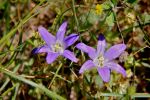
In grassy meadows and along open hillsides, these low-growing flowers open their purple petals to the sun. Each plant has one or two medium-sized flowers that have the classic lily family form. Six gracefully pointed petals fade to white towards the center. Three flat, white, tongue-like spurs (which are actually sterile stamen called staminodia) sit at the base of alternating petals. These staminodia in turn alternate with an interior cluster of flat, fertile stamen dusted with yellow pollen, which at first look like a stout, three-sided pistil.  To see the actual pistil, you have to gently tug on the petals to draw the stamens apart.

The easiest way to tell this from similar species is that it is so low to the ground, with the flower only rising a few inches off the ground. It truly is Brodiaea terrestris.

Leave a comment

Filed under Native, Plant of the day

Plant of the day: rose clover

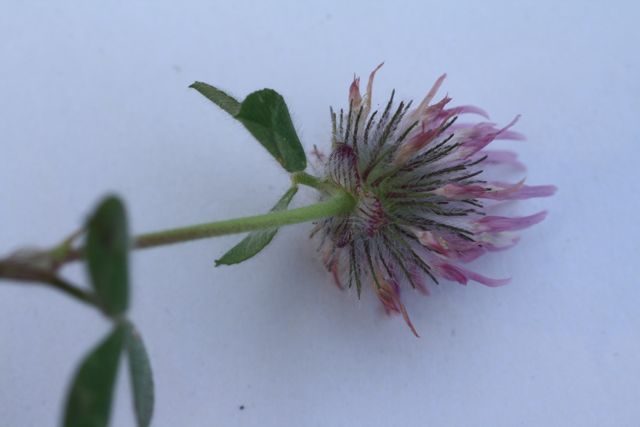
There are so many clovers around that they can be daunting to identify. But this little one has long caught my eye—partly because of the pretty pink color of its petals, combined with the many long green teeth of the calyx. But mostly I just like how it invariably has one little leaf coming directly off the flower. It may be strange but I find that adorable. Of course it turns out that botanically speaking the leaf isn’t actually part of the flower, it just appears to be so. In science-speak, the “heads are sessile above the uppermost leaves and stipules”. But that is good enough for me.

Rose clover (Trifolium hirtum) is native to Europe, not California. But it is now so ubiquitous as to be described by the authorities as “one of the most common” of the European species that have naturalized here.

You can pretty much tell rose clover from other species of clover because it has all of the following features: (a) It is hairy but doesn’t get cottony when it goes to seed; (b) Its showy, rosy flowers; (c) It’s an annual not a perennial; (e) That cute little leaf.

Leave a comment

Filed under Invasive, Non-native, Plant of the day