Monthly Archives: July 2012

Plant of the day: pride of Madeira

You’ll see these towering purple spikes looming from road cuts and clifftops. This is pride of Madeira, or Echium candicans. It’s a common sight – especially in more coastal areas. It grows to more than seven feet tall, and is very striking with its gray-green leaves and massive heads of flowers (easily over a foot long).
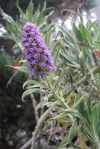
Sadly, this plant isn’t native to the US. It’s another escaped ornamental species that’s still commonly used in landscaping. Birds and butterflies love it, and deer don’t. In inland areas this isn’t a problem but in the coastal climate it spreads on its own, gradually creeping into wild areas. Because it spreads slowly it is only considered to be moderately invasive, but it’s still not recommended for local gardens.
Leave a comment

Filed under Invasive, Non-native, Plant of the day

Plant of the day: coyote mint

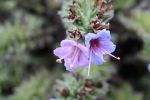
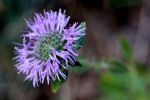
A purple crown of flowers above dusty gray-green leaves: here is a coyote mint in bloom. In the center of the exuberant lilac ring of flowers, a round green bulge of unopened buds looks like a clown’s pate peeking through. Each flower is tube-shaped, its sprawling petals accented by many long stamens. The entire flower head approaches two inches across, and the plant grows one to two feet high, slightly sprawling.

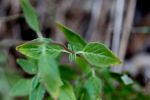
One very charming thing about this coyote mint (Monardella villosa) is that it sports a twin pair of tiny leaves at the base of each pair of larger leaves.

This flower grows only in Oregon and California, and is a great addition to a well-drained garden since it attracts bees and butterflies. You can tell it’s in the mint family by taking a look at the square, four-sided stem. Every time I’ve seen it I’ve forgotten to take a sniff, but I hear that it has a characteristic toothpaste-like aroma as well… It was used by the Spanish as a cure for sore throats.

Leave a comment

Filed under Good for gardens, Medicinal, Native, Plant of the day

Plant of the day: oxeye daisy

Hiking across a remote meadow, I suddenly find myself in a knee-high field of daisies. This is the invasive oxeye daisy (Leucanthemum vulgare), a striking flower with stark white petals around a yellow center.

This bloom was introduced from Europe and is now widespread throughout Marin and much of California. It has a cousin, Shasta daisy, which is less common and has (very slightly) larger flowers and leaves. Oxeye daisy is a moderately problematic invasive, growing so densely in places that it excludes other native vegetation. It also is known for giving cows’ milk an unpleasant taste if they eat it.

Leave a comment

Filed under Invasive, Non-native, Plant of the day

Plant of the day: thimbleberry

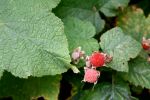
Berry season is upon us! Thimbleberries are a great trailside treat – the red berries are so delicate that picking a large quantity can be hard. But that delicacy is also what makes them so fun to eat. To me they taste like a little dollop of jam, served up right there on the bush. The fruit just dissolves in your mouth like it was already cooked.

Thimbleberries are distinguished by their large, soft, maple-shaped leaves. In the spring they sport large white flowers: many stamens gather around a yellow center. By early summer their bright red raspberry-like fruits have begun to ripen. You can find them in most parts of California, from the Sierras to the sea, and also across much of North America.

Thimbleberries (Rubus parviflorus) are in the Rosaceae family, and are closely related to blackberries, raspberries and salmonberries – all of which are in the Rubus genus as well. What a tasty clan!

Leave a comment

Filed under Edible, Good for gardens, Native, Plant of the day

Plant of the day: harvest brodiaea

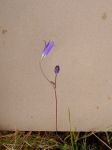
Here is one of the leggy purple flowers of the grasslands. The funnel-shaped blossom sprawls open as it ages, revealing three pale spatula-like staminoides.  The narrow stalk is leafless, and branches into a loose umbel of a few flowers.

Harvest brodiaea (Brodiaea elegans) is one of only two brodiaeas in Marin, but there are several others in the greater bay area – e.g. California brodiaea, Hoover’s brodiaea, and crown brodiaea. Dwarf brodiaea is the other kind that grows in Marin.

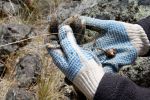
In the dormant season, this perennial flower dies back to an underground corm, which is the bulb-like structure pictured above (I say bulb-like because a bulb is actually made of modified leaves, like an onion, whereas a corm is solid all the way through. And as long as I’m getting technical, I may as well point out that a corm is not a root. It’s a modified bit of the plant’s stem that serves to store food and help it survive the winter. The actual roots branch off from the bottom of the corm.)

Leave a comment

Filed under Good for gardens, Native, Plant of the day

Plant of the day: trail plant

Adenocaulon bicolor

With distinctive arrow-shaped leaves, trail plant is a common sight while hiking. The tiny white flower is much easier to miss – I mostly notice the leaves without blooms. When it does flower, this perennial herb shoots up a long, mostly bare stalk from the low cluster of leaves.

The small flowers initially appear in a series of tiny heads, each on their own branch off the central stalk. But as the plant ages and the seed pods elongate, one flower will stay perched on the end of each seed/ovary as it matures. This gives the head an interesting multi-storied look, with some flowers still clustered in the center and some perched above them atop their green pedestals.

Adenocaulon bicolor seeds get sticky and cling to socks, pants, and fur – a handy way to disperse but a pain in the neck to walk through. Still, I’ve always been fond of this unassuming plant. The leaves are a cheerful green (with a cottony white coating underneath) and the flowers are quirky. Good enough for me!

This slideshow requires JavaScript.


Leave a comment

Filed under Native, Plant of the day

Plant of the day: yarrow

Achillea millefolium

Knee-high clumps of creamy flowers stand atop a narrow stalk. Each yarrow flower has a sweetly classic daisy shape to it – and like a daisy, it is actually many flowers. If you look close you’ll see the demure inner “disc” petals surrounded by the flashy outer “ray” petals.

In the southwest, yarrow is sometimes called Plumajillo, or little feather, because of its delicate plume-shaped leaves. It is listed as being mildly toxic by the California Poison Control system, but historically has been used as a tea to treat colds, nausea, cramps, hives, measles and kidney ailments. Yarrow (Achillea millefolium) also was used externally to treat cuts, stop nosebleeds, and as a hair wash to prevent baldness!

Leave a comment

Filed under Native, Plant of the day

Plant of the day: huckleberry

Vaccinium ovatum

One of my favorite Fourth of July memories is eating my great-aunt Martha’s huckleberry pie when I was a kid. We’d gather at the family campground by a little river, and eat California delicacies like abalone, venison, and this wonderful pie. Huckleberries are a wild-tasting fruit, tart but sweet. They taste of pine forest and long days with picking buckets. The little fruits hold their texture even when cooked, they  pop in your mouth with a satisfying burst: perfect when blended with sugar and a flaky crust.

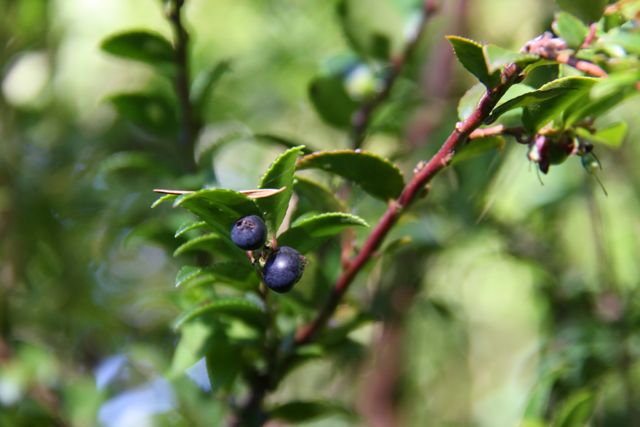
Huckleberries (Vaccinium ovatum) grow all along the west coast – from Canada to Alaska – but not many people cook with them often since they are so small that picking enough for a pie takes a long time. Look for them  in forests and clearings, often on slopes. The shrubs are attractive, with dense shiny foliage of small oval leaves. White lantern-shaped flowers give rise to small, round, dark purple fruit that looks like a small blueberry.

2 Comments

Filed under Edible, Good for gardens, Native, Plant of the day

Plant of the day: oceanspray

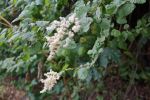
This graceful shrub has soft scalloped leaves and creamy white sprays of flowers. It is happily in bloom right now, and a fun one for drive-by botanizing since it thrives on roadside banks. Usually oceanspray (or cream bush, aka Holodiscus discolor) is a medium-sized shrub, but on exposed hills it can become a low-growing mat, according to the Marin Flora.

This is a good one for gardens since it can grow in a wide range of soils from wetlands to dry and well-drained. The beautiful flowers with their many long stamens are typical of its family, the Rosaceae or rose family. This big clan contains a wide spectrum of species from cherries and plums to roses to silverweed. It’s one of the biggest plant families there is.

Leave a comment

Filed under Good for gardens, Native, Plant of the day

Plant of the day: little rattlesnake grass

Briza minor

Tiny brown wedges float on delicately branched stems like a minute Calder mobile. This is little rattlesnake grass, or Briza minor. The wedges are actually tiered heads, very similar to those I wrote about yesterday that you see on (big) rattlesnake grass. But at first glance, they don’t look at all alike, since the little rattler has heads too small to easily see, and a delicate, lacy structure when it grows.

Like its larger cousin, little rattlesnake grass was also introduced from Europe. Though Briza minor is more widespread, it is less aggressive and is not listed as invasive (while big rattlesnake grass IS invasive).

Rattlesnake grasses are in the Poaceae family, the group that essentially all grasses belong to (with the exception of some plants with the name “grass,” like eelgrass). This is one of the largest plant families, with over 9,000 different species, including many of our vital food sources like wheat, corn, barley, and rice!

Leave a comment

Filed under Non-native, Plant of the day