Monthly Archives: September 2012

Plant of the day: nasturtium

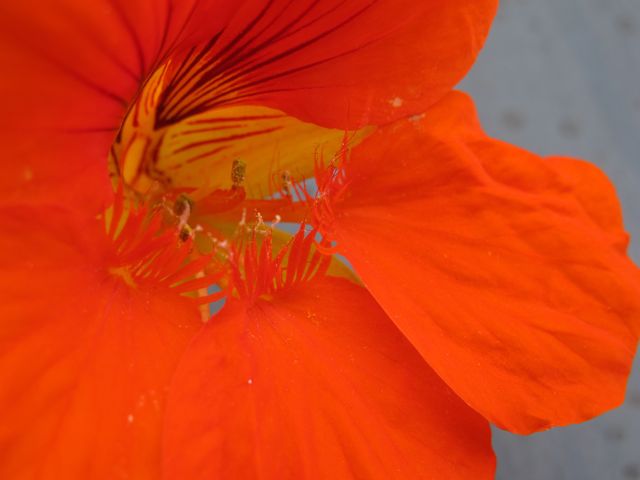
These brilliant orange flowers are so brightly colored they can almost seem to glow. Nasturtium (Tropaeolum majus) is a garden plant that can sometimes escape into nearby forest–usually near the coast. It’s never seen growing far from human habitation.

The flowers are large, edible and very beautiful. They range in color from buttery yellow to pale orange, and the upper petals often have dark stripes that run into the throat of the blossom. The three lower petals are dramatically fringed at the entry to the throat. Each flower has five pale sepals. The upper several sepals are fused into a long spur that extends backwards behind the bloom like a gnome’s cap.

When they are happy, nasturtium plants can grow into dense mats, sprawling across the ground and climbing up fences, buildings and other plants. Fortunately they don’t appear to take over large areas, so gardeners don’t have to feel too guilty about planting this potential invasive.

All parts of the plant are edible, and they have a sweet, spicy flavor that is somewhat like arugula. The seed pods are even spicier–some people harvest them young to use like capers, and others dry the mature seeds and grind them like pepper. I love to nibble the flowers raw or add them to salads. In the Andes, the nasturtium’s native range, they were used medicinally to disinfect and heal wounds, and to treat chest congestion. It is described as having properties that are antibacterial, antifungal, antibiotic and possibly even anti cancer.
Leave a comment

Filed under Edible, Non-native, Plant of the day

Plant of the day: Mt. Tamalpais lessingia

Tiny pale pink flowers are scattered throughout the grasses and serpentine rocks of Carson Ridge. They grow singly and in small clusters at the end of highly branched, wiry stems. When you look close you see that they form a cobwebby network throughout the brown grass. This is Mt. Tamalpais lessingia (Lessingia micradenia var. micradenia).

This slideshow requires JavaScript.


This plant prefers shallow gravely soil on serpentine outcrops, according to the Marin Flora. This variety grows only in Marin, and is listed as a rare species. It also is very counterintuitive to identify. Though it appears to have single blossoms with five petals, it’s actually in the Asteraceae family along with sunflowers, daisies and other composites. But the Lessingia species tend to be sneaky this way–check out this list and see for yourself.

Leave a comment

Filed under Native, Plant of the day, Rare

Plant of the day: English plantain

English plantain are supposed to be done flowering, but a few are still blooming along the coast. These green grass-like torpedos were one of my favorite childhood plants. You can make a loop out of the stem, and if you slide the flowering stalk through the loop quickly then the head will pop off–a missile to bombard another kid with.

Plantago lanceolata is in the group of low-growing plants known as plantains–and is not at all related to the banana-like plantains. This little herb sprouts a long stalk bearing a single flower, extending up from a low rosette of ground-level leaves. It is not a native to California.

Though technically edible, the leaves are described as fibrous, and removing the fibers is hard work for a somewhat bitter green. The plant is better used medicinally, as it has antibacterial properties. English plantain is used to treat ulcers, rattlesnake bites and myriad other maladies. The seeds are mucilaginous and swell up if eaten–apparently this makes them good as laxatives and treatments for indigestion.

Leave a comment

Filed under Non-native, Plant of the day

Plant of the day: narrowleaf trefoil

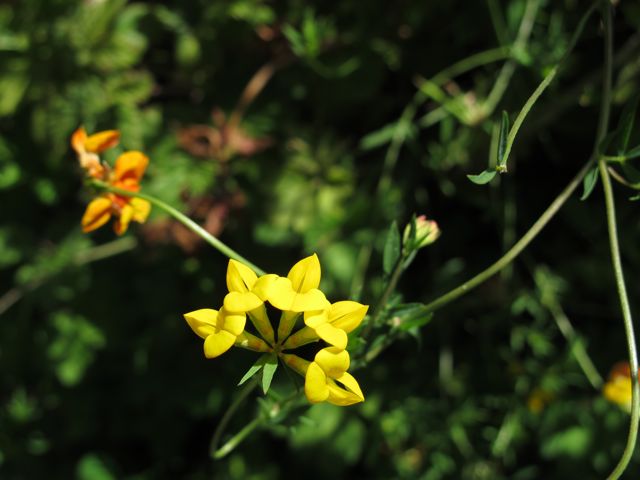
Bright yellow pea flowers grow scattered and in mounds. Narrowleaf trefoil (Lotus tenuis) is an oft-overlooked plant, common to roadsides and meadows. A native to Europe, it escaped from cultivation and is now a common sight in Marin.

Several blooms grow clustered together at the end of low, sprawling branches that are largely leafless. Leaves consist of five leaflets, which can sometimes look like only three since the lowest two grow very close to the stem.

Narrowleaf trefoil is common across most of California and much of the US, particularly on both the east and west coast.


Leave a comment

Filed under Non-native, Plant of the day

Plant of the day: bristly ox-tongue

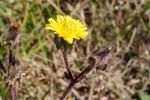
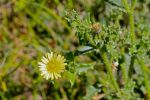
It looks like a dandelion on steroids–a big, mean, nasty dandelion. The flowers are sunny little composites that dry into carefree puffs. But it grows to be six feet tall… and the entire plant is prickly. This is bristly ox-tongue, or Helminthotheca echioides.

One of the most unique aspects of bristly ox-tongue are the pale blister-like bumps on its leaves. I have seen a huge variation in size; often it is only ankle-high, but sometimes (even in the same general area as the smaller versions) the stalks can grow as tall as my shoulder.

This species is a late bloomer, with flowers beginning in June but continuing in places all the way until December. It is native to the Mediterranean but isn’t highly invasive. You will usually see it growing it seasonally wet or damp soils. It has no medicinal or traditional uses that I know of.

Leave a comment

Filed under Non-native, Plant of the day

Plant of the day: coastal sagebrush

The haunting smell of sagebrush is iconic for anyone who has spent time outdoors in the west. There are many different species, and though they go by different names (sagebrush, sagewort, wormwood) the smells are all similar. It’s a pungent, spicy fragrance that speaks of campfires and starry nights and open spaces.

This slideshow requires JavaScript.

Coastal sagebrush (Artemisia californica) is the only shrubby sagebrush in Marin; the species grows only in California and Baja. You can usually find it along the coast or in chaparral communities. It has narrow, linear leaves that sometimes branch like the tines of a pitchfork. The flowers are unobtrusive–small yellowish-green or reddish-green discs. The smell is classic sagebrush.

Historically, some tribes used a tea made from Coastal sagebrush as a female tonic. It was used to induce menstruation, as well as to ease and recover from childbirth. Women drank the tea at the start of their cycle, and it was fed to one-day-old newborns to cleanse their system. It was also used to treat colds, headaches, and to desensitize those suffering from hay fever. Dried leaves were smoked in a mix with tobacco, and used in sweathouses. Bundles of sagebrush branches were hung along trails leading to shrines. The wood was also used for arrows, fire sticks and windbreaks.

Dusky-footed woodrats love to eat it.

Leave a comment

Filed under Medicinal, Native, Plant of the day

Plant of the day: woolly mullein

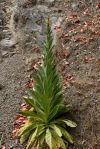
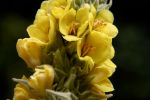
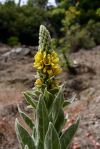
A tall spire of wooly leaves is topped with many bright yellow flowers. Each five-petaled bloom has two lower, straightened stamens and the remaining three are smaller and hairy. This is woolly mullein, or Verbascum thapsus, an invasive species that is now found throughout much of California and the rest of the country.

This plant prefers to grow in dry places, and can grow to more than six feet tall. The leaves are furry like lamb’s ears, and taper progressively smaller towards the top of the stem–giving the whole plant the shape of a narrow christmas tree. In addition to being an invasive, woolly mullein is also a host to insect species that can damage crops. It’s a persistent plant, with seeds that can survive up to 35 years in the soil.

Leave a comment

Filed under Invasive, Non-native, Plant of the day

Plant of the day: California rose

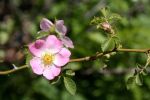
This wild rose is a favorite sight in spring and summer, as pink blossoms give way to ripe red fruit. This is the California rose (or as it is conversely known in Latin, Rosa californica), which grows in nearly every county in California, as well as in parts of Oregon.

This hardy shrub can look scraggly, but also can be groomed into a good garden plant, with pale green leaves and colorful fruit and flowers. It grows to 8 feet tall but is usually smaller. The tangle of thorny branches make excellent shelter for birds, and I’ve spotted many a nest by peering into a wild rose bush.

Rose hips are a renowned source of Vitamin C, and you can make an immune-boosting tea just by pouring boiling water over the red fruit. The hips can also be eaten fresh, though the inner bit is unappetizing, filled with seeds and strange stiff hairs. But the thin outer layer of flesh is tasty–I usually eat it by splitting the fruit open with a fingernail and scraping out the seeds. But this is labor intensive, and rose hips were never a significant food source for Native Americans. There was some medicinal use, though. A tea of wild rose hips was used to treat fever, sore throats and stomach aches–as well as to wash sores and sooth the pain of babies.

There are several different kinds of wild roses in California, and they all look fairly similar. The California rose (according to the Marin Flora) has the brown remains of its sepals at the tip of its ripe hips, and also tiny hairs visible on the stems of its leaves. It grows in full sun and partial shade, and in both wet and dry areas.

Leave a comment

Filed under Edible, Good for gardens, Medicinal, Plant of the day

Plant of the day: redwood sorrel

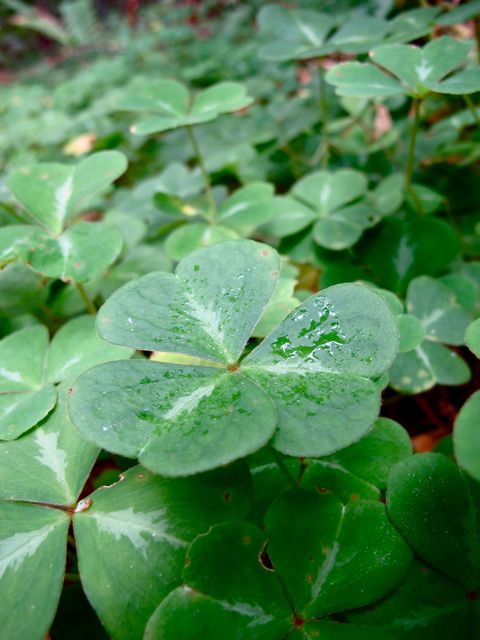
Deep under the shade of the redwood trees is a brilliant swathe of green. A field of tiny three-leaved plants carpet the forest floor. This is redwood sorrel, or Oxalis oregana. Each heart-shaped leaf has a pale splotch along its midrib, as though it had been folded around a dab of light green paint in a kindergarten art class.

When I was a kid, this little plant was a favorite treat. It’s edible and easy to spot, so I would eat it all the time. The leaves have a fresh, lightly bitter flavor like a mild lemon. You can add them to salad or other foods, and since they love to grow in shade they are a nice addition to a garden that doesn’t get full sunlight. In late spring they sprout an attractive, pale-pink flower.

An interesting list of historical uses is described on the Native American Ethnobotany Database: chewed redwood sorrel roots were applied to sore eyes. It was given to anyone who didn’t feel like eating, and used as a wash to treat rheumatism. Poultices were applied to boils, sores and infections. Leaves were eaten raw, cooked with grease, or with dried fish. One source says the stems could also be used to make a rhubarb-like pie–but wow, that would need a LOT of stems.Oxalis_oregana

Leave a comment

Filed under Edible, Good for gardens, Native, Plant of the day

Plant of the day: toyon

Heteromeles arbutifolia

Small, dark green trees with clusters of white flowers are scattered here and there across the hillsides. This is toyon (Heteromeles arbutifolia). It will truly come into its own in a few months, when clusters of brilliant red berries begin to ripen. Toyon is also called “christmas berry” for these cheerful December fruit, which once were sold as a local substitute for similarly colored holly sprigs.

Don’t get any ideas about collecting your own–it’s now illegal to harvest wild toyon. This species is often a part of the scrubby chaparral community, but you can also see it in oak woodlands and other forests and shrublands across the state. The berries are described as having a “sweet and spicy” flavor, and a tea made from the leaves was used for irregular menses, aches, pains, stomachaches, and to wash wounds. Californians once ate the fruit regularly–roasted, toasted and fresh. Spanish settlers made a drink from the bark, and Channel Island fishermen used it to tan their fishing lines.

Leave a comment

Filed under Edible, Medicinal, Native, Plant of the day