Monthly Archives: November 2012

Plant of the day: bishop pine

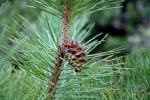
The Point Reyes Peninsula is geologically and geographically fascinating. It’s a chunk of high-riding land on the Pacific Plate, sandwiched up against the rest of Marin–and the continent–which is on the North American plate. Inch by inch, Point Reyes is creeping northward. The fault runs through the Bolinas Lagoon and created Tomales Bay. Stone and soil have entirely different provenances across the invisible line of the fault. The plants change across the fault as well–and one of the most dramatic of those changes is the abundance of bishop pine (Pinus muricata). This tree has an extremely limited range, and in Marin it mainly grows on Point Reyes, though scattered trees can be seen elsewhere.

Because of this the graceful pine is iconic of the peninsula–especially since the Vision wildfire burned through in 1995. One of the unique things about this tree is that its seeds can only sprout after being heated by fire, so in the last fifteen years a dense and lush forest of young bishop pine trees has grown up in the areas where the fire burned.

You can distinguish bishop pine from other species of Pinus because its needles come bundled in pairs of two.

Leave a comment

Filed under Native, Plant of the day

Plant of the day: cascara

Saplings with large, shiny, deeply creased leaves grow on an old logging road just north of Arcata. This is cascara (Frangula purshiana), another plant of Pacific Northwest affiliation, which can be either a shrub or a small tree up to 30 feet tall. Most of its beauty is in its smooth gray bark and shiny leaves. The spring clusters of greenish-yellow flowers are unobtrusive, but the fruits are also striking–small purplish-black berries that look similar to those of its cousin, coffeeberry.

Native tribes used cascara bark as a laxative, and settlers found it so effective that  in the late 1800s it became the base of a commercial pharmaceutical that was exported to the rest of the US and Europe. For a time it was so heavily harvested that it was almost exterminated from some areas–some say that it still hasn’t fully recovered. In fact, according to Wikipedia (which I hate to quote, but here goes) even in 1999 cascara made up more than 20% of the national laxative market in the U.S., with a total estimated value of $400 million and the bark alone being worth $100 million.

Potential collectors should beware–some reports say that if the bark is handled for long enough, the laxative effects can even pass through the skin! Eaten fresh, or in large quantities, cascara bark is toxic and can lead to severe diarrhea and vomiting. The berries are described as “edible but not incredible.”

Cascara grows from BC to Northern California. It stops short of the Bay Area, but it is found in Sonoma county where it’s been reported from Salt Point, Fort Ross and other places.

Leave a comment

Filed under Native, Plant of the day

Plant of the day: western hemlock

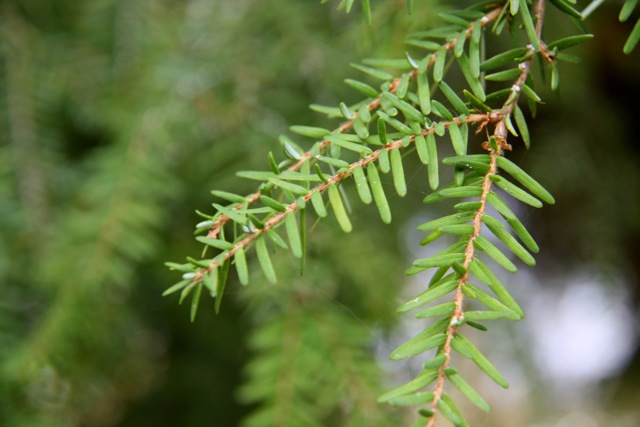
Continuing yesterday’s theme–here is an iconic tree of the Pacific Northwest. Western Hemock (Tsuga heterophylla) is a tall, straight-trunked tree that can be identified at a distance by the way its tip droops sideways rather than standing upright. Up close, look for short, round-tipped needles of irregular length (5 to 20 m) that splay out from the twig in several directions. Ain’t it adorable!!

Western Hemlock was used extensively by the northwestern tribes–for medicine and lots of other stuff besides. For example, you can make a black dye by steeping its bark in urine (left on its own, the bark can make a red dye). It can also be used to tan hides. Wood was carved into paddles, spits, spearshafts and more. Dancers in one tribe made much of their outfits from the boughs.

This tree also forms the densest canopy of any tree in the west, according to Plants of the Pacific Northwest Coast. As a result, not many other plants grow underneath–I saw this recently near Arcata, where nothing grew in the understory except a few patches of false Solomon’s seal.

Sadly (luckily?) you’ll have to travel to see a wild specimen of this tree–the only places it grows in California are Humboldt and Del Norte counties (and possibly Trinity).

1 Comment

Filed under Plant of the day

Plant of the day: tall Oregon grape

I’ve been visiting Seattle this week, a city where I spent my college years and first learned botany. It’s been a treat to revisit the landscape of the Pacific Northwest–including the plants. Some are old friends who I haven’t seen for years; others are common down in California as well.

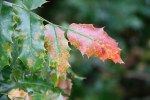
Tall Oregon grape (Berberis aquifolium) is one that falls in the middle. This scrubby shrub of the forest understory is distinguished by glossy pointed leaflets that grow 5 to 9 in each sprig; in the fall some of them may turn red.

It’s a common sight in the Pacific Northwest. But though it technically grows across most of the west coast (including almost all counties in California, according to CalFlora) I have never seen it in the Bay Area. And Marin is one of the only counties in the state that does not have any records of this species at ALL–though its similar-looking cousin, dull Oregon grape, does grow here. (This species, B. nervosa, has 9 to 19 leaflets).

The purple berries are tart; some people make them into jelly or wine–generally mixed with other (sweeter) fruit. The inside layer of the bark is brilliant yellow and can be used to make a dye.

Leave a comment

Filed under Native, Plant of the day

“Plant” of the day: artists conk

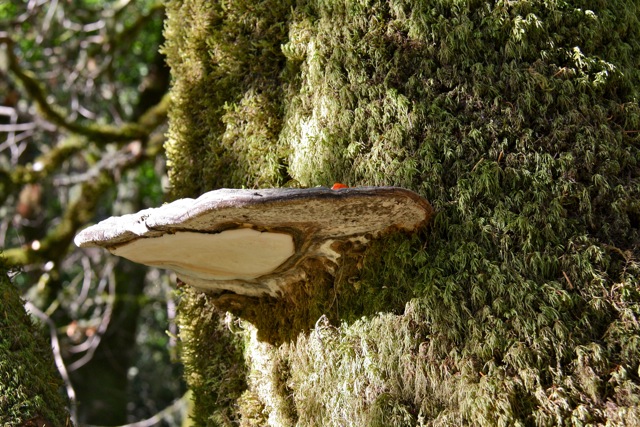
A sturdy, round shelf seems to be hung from the mossy trunk of a pepperwood tree. It’s brown and woody on top, with a creamy white surface below. You could set your drink on it, if you happened to have one with you while hiking. This charismatic fungi is an artists conk (Ganoderma applanatum), earning its name because if you scratch an image into its white underbelly, the depressed area immediately turns dark brown. This ready canvas is tough to resist–but any marks made are permanent, so it’s probably best to hold back and keep graffiti out of the woods.

This woody fungus is in the polypore family. This group tends to be shelf-shaped and also lacks gills; instead spores are released from a minutely pored undersurface. There are a lot of different kinds of shelf fungi, but artists conks are fairly easy to identify. They grow on many different types of trees, but are particularly common on pepperwood (aka bay laurel).

Leave a comment

Filed under Native, Plant of the day

Plant of the day: brass buttons

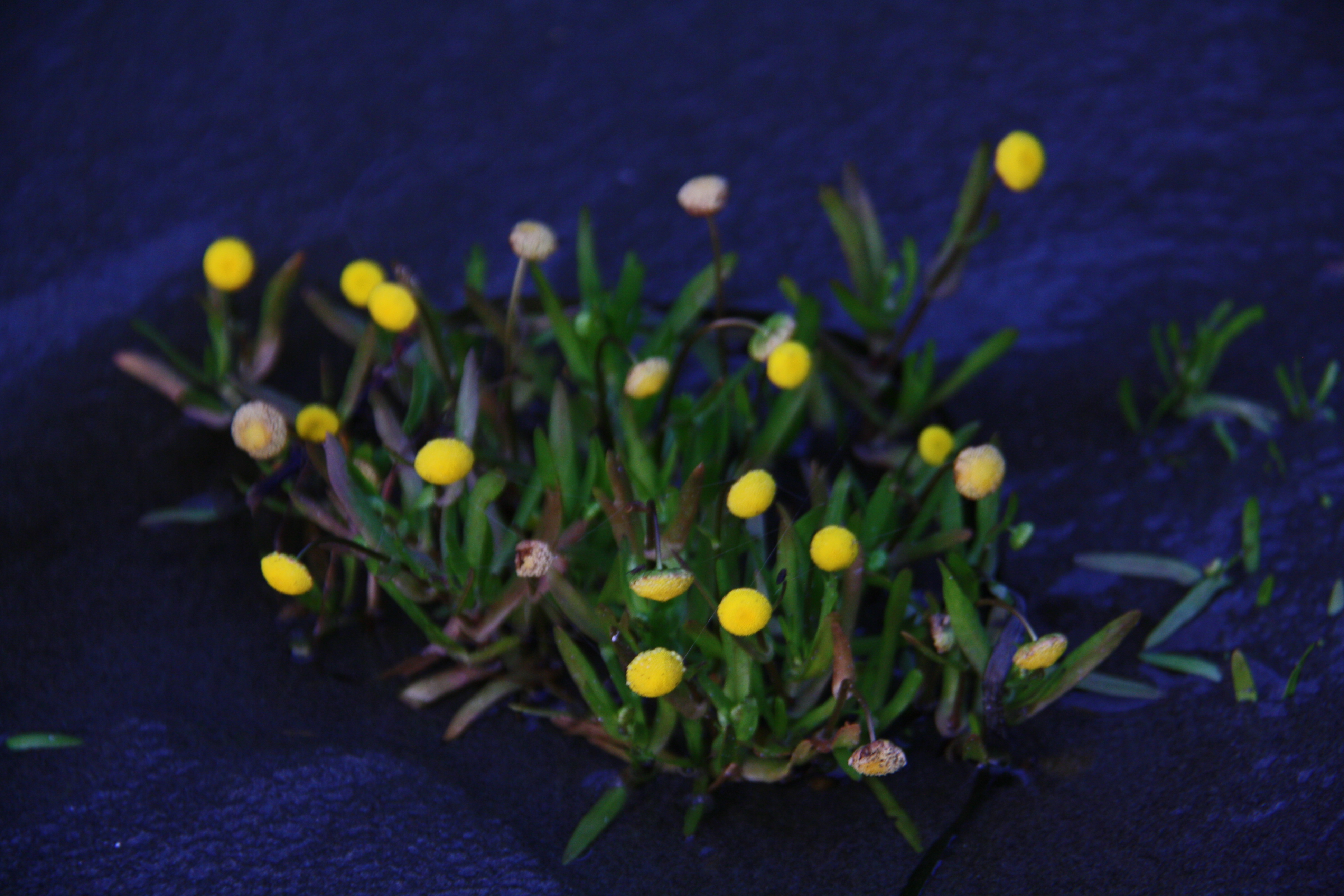
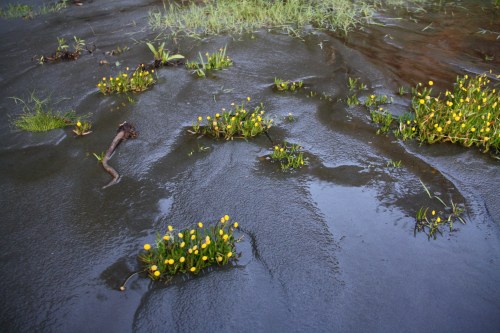
Small discs of gold gleam on a beach at twilight. It’s not pirate treasure–it’s a little, tiny, petal-less flower. Brass buttons (Cotula coronopifolia) can grow in both salt and fresh water marshes. I saw it growing in the sandy flats where a stream spread out flat across the beach before flowing into the ocean. Its small seeds are spread by birds or moving water, but it also can reproduce vegetatively, sprouting roots at the joints of its stems.

Brass buttons is a member of the Asteraceae family but it has only disc flowers–ie none of the typical daisy-like “petals”. Instead it looks like a little yellow pincushion. This is a non-native plant that was introduced from South Africa to California, but since it spreads slowly it isn’t known as a big ecological problem.

Leave a comment

Filed under Non-native, Plant of the day

Plant of the day: saltgrass

From far away, the edges of the marsh appear to be covered in a herringbone pattern of green and brown. This is actually a carpet of low-growing saltgrass (Distichlis spicata). Bunched into mounds or swept smooth by the outgoing tide, this is a beautiful and distinctive plant of the salty intertidal places. The leaves are flattened and create a dramatic geometric pattern as they alternate up the stem: wedge-shaped leaves offset by the space that they define. The effect of a single stalk is nice, but usually it is magnified by the thousand since this creeping, rhizome-forming grass tends to grow in dense colonies.

Saltgrass can stand being submerged in sea water and so it will often be one of the only plants growing along the tideline. I’ve sat along the shore of Tomales Bay and watched as the water creeps in or out, clambering farther up each leaf blade with each incoming wavelet. It’s a beautiful sight–and happens a lot faster than you might think!

Native tribes of California made a seasoning from the plant, threshing it to harvest the dusky-green salt crystals that coalesce on the leaves (and reputedly have a flavor rather like that of dill pickles).

1 Comment

Filed under Edible, Native, Plant of the day

Plant of the day: rattlesnake plantain

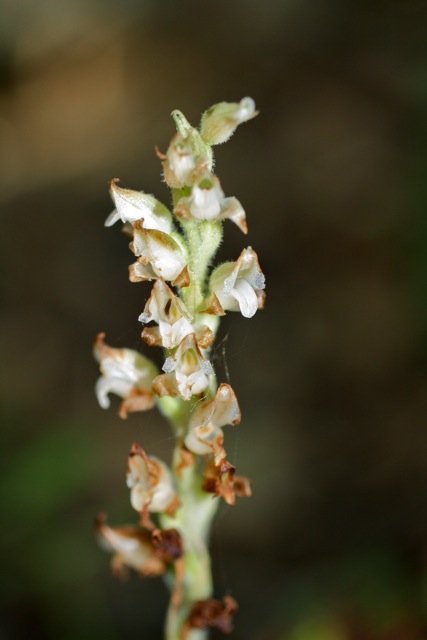
Vivid green leaves are bisected with a lightning-bolt of white. A tall pale stalk of white flowers rises from this small, ground-level rosette of leaves. This is rattlesnake plantain (Goodyera oblongifolia), a distinctive little plant that grows in Northern California (and many other parts of the country).It’s in the orchid family–look close and you’ll see the flowers have the typical orchid look, of a mouth gaping open with a cute little tongue hanging out. I’ve usually seen them growing in shady forested understories.

Apparently rattlesnake plantain can be used as a chewing gum, but though many places repeat that fact I haven’t yet found any information about which parts or how it is used. Traditionally, it was thought to have medicinal properties–particularly having to do with childbirth. It was chewed to help ease delivery and also to affect the sex of the baby–but again, there’s no details about this. It was also used in assorted other treatments for things such as colds, rheumatism, toothache and stimulating the appetite.

Leave a comment

Filed under Medicinal, Native, Plant of the day

Plant of the day: dotted smartweed

Unattended roadside ditches can also double as great wild gardens. Lush greenery thrives in the moist earth, and the plants found here can be really diverse as passing cars (and creatures) spread seed. True, there tend to be a lot of weeds in these places–but native plants can be found here as well.

This slideshow requires JavaScript.

Dotted smartweed (Persicaria punctata) is a pretty little native with a diminutive spike of white flowers. The leaves emerge from a papery sheath that wraps around the stem–and is often present in member of this family, the Portulaceae. Dotted smartweed likes to grow (usually near the coast) in wetlands, marshes and moist on hillsides.

Random fact: that papery sheath is called an “ocrea” and is formed by stipules, the leaflike structures at the base of the leaf stem.

Leave a comment

Filed under Native, Plant of the day

Plant of the day: coast silktassle

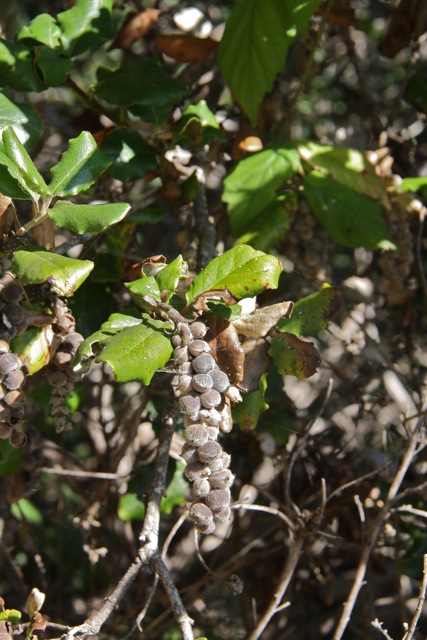
A strand of fuzzy beads dangles from what looks like a little live-oak tree. These are seeds that grew from the long flowers that bloomed last winter–the male and female flowers cascade in long decorative cascades when in bloom. This is a coast silktassle, or Garrya elliptica. The leaves are leathery and green, with rippled edges. It’s found growing near the coast in California and Oregon. Even though it superficially looks like an oak, the two groups aren’t at all closely related. The silktassle species are in the Garryaceae family, while oaks are in the Fabaceae.

Silktassle is also known as quinine bush, as early settlers used the bitter bark and leaves as a substitute for quinine. The berries were also used to make a grey or black dye. But besides these few tidbits, there is very little information about the medicinal uses of this interesting tree.

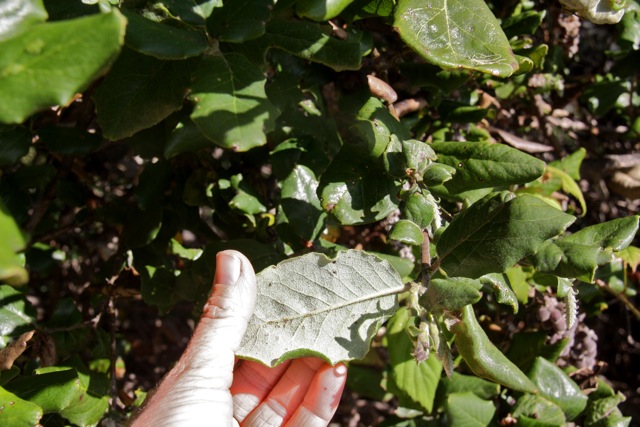
Look for wavy, inrolled leaf margins with a dense white fuzz on the underside of the leaf to tell this plant from other species of silktassle. It’s also the one most likely to be seen near the coast.

Leave a comment

Filed under Plant of the day