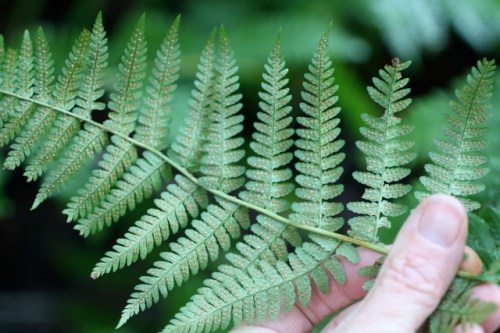
Monthly Archives: December 2012

Plant of the day: maidenhair fern

Adiantum_jordanii1A cascade of delicate fronds trickles down the side of a hill. This is California maidenhair fern (Adiantum jordanii), one of the most beautiful ferns around. It’s tiny round leaflets are suspended from a black, hair-thin stalk; the overall effect is reminiscent of a mobile designed by Calder.

This native fern can be found growing in damp, shady places throughout most of California and into Oregon.

Leave a comment

Filed under Good for gardens, Native, Plant of the day

Plant of the day: sword fern

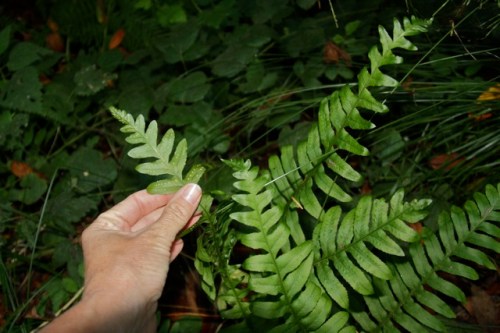
The deep green leaves of sword fern (Polystichum munitum) are leathery yet graceful–and they are indeed shaped like swords. The lance-shaped leaves are made of  smaller leaflets also shaped like a pointed blade.  At the base of each of these pinnae, a thumb (or, hilt?) shaped lobe points toward the tip of the leaf.

This slideshow requires JavaScript.

Sword fern is a ubiquitous denizen of the woods from Alaska to California. It can grow singly or in dense stands; in forest, brush, or on open hillsides. Historically it had many uses among the western tribes–from food to mattresses to poultices to good luck charms for fishing and childbirth. They were used to line cooking pits, as placemats, and as flooring.

Leave a comment

Filed under Good for gardens, Native, Plant of the day

Plant of the day: gorse

I spotted these mounded, dark green bushes covered with yellow flowers as I drove north on Highway One.

This slideshow requires JavaScript.

This is gorse (Ulex europaeus), a nasty invasive with yellow pea-like flowers and unpleasant spikes instead of leaves. It was introduced–perhaps deliberately–from western Europe, where I have heard that it was trimmed into hedgerows that made effective fences. Here, this invasive species is very hard to get rid of once it’s established–so if you see any getting started on your property, get rid of it right away.

Leave a comment

Filed under Invasive, Non-native, Plant of the day

Plant of the day: lady fern

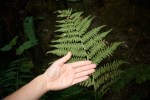
This sweet forest fern likes to grow in forests and streamsides. Lady fern (Athyrium felix-femina)  can grow fairly large; the lacy fronds are pale green and have a delicate texture, but can grow to more than 3 feet long. Each leaf is roughly diamond-shaped, with the largest leaflets in the middle, getting smaller towards both the top and the bottom. Unlike many ferns, lady fern doesn’t have a long bare stalk–the small lowest leaflets grow almost to the ground. As you can see in these photos, the leaflets are twice pinnate, and have crescent-shaped sori (or spore capsules) that grow close to the vein.

The root is edible, and was often eaten (roasted and peeled) by the Quileute tribe in the Pacific northwest. Woodsmen looked for it as a sign of nearby water. There are myriad medicinal uses recorded for this fern–particularly for feminine problems. Native Americans used it as a painkiller for labor, childbirth, and general body pains. Young fronds were eaten to treat cancer of the womb.

Leave a comment

Filed under Native, Plant of the day

“Plant” of the day: forest pinwheel

A row of mushrooms growing up the side of a dead tree seem to glow in the dim light of a rainy forest. Seen from below, their caps are nearly translucent, with the irregular branching gills standing out like spokes. As they age the caps may grow pink, and the stem may darken. With their delicate form, wavy gills, and off-center stem these are a particularly sculptural and lovely fungus.

This slideshow requires JavaScript.

There is no common name listed for Marasmiellus candidus, but I’ve always heard them called forest pinwheel. They grow on dead wood such as sticks, branches, berry canes and tree trunks–often near creeks. The thick, widely spaced gills are a distinctive feature of this small white mushroom.

Leave a comment

Filed under Native, Plant of the day

Plant of the day: California polypody

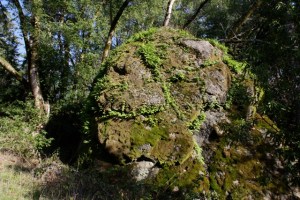
Polypodium_californicum2Small ferns trace patterns on the side of a house-sized boulder. This is California polypody (Polypodium californicum), which spreads by creeping rhizome. It can appear in small clusters, but it isn’t uncommon to find in dense patches carpeting cliffs, hillsides, and canyon walls. The pinnae of each frond are broad and seem to connect at the base, giving the leaf a distinctively chunkier look than most other ferns. California polypody looks a lot like its cousin, licorice fern, but its pinnae are generally rounded at the tips instead of being pointed (click here for a picture of licorice fern leaves).

An infusion made from the rhizomes was used by Native Americans to treat rheumatism, as an antibiotic and to wash sores and wounds. Unlike its anise-flavored cousin, California polypody is “bland or acrid” according to the Jepson manual. It grows from the central Coast ranges south into Mexico. Polypodium_californicum1

Leave a comment

Filed under Native, Plant of the day

Plant of the day: canyon live oak

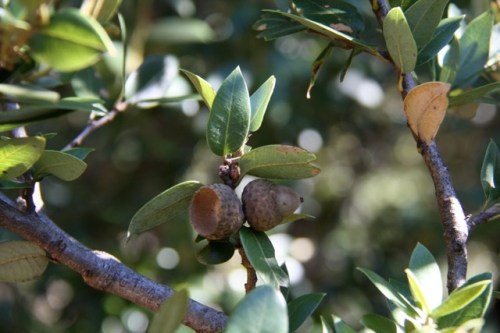
Quercus_chrysolepis1True to its name, canyon live oak (Quercus chrysolepis)  is often found clinging to ravine walls and steep hillsides. This beautiful and abundant tree is most easily identified by the golden-colored fuzz that coats the concave underside of young leaves–giving rise to one of it’s other common names, goldencup oak. In chaparral it can be low low and shrubby, but in more open country it grows into a graceful tree.

Canyon live oak has particularly hard wood for an oak, and its third common name is maul oak as it historically was used to make axles, tool handles, mauls, wagon tongues, plow beams, ship frames, and wheels. Wedges made from canyon live oak were used to split redwood into railroad ties. As with all oaks, its acorns were a favorite food of Native Americans. Once the bitter tannins had been leached out, it can be made into flour for cakes, breads and stews. In the southern coast range, it is a main habitat for spotted owls; myriad other species live in the oak forests, thriving on the abundant nourishment provided by the acorns. Reptiles and amphibians live in trunk cavities, birds nest among the branches, black-tailed deer browse on the leaves and mountain lions prowl through the underbrush.
Quercus_chrysolepis2

Leave a comment

Filed under Edible, Native, Plant of the day, Poisonous

“Plant” of the day: comb’s tooth fungus

Hericium_ramosum1Another dead oak tree and another fungal treasure. This one looks like a frozen waterfall or an ice palace. Stark white arms, dripping with tiny icicles, stand out against the dark backdrop of the log. This is comb’s tooth fungus (Hericium ramosum), a slightly uncommon find. It has two similar lookalikes in the area, but the somewhat larger conifer coral is found only on–you guessed it–conifers, while old man’s beard looks just like its name; a shaggy, unbranched mass that could readily be transferred to adorn a cartoon character’s chin.

One caveat: my mushroom guide is somewhat out of date, and I think that H. ramosum is now named H. corralloides, while the mushroom formerly known as H. corralloides is now H. americanum, which grows only in the east. But because most websites and identification guides still use the old name, I decided to go with the flow and not delve too deeply into this taxonomic tangle.

Leave a comment

Filed under Native, Plant of the day

“Plant” of the day: black witch’s butter

Exidia_glandulosa1

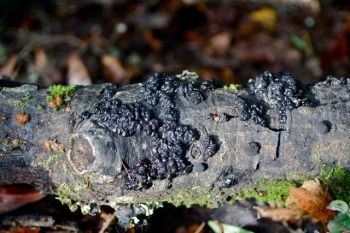
Haven’t gotten enough of the jelly fungi? Good! Meet BLACK witch’s butter, the jiggly cousin of the pumpkin-orange varieties. Exidia glandulosa is often overlooked–with its dark color, it easily blends in with the dead wood it grows on. Its preferred hosts are hardwoods such as oaks, but it can also be found on Monterey pine. In dry weather it can deflate, becoming dry and scale-like.

Leave a comment

Filed under Native, Plant of the day

Plant of the day: coastal wood fern

Dryopteris_arguta2A shin-high carpet of ferns covers the ground in the shaded understory of a redwood forest. The leaves are shaped like a narrow triangle and have a shaggy reddish hair along the lowest parts of their stems. This is coastal wood fern (Dryopteris arguta), a common sight throughout Marin.

One of the things you need to look at to identify ferns is the number of times each leaf is divided. Each stalk rising from the ground is a leaf; the smaller leaflets branching off the stalk are pinnae. If the leaf branches only once, it is once-pinnate. The leaves of coastal wood fern are 2-pinnate, meaning the smaller leaf also branches off the smaller central stalk (see the photo). The other species of Dryopteris in the area looks similar but can’t be confused with this one because its leaves are 3-pinnate.

Another common lookalike for coastal wood fern is lady fern; but instead of being roughly triangular, each lady fern leaf tapers so that the leaf outline is diamond-shaped. In other words, the lowest wood fern pinnae are among the longest. In lady fern, the pinnae that are nearest the ground are quite small (click here for a photo).

Other names for this plant are shield fern and California wood fern.

Dryopteris_arguta1

Leave a comment

Filed under Native, Plant of the day