Category Archives: Edible

Plant of the day: fat hen

One doesn’t usually think of a salt marsh as a colorful place. It’s pretty much all green plants and brown mud, right? WRONG. Especially at this time of year. The pickleweed is looking like a Christmas decoration, fat little stems of mottled red and green with the bright orange threads of dodder twining around it. As if this weren’t color enough, great swathes of pink have begun to emerge.

This slideshow requires JavaScript.

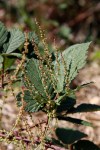
Look close and you’ll see sprawling stems with slightly fleshy triangular leaves. Small seeds are also turning rosy, each small and spiky like a tiny spaceship. This is fat hen, or Atriplex prostrata, a non-native weed has naturalized here from Eurasia. The leaves are said to be bland but edible, and the seeds are as well–if anyone cares to take the time to collect them.

Also known as spear-leaved orache, it can be found growing in salt marshes and weedy places throughout the country.

Random fact: it inhibits the growth of potatoes if the two happen to grow near one another.
Leave a comment

Filed under Edible, Non-native, Plant of the day

Plant of the day: sheep sorrel

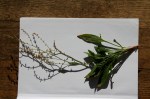
Almost all the year round you can see low green stalks studded with small red flower buds–a splash of color usually growing intermixed with grasses. This is common sheep sorrel, or Rumex acetosella, an invasive species that was introduced from Europe. It usually grows in weedy areas, and has a long bloom period from March all the way through November.

The tart leaves are edible, and taste like redwood sorrel or lemongrass. Try it in salad or steep the leaves for a tea. The acidy-lemon flavor comes from oxalic acid–small doses are fine, but eating a lot of it can lock up calcium and other nutrients in your body.

The root can be dried, ground and made into noodles but this seems like a lot of work and I’ve never heard of anyone actually doing it. The seeds are also edible, but they are so tiny that they also aren’t practical as anything other than a novelty.

Leave a comment

Filed under Edible, Invasive, Non-native, Plant of the day

Plant of the day: beaked hazelnut

Broad, fuzzy leaves are beginning to turn brown on this charming shrub of the understory. In a month or so, the branches will be bare skeletons, ready for the winter.

Beaked hazelnut (Corylus cornuta) is found across the country–except for the south. Around here you usually see it in moist forest understories, shaded canyons or streamsides. It has slim, sometimes drooping branches decked with light green, jagged-edged leaves. The flowers are monoecious, meaning that each flower is either male or female–but both sexes appear on a single plant. The female flowers look like tassels of small crimson threads; the male flowers are drooping pale catkins. But often this plant reproduces clonally, growing in dense clusters that are genetically identical.

Grouse, deer, rabbits, voles, and other critters use these shrubs for food and shelter. The tasty nuts have been compared to filberts, and commercial hazelnuts, and can be eaten raw or cooked. Native Americans wove the slim and flexible branches into baskets and baby carriers.

It’s the only hazelnut found in California.

Leave a comment

Filed under Edible, Good for gardens, Native, Plant of the day

Plant of the day: California white oak

The changing leaves of the oaks are another sign of the shift in seasons. Brown is quickly overtaking green, especially in the drier hills. Only the large, lobe-leaved oaks are deciduous–the species with small leathery foliage hang on to their leaves year-round.

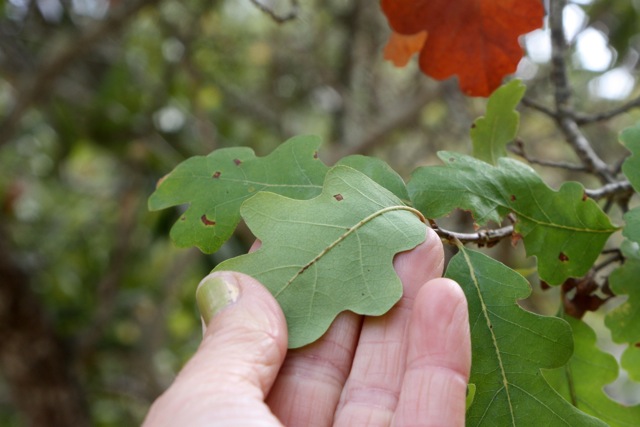
California white oak (Quercus lobata) has lobed leaves that are paler beneath and rich, shiny green above. Their acorns are slim, with a large cap-shaped cup that resembles a Rastafarian’s hat. They can be distinguished from their cousins that also have pale underbellies because blue oak has–wait for it–a blueish cast to the upper surface of the leaf. And Oregon oak has a furry coat on its underside (as well as plump, squat acorns). I use the memory-trick that Oregon oaks need such things to grow in the chilly north, whereas Californian oaks have no need for extra insulation.

Identifying oaks can be notoriously tricky, since they cross with one another easily and the results have a mixed blend of characteristics. I tend to stick with the Marin Flora and that keeps me happy. The California white oak pictured here, for example, has shallower lobes than the classic examples. But lobes aren’t an issue in the Marin Flora–so I can happily feel comfortable with my ID.

Note the pale underside of the leaf

Leave a comment

Filed under Edible, Native, Plant of the day

Plant of the day: pepperwood

Scrappy and graceful, the pepperwood (Umbellularia californica, or California bay laurel) is often overlooked and underappreciated, but it’s one of my favorite trees. It can take on all sorts of forms, from skinny trunks packed close together in the understory to stoic ancient giants. Near the coast they can become windswept, so an entire stand of trees melds together into a single undulating canopy of green. They host many other species–from birds and beetles to the moss and ferns that grow on their trunks. Pepperwood often are full of cavities where critters roost or nest, and if you climb them often–as I did as a kid–you quickly learn to check the crooks of the branches for racoon scat.

This slideshow requires JavaScript.

Right now the nuts of the pepperwood are beginning to ripen; inch-long orbs of green or purple or yellow peek out from among the leaves. In the early winter, tiny pale yellow flowers will begin to bloom. They are easy to miss, but worth looking for: each tiny blossom is an intricate display (see the photos above). I particularly love the decorative dots of pollen arranged on spatula-shaped stamens. The leaves are wonderful too, both to look at and eat: the distinctive peppery aroma adds a nice flavor to beans or tomato sauce.

Recently pepperwood has gotten a bad rap because it’s a vector for sudden oak death but doesn’t die from it. Some people advocate cutting down pepperwoods to protect their oaks. Perhaps this method might slow the spread of the disease–but it won’t stop it. Personally I’d rather keep the mature pepperwoods around then have to start a forest over from scratch.

I should note that pepperwood is the less-used name for this tree; but personally I think it’s much better than the staid and unevocative bay laurel. I also like the heritage of the word–it’s what my grandfather always called it, and those who use it nowadays tend to be old-time Californians. A tribe I’m happy to be in.


Leave a comment

Filed under Edible, Good for gardens, Native, Plant of the day

Plant of the day: curly dock

Dock is a striking roadside sight, especially now as it is in fruit or beginning to die. The tall stalks of red or dark brown stand out in bold contrast to the dry grasses they often grow in. Curly dock likes to grow in damp areas that have standing water in the winter.

I had a lot of trouble telling curly dock (Rumex crispus) from Western dock (Rumex occidentalis) using my key. But I am now pretty sure that I’ve figured out a good seat-of-the-pants way to tell them apart: look at the tiny fan-like fruit. Curly dock, shown here, has a little nub at the center of every one–sort of like a baseball lodged in a mitt (see the photo above). Western dock looks more like a reddish leaf with a thickened vein at the center.

Young leaves are edible in small quantities, and have high levels of oxalic acid which give it a lemony flavor (like redwood sorrel). Eating it may aggravate people with rheumatism, arthritis, gout, or kidney stones so be careful! It also can be used as a gentle laxative.

Leave a comment

Filed under Edible, Invasive, Medicinal, Non-native, Plant of the day

Plant of the day: nasturtium

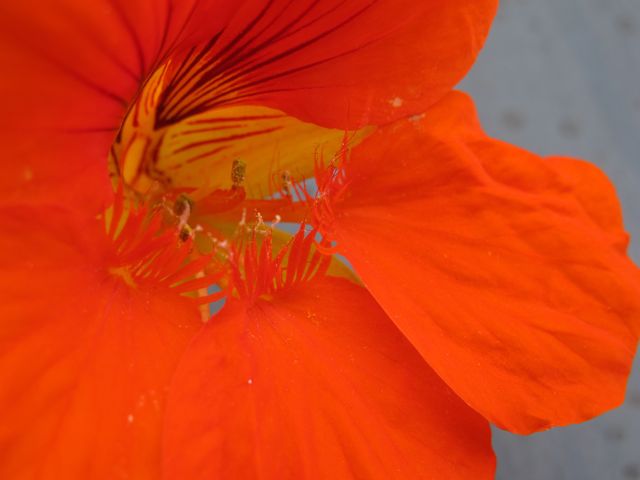
These brilliant orange flowers are so brightly colored they can almost seem to glow. Nasturtium (Tropaeolum majus) is a garden plant that can sometimes escape into nearby forest–usually near the coast. It’s never seen growing far from human habitation.

The flowers are large, edible and very beautiful. They range in color from buttery yellow to pale orange, and the upper petals often have dark stripes that run into the throat of the blossom. The three lower petals are dramatically fringed at the entry to the throat. Each flower has five pale sepals. The upper several sepals are fused into a long spur that extends backwards behind the bloom like a gnome’s cap.

When they are happy, nasturtium plants can grow into dense mats, sprawling across the ground and climbing up fences, buildings and other plants. Fortunately they don’t appear to take over large areas, so gardeners don’t have to feel too guilty about planting this potential invasive.

All parts of the plant are edible, and they have a sweet, spicy flavor that is somewhat like arugula. The seed pods are even spicier–some people harvest them young to use like capers, and others dry the mature seeds and grind them like pepper. I love to nibble the flowers raw or add them to salads. In the Andes, the nasturtium’s native range, they were used medicinally to disinfect and heal wounds, and to treat chest congestion. It is described as having properties that are antibacterial, antifungal, antibiotic and possibly even anti cancer.

Leave a comment

Filed under Edible, Non-native, Plant of the day

Plant of the day: California rose

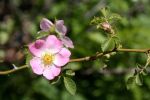
This wild rose is a favorite sight in spring and summer, as pink blossoms give way to ripe red fruit. This is the California rose (or as it is conversely known in Latin, Rosa californica), which grows in nearly every county in California, as well as in parts of Oregon.

This hardy shrub can look scraggly, but also can be groomed into a good garden plant, with pale green leaves and colorful fruit and flowers. It grows to 8 feet tall but is usually smaller. The tangle of thorny branches make excellent shelter for birds, and I’ve spotted many a nest by peering into a wild rose bush.

Rose hips are a renowned source of Vitamin C, and you can make an immune-boosting tea just by pouring boiling water over the red fruit. The hips can also be eaten fresh, though the inner bit is unappetizing, filled with seeds and strange stiff hairs. But the thin outer layer of flesh is tasty–I usually eat it by splitting the fruit open with a fingernail and scraping out the seeds. But this is labor intensive, and rose hips were never a significant food source for Native Americans. There was some medicinal use, though. A tea of wild rose hips was used to treat fever, sore throats and stomach aches–as well as to wash sores and sooth the pain of babies.

There are several different kinds of wild roses in California, and they all look fairly similar. The California rose (according to the Marin Flora) has the brown remains of its sepals at the tip of its ripe hips, and also tiny hairs visible on the stems of its leaves. It grows in full sun and partial shade, and in both wet and dry areas.

Leave a comment

Filed under Edible, Good for gardens, Medicinal, Plant of the day

Plant of the day: redwood sorrel

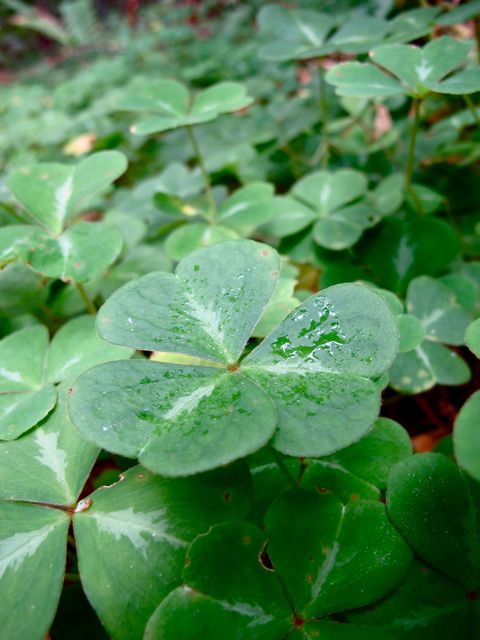
Deep under the shade of the redwood trees is a brilliant swathe of green. A field of tiny three-leaved plants carpet the forest floor. This is redwood sorrel, or Oxalis oregana. Each heart-shaped leaf has a pale splotch along its midrib, as though it had been folded around a dab of light green paint in a kindergarten art class.

When I was a kid, this little plant was a favorite treat. It’s edible and easy to spot, so I would eat it all the time. The leaves have a fresh, lightly bitter flavor like a mild lemon. You can add them to salad or other foods, and since they love to grow in shade they are a nice addition to a garden that doesn’t get full sunlight. In late spring they sprout an attractive, pale-pink flower.

An interesting list of historical uses is described on the Native American Ethnobotany Database: chewed redwood sorrel roots were applied to sore eyes. It was given to anyone who didn’t feel like eating, and used as a wash to treat rheumatism. Poultices were applied to boils, sores and infections. Leaves were eaten raw, cooked with grease, or with dried fish. One source says the stems could also be used to make a rhubarb-like pie–but wow, that would need a LOT of stems.Oxalis_oregana

Leave a comment

Filed under Edible, Good for gardens, Native, Plant of the day

Plant of the day: toyon

Heteromeles arbutifolia

Small, dark green trees with clusters of white flowers are scattered here and there across the hillsides. This is toyon (Heteromeles arbutifolia). It will truly come into its own in a few months, when clusters of brilliant red berries begin to ripen. Toyon is also called “christmas berry” for these cheerful December fruit, which once were sold as a local substitute for similarly colored holly sprigs.

Don’t get any ideas about collecting your own–it’s now illegal to harvest wild toyon. This species is often a part of the scrubby chaparral community, but you can also see it in oak woodlands and other forests and shrublands across the state. The berries are described as having a “sweet and spicy” flavor, and a tea made from the leaves was used for irregular menses, aches, pains, stomachaches, and to wash wounds. Californians once ate the fruit regularly–roasted, toasted and fresh. Spanish settlers made a drink from the bark, and Channel Island fishermen used it to tan their fishing lines.

Leave a comment

Filed under Edible, Medicinal, Native, Plant of the day