Category Archives: Good for gardens

Plant of the day: California fuchsia

It’s a treat to see a whole cliff-full of flowers blooming at this time of year–but that’s just what I found on Mt. Tam the other day. California fuchsia (Epilobium canum) is a late bloomer that you can see in scattered spots throughout the bay area.

Hummingbirds pollinate this flower, attracted by the scarlet, trumpet-shaped blooms. Other common names include hummingbird flower or hummingbird trumpet. It sports these flowers at the end of long stalks densely covered with small, slightly wooly leaves. This perennial plant can be woody at the base (the technical term for this is suffrutescent) but it is usually fairly low growing, with several sprawling stems that are around one foot long. California fuchsia is in the Onagraceae family along with other showy blooms like fireweed, clarkia, and evening primrose.

I saw it growing on a hot, southwest-facing road cut as Pantoll climbs up towards Rock Springs.


Leave a comment

Filed under Good for gardens, Native, Plant of the day

Plant of the day: Oregon ash

Oregon ash is a stately tree of the riverbanks. It grows tall and upright, creating an umbrella of sweeping branches and bright green leaves. In the late summer the female plants become heavily decorated with winged seed-pods called samaras–these trees are dioecious, meaning each plant is either male or female (instead of both, as most plants are).

This slideshow requires JavaScript.

Right now, the seeds are ripening as the leaves are yellowing and beginning to fall.

The range of Oregon ash (Fraxinus latifolia) is from British Columbia to Riverside County near LA, in a belt along the coast. Look for pinnate leaves, where each “leaf” is composed of five to nine large, paired leaflets. The photos here were taken in Cascade Canyon of Fairfax, and also on the Marin Municipal Water District.

Leave a comment

Filed under Good for gardens, Native, Plant of the day

Plant of the day: beaked hazelnut

Broad, fuzzy leaves are beginning to turn brown on this charming shrub of the understory. In a month or so, the branches will be bare skeletons, ready for the winter.

Beaked hazelnut (Corylus cornuta) is found across the country–except for the south. Around here you usually see it in moist forest understories, shaded canyons or streamsides. It has slim, sometimes drooping branches decked with light green, jagged-edged leaves. The flowers are monoecious, meaning that each flower is either male or female–but both sexes appear on a single plant. The female flowers look like tassels of small crimson threads; the male flowers are drooping pale catkins. But often this plant reproduces clonally, growing in dense clusters that are genetically identical.

Grouse, deer, rabbits, voles, and other critters use these shrubs for food and shelter. The tasty nuts have been compared to filberts, and commercial hazelnuts, and can be eaten raw or cooked. Native Americans wove the slim and flexible branches into baskets and baby carriers.

It’s the only hazelnut found in California.

Leave a comment

Filed under Edible, Good for gardens, Native, Plant of the day

Plant of the day: pepperwood

Scrappy and graceful, the pepperwood (Umbellularia californica, or California bay laurel) is often overlooked and underappreciated, but it’s one of my favorite trees. It can take on all sorts of forms, from skinny trunks packed close together in the understory to stoic ancient giants. Near the coast they can become windswept, so an entire stand of trees melds together into a single undulating canopy of green. They host many other species–from birds and beetles to the moss and ferns that grow on their trunks. Pepperwood often are full of cavities where critters roost or nest, and if you climb them often–as I did as a kid–you quickly learn to check the crooks of the branches for racoon scat.

This slideshow requires JavaScript.

Right now the nuts of the pepperwood are beginning to ripen; inch-long orbs of green or purple or yellow peek out from among the leaves. In the early winter, tiny pale yellow flowers will begin to bloom. They are easy to miss, but worth looking for: each tiny blossom is an intricate display (see the photos above). I particularly love the decorative dots of pollen arranged on spatula-shaped stamens. The leaves are wonderful too, both to look at and eat: the distinctive peppery aroma adds a nice flavor to beans or tomato sauce.

Recently pepperwood has gotten a bad rap because it’s a vector for sudden oak death but doesn’t die from it. Some people advocate cutting down pepperwoods to protect their oaks. Perhaps this method might slow the spread of the disease–but it won’t stop it. Personally I’d rather keep the mature pepperwoods around then have to start a forest over from scratch.

I should note that pepperwood is the less-used name for this tree; but personally I think it’s much better than the staid and unevocative bay laurel. I also like the heritage of the word–it’s what my grandfather always called it, and those who use it nowadays tend to be old-time Californians. A tribe I’m happy to be in.


Leave a comment

Filed under Edible, Good for gardens, Native, Plant of the day

Plant of the day: madrone

The bright red-orange berries of madrone trees are ripening, giving hillsides and forest canopies a crimson tint. This tree is a stunning sight at any time of year, with large dark-green leaves, crooked trunks and smooth, rust-colored bark. But right now the madrones are particularly gorgeous as they add their brilliant berries into the mix. And there are a lot of them! Each tree is decked with so much fruit that it takes on a reddish glow. 

This slideshow requires JavaScript.

Look for madrone (Arbutus menziesii) as one of the many species growing in mixed hardwood and conifer forests. You can see them even while driving: look for bursts of red scattered across the dark green wallpaper of a forested hillside. It often is found growing along with Doug fir, tanoak and other oaks–usually on well-drained, rocky soils.

Madrone berries are edible, and were used widely by Native American tribes such as the Miwok and the Salinan. The fruits were eaten raw–but in small quantities. Sometimes they were chewed for flavor, but not swallowed. They were more often eaten cooked or dried, or made into unfermented cider (water used to make the cider was boiled by adding hot rocks to a watertight basket, and stirring them so they wouldn’t burn through).

Berries were also made into necklaces, and used for bait in fishing. The leaves were chewed to treat stomachache and cramps, or used to make a wash for poison oak.

1 Comment

Filed under Good for gardens, Native, Plant of the day

Plant of the day: bigleaf maple

The subtle colors of California fall are washing across the landscape. The scattered patches of yellow you see starting to show up in the forest are probably bigleaf maple, or Acer macrophyllum. This native tree drops its  leaves in the fall, and it is one of the few species around here that turns yellow before it turns brown.

This slideshow requires JavaScript.

Bigleaf maple is found along the west coast from central California to the Alaska panhandle. The sap can be made into maple syrup–but this isn’t done often since the yield is lower than from the eastern sugar maple. The timber is harvested commercially. The largest known bigleaf maple is eight feet in diameter.

This tall tree drops piles of soft leaves, and is used for wildlife habitat year-round. Bugs live in its furrowed bark, and birds (including harlequin duck and pileated woodpecker, where they occur) sometimes nest in the bigleaf maple–as does the dusky footed woodrat. Deer forage and bed down in the understory of the mixed forest that this tree generally grows in.

Leave a comment

Filed under Good for gardens, Native, Plant of the day

Plant of the day: San Francisco gum plant

Its easy to tell if you’re looking at a gum plant. All the different species have big yellow daisy-like flowers perched atop a green nub that is studded with fleshy hooks. Before the young buds bloom they ooze a white sap that looks exactly like fresh Elmer’s glue.

San Francisco gum plant (Grindelia hirsutula var. maritima) only grows near the coast, on hills and bluffs from Marin to Monterey. I spotted these specimens on a recent hike to Chimney Rock on Point Reyes. Distinguish this plant from its cousin, coastal gumplant, because it grows on the hills instead of the salt marshes–but mainly because it doesn’t have perennial woody stems. San Francisco gum plant can vary dramatically in size, from 8 inches to nearly 5 feet. The plants I saw had hairy leaves, but according to the Marin Flora the leaves are usually hairless (aka “glabrous” in botany-speak).

Surprisingly, the Elmer’s glue doesn’t seem to have had any historical uses (that I’ve been able to unearth). But the dried leaves and buds were used to treat bronchial conditions including asthma.

Though there are three different species listed in the Marin Flora, it’s worth noting that some experts think that they all are actually part of the same species, Grindelia hirsutula.

Leave a comment

Filed under Good for gardens, Medicinal, Native, Plant of the day

Plant of the day: seaside daisy

This pretty purple daisy prefers excellent views. It grows along the coast, often clinging to rocky cliffs or sunbathing on sandy beaches. I photographed the ones shown here on the Point Reyes Peninsula, growing on the top of Arch Rock–a lovely vantage point looking down on the long stretch of coast to the north and south.

Seaside daisy (Erigeron glaucus) has rounded, grayish green leaves that are soft to the touch. The flowers heads are purple, ranging towards white or pink, with a yellow center. It’s native to California and Oregon, and it’s often seen in rock gardens as well as in the wild. Other names include beach daisy and seaside fleabane.

3 Comments

Filed under Good for gardens, Native, Plant of the day

Plant of the day: California rose

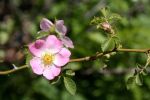
This wild rose is a favorite sight in spring and summer, as pink blossoms give way to ripe red fruit. This is the California rose (or as it is conversely known in Latin, Rosa californica), which grows in nearly every county in California, as well as in parts of Oregon.

This hardy shrub can look scraggly, but also can be groomed into a good garden plant, with pale green leaves and colorful fruit and flowers. It grows to 8 feet tall but is usually smaller. The tangle of thorny branches make excellent shelter for birds, and I’ve spotted many a nest by peering into a wild rose bush.

Rose hips are a renowned source of Vitamin C, and you can make an immune-boosting tea just by pouring boiling water over the red fruit. The hips can also be eaten fresh, though the inner bit is unappetizing, filled with seeds and strange stiff hairs. But the thin outer layer of flesh is tasty–I usually eat it by splitting the fruit open with a fingernail and scraping out the seeds. But this is labor intensive, and rose hips were never a significant food source for Native Americans. There was some medicinal use, though. A tea of wild rose hips was used to treat fever, sore throats and stomach aches–as well as to wash sores and sooth the pain of babies.

There are several different kinds of wild roses in California, and they all look fairly similar. The California rose (according to the Marin Flora) has the brown remains of its sepals at the tip of its ripe hips, and also tiny hairs visible on the stems of its leaves. It grows in full sun and partial shade, and in both wet and dry areas.

Leave a comment

Filed under Edible, Good for gardens, Medicinal, Plant of the day

Plant of the day: redwood sorrel

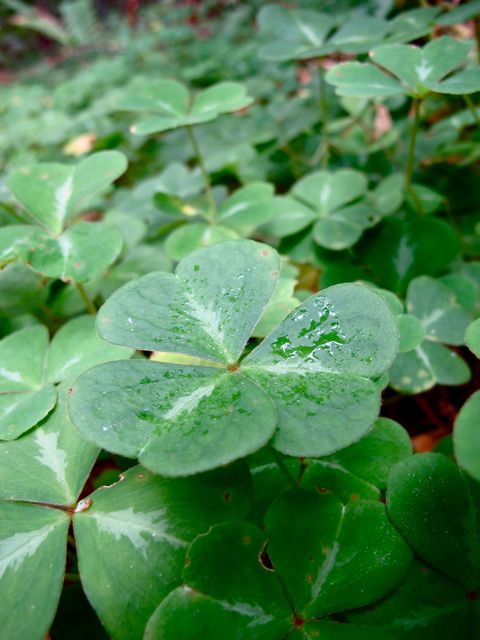
Deep under the shade of the redwood trees is a brilliant swathe of green. A field of tiny three-leaved plants carpet the forest floor. This is redwood sorrel, or Oxalis oregana. Each heart-shaped leaf has a pale splotch along its midrib, as though it had been folded around a dab of light green paint in a kindergarten art class.

When I was a kid, this little plant was a favorite treat. It’s edible and easy to spot, so I would eat it all the time. The leaves have a fresh, lightly bitter flavor like a mild lemon. You can add them to salad or other foods, and since they love to grow in shade they are a nice addition to a garden that doesn’t get full sunlight. In late spring they sprout an attractive, pale-pink flower.

An interesting list of historical uses is described on the Native American Ethnobotany Database: chewed redwood sorrel roots were applied to sore eyes. It was given to anyone who didn’t feel like eating, and used as a wash to treat rheumatism. Poultices were applied to boils, sores and infections. Leaves were eaten raw, cooked with grease, or with dried fish. One source says the stems could also be used to make a rhubarb-like pie–but wow, that would need a LOT of stems.Oxalis_oregana

Leave a comment

Filed under Edible, Good for gardens, Native, Plant of the day