Category Archives: Good for gardens

Plant of the day: thimbleberry

Berry season is upon us! Thimbleberries are a great trailside treat – the red berries are so delicate that picking a large quantity can be hard. But that delicacy is also what makes them so fun to eat. To me they taste like a little dollop of jam, served up right there on the bush. The fruit just dissolves in your mouth like it was already cooked.

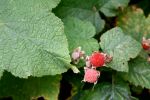
Thimbleberries are distinguished by their large, soft, maple-shaped leaves. In the spring they sport large white flowers: many stamens gather around a yellow center. By early summer their bright red raspberry-like fruits have begun to ripen. You can find them in most parts of California, from the Sierras to the sea, and also across much of North America.

Thimbleberries (Rubus parviflorus) are in the Rosaceae family, and are closely related to blackberries, raspberries and salmonberries – all of which are in the Rubus genus as well. What a tasty clan!

Leave a comment

Filed under Edible, Good for gardens, Native, Plant of the day

Plant of the day: harvest brodiaea

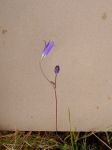
Here is one of the leggy purple flowers of the grasslands. The funnel-shaped blossom sprawls open as it ages, revealing three pale spatula-like staminoides.  The narrow stalk is leafless, and branches into a loose umbel of a few flowers.

Harvest brodiaea (Brodiaea elegans) is one of only two brodiaeas in Marin, but there are several others in the greater bay area – e.g. California brodiaea, Hoover’s brodiaea, and crown brodiaea. Dwarf brodiaea is the other kind that grows in Marin.

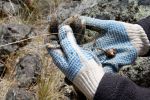
In the dormant season, this perennial flower dies back to an underground corm, which is the bulb-like structure pictured above (I say bulb-like because a bulb is actually made of modified leaves, like an onion, whereas a corm is solid all the way through. And as long as I’m getting technical, I may as well point out that a corm is not a root. It’s a modified bit of the plant’s stem that serves to store food and help it survive the winter. The actual roots branch off from the bottom of the corm.)

Leave a comment

Filed under Good for gardens, Native, Plant of the day

Plant of the day: huckleberry

Vaccinium ovatum

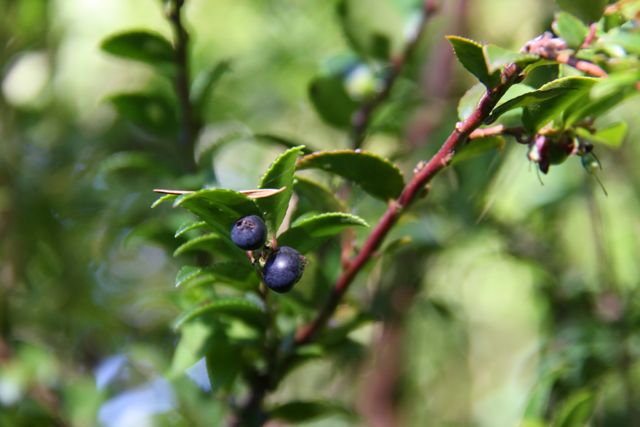
One of my favorite Fourth of July memories is eating my great-aunt Martha’s huckleberry pie when I was a kid. We’d gather at the family campground by a little river, and eat California delicacies like abalone, venison, and this wonderful pie. Huckleberries are a wild-tasting fruit, tart but sweet. They taste of pine forest and long days with picking buckets. The little fruits hold their texture even when cooked, they  pop in your mouth with a satisfying burst: perfect when blended with sugar and a flaky crust.

Huckleberries (Vaccinium ovatum) grow all along the west coast – from Canada to Alaska – but not many people cook with them often since they are so small that picking enough for a pie takes a long time. Look for them  in forests and clearings, often on slopes. The shrubs are attractive, with dense shiny foliage of small oval leaves. White lantern-shaped flowers give rise to small, round, dark purple fruit that looks like a small blueberry.

2 Comments

Filed under Edible, Good for gardens, Native, Plant of the day

Plant of the day: oceanspray

This graceful shrub has soft scalloped leaves and creamy white sprays of flowers. It is happily in bloom right now, and a fun one for drive-by botanizing since it thrives on roadside banks. Usually oceanspray (or cream bush, aka Holodiscus discolor) is a medium-sized shrub, but on exposed hills it can become a low-growing mat, according to the Marin Flora.

This is a good one for gardens since it can grow in a wide range of soils from wetlands to dry and well-drained. The beautiful flowers with their many long stamens are typical of its family, the Rosaceae or rose family. This big clan contains a wide spectrum of species from cherries and plums to roses to silverweed. It’s one of the biggest plant families there is.

Leave a comment

Filed under Good for gardens, Native, Plant of the day

Plant of the day: pink honeysuckle

A bough of pink flowers droops down at me from the nearby tree. But I’m not looking at a blooming branch; the narrow, twining stem is tough but not woody enough to stand this high on its own. Here is a vine of pink honeysuckle, or Lonicera hispidula. The whorled cluster of flowers perches at the end of the vine, right at eye-height. They don’t always grow this way (I’ve seen them at ankle level alongside trails) but I got lucky this time with an easy view of the pretty flowers.

This slideshow requires JavaScript.

The upper petal is a soft, rosy pink and is dramatically rolled back. Five stamens are on prominent display, waiting for a passing bumble bee or hummingbird. Each stamen is T-shaped, with the brown bar of the anther dusted in pollen and delicately balanced on the greenish-yellow filament. This vine is often recommended for native plant gardens because it is so attractive to birds. Hummers love the sweet nectar, and other birds feast on the berries.

Honeysuckle is easy to recognize even when it isn’t blooming because the pattern of leaves is distinctive. The oval leaves are paired, and often fuse together into a disc around the stem when they are young. More mature leaves are separate, but often have a small leaflet at their base that is fused to the stem.

Leave a comment

Filed under Good for gardens, Native, Plant of the day

Plant of the day: sneezeweed

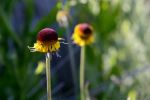
A brown golf ball is dressed in a short yellow skirt. Well not really, but that’s what this funny flower looks like: a big round ball, fringed at its very lower edge with dangling petals. I found this patch of Helenium puberulum perched alongside Highway One just south of Stinson Beach.

There are several different kinds of sneezeweed (a.k.a. Helenium) and they all look like variations on this theme.  The “classic” sneezeweed shown here has many flowers per plant, noticeably short petals – they almost look like an afterthought! – and leaves that attach to the stem (the botanical term is decurrent). This combination of traits lets you know you’re looking at plain ‘ol sneezeweed instead of Bigelow’s sneezeweed or yellow sneezeweed. Actually as far as I can tell you don’t even need to look at the leaves or number of flowers – the other sneezeweeds both seem to have larger petals. But it’s always good to ID a plant using more than one feature, since individuals of the same species can show a LOT of variation in its shape, color, size and so on.

The sneezeweeds are in the enormous Asteraceae family, and if you look close you’ll see that the brown ball is made up of hundreds of individual “disc” flowers, and the yellow skirt is the showier “ray” petals.

Leave a comment

Filed under Good for gardens, Native, Plant of the day

Plant of the day: buckeye

It’s buckeye season – one of my favorite stages of spring. These spreading trees with their tall, pinkish-white spires of flowers can be seen along roadsides, streamsides, in mixed woodlands and even at the edge of pebbly beaches on Tomales Bay. I’ve seen Aesculus californica growing so close to the water that the lower branches were draped with streamers of dried eelgrass.

This slideshow requires JavaScript.

This lovely tree is unique to California, and can be found across much of the state. It has loads of character, with knobby, gnarled trunks and wide palmately compound leaves. It leafs out during the winter, offering cool shade on hot days into the early summer, and then it goes dormant. In the fall it drops beautiful shiny chestnut-colored nuts (ok, actually they are “capsules” since the hard exterior contains several seeds). I like to gather them and use them for decoration. But don’t eat any! They are toxic, known to depress the nervous system, cause abortions in cattle and be toxic to bees. Native Americans would use extract of the seed topically (for hermerrhoids?!). In tough times the seeds were sometimes eaten (after careful preparation to leach the poison out). Buckeye also provided food in a different way: pouring a ground-up powder of the seed into a stream would stupify fish for easier catching!

Leave a comment

Filed under Good for gardens, Medicinal, Native, Plant of the day, Poisonous

Plant of the day: Douglas iris

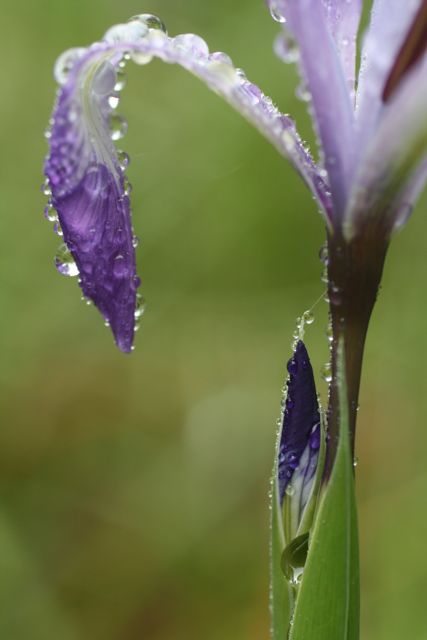
The wild irises of California are a spring delight. You can see them in forest clearings and meadows, sometimes in great green and purple masses. Other times one plant will appear singly, a burst of color against the browns of an understory. With their many variations in color and decoration they are a never-ending visual treat ranging from dark purple to pale yellow.

This slideshow requires JavaScript.

The three largest, lower petals can look like a cross between a watercolor and a stained-glass window, with dark veins blocking out yellows, whites and purples – but with the color fading gently towards the edge of the petal. Above it is what appears to be a paler, less gaudy petal (it’s actually part of the pistil). Sandwiched between the two is the dark purple tongue of the stamen, dusted underneath with pollen, and invisible unless you pry the flower open or look very close. Often you’ll see bees rummaging around and coming out with their legs laden with pollen.

Douglas iris (Iris douglasiana) is the most common wild iris species, but coast iris (Iris longipetala) and ground iris (Iris macrosiphon) are also somewhat common. And keying them is a trick!! Every book or expert gives different suggestions about how to distinguish one from another. The Marin Flora says you can identify a Douglas iris if the pollen is yellow and the surface of the leaf is shinier than the underside and the long purple tube below the flower (the perianth tube) is about 2 centimeters long. But the Flora of Sonoma County suggests two ways to ID the Douglas. First  is if the leaf bases (but not the entire plant!) is reddish. Second is if the perianth tube is less than 3 centimeters long. So take your pick! Once I get a confident ID on another species I’ll post about those as well.

1 Comment

Filed under Good for gardens, Native, Plant of the day

Plant of the day: two eyed violet

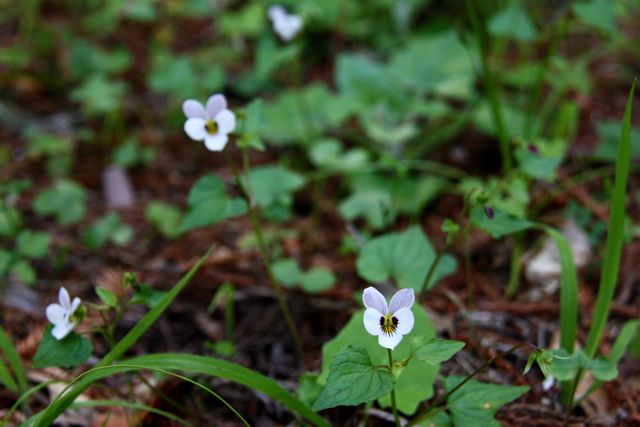
There’s not much that is prettier than a glade filled with violets. They are tougher than they look – two eyed violets like serpentine soil, as well as grassy meadows or rocky hillsides. I saw the ones pictured here growing on the edge of a redwood forest, under some pepperwood trees. Two eyed violets (Viola ocellata) are distinctively named, as they can be distinguished from all other local violets by the two purple spots on their lateral petals. According to the Marin Flora, there is only one other purple violet in the area, and it lacks the paired spots. All the other violets around are yellow.

These little beauties are endemic to the north-western parts of California, and even though they look like a fragile annual they are actually perennials!

Leave a comment

Filed under Good for gardens, Native, Plant of the day

Plant of the day: crimson columbine

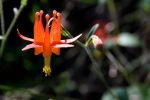
Crimson columbine is a bizarre confection of a flower. With its bright red turrets and awnings, and a dangling bouquet of long yellow stamens, Aquilegia formosa is one of the most sculptural flowers around. It looks like it was designed by Frank Lloyd Wright just to grow in the gardens of the Marin Civic Center – though it doesn’t, as far as I know. Believe it or not, this extravagant bloom is in the same family (Ranunculaceae) as the simple buttercup!

These columbine prefer moist spots and stream banks, where you can find their flaming blossoms high above an airy nest of deeply lobed leaves. In general, the plants grow one to three feet tall, and they are found in all the western states. I saw the beauties photographed here on the Concrete Pipe Trail on the Marin Municipal Water District lands. This is an unpaved access road with a steep bank running along one side for much of its length, and it’s a great spot for seeing a diverse collection of spring flowers.

2 Comments

Filed under Good for gardens, Native, Plant of the day