Category Archives: Good for gardens

Plant of the day: common woodland star

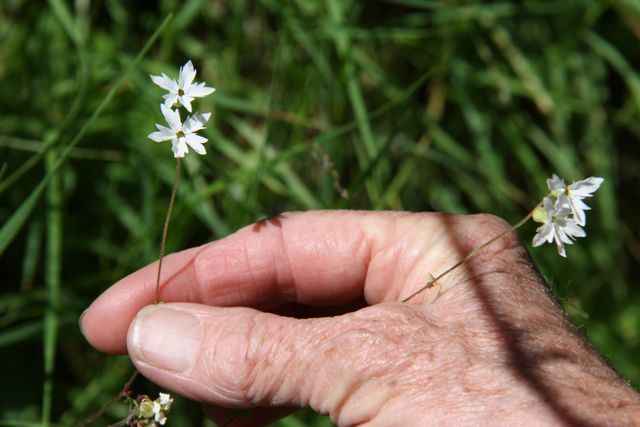
This delicate flower boasts five raggedy white petals on a long bare stem. Common woodland star (Lithophragma affine) is a member of the Saxifragaeae family, as was yesterdays post.  The woodland star is a little more “typical” of the family, with its elegant white flowers and long, mostly leafless stem. But because of its tendency to sprawl rather than grow upright, I wasn’t sure if my hunch that it was a saxifrage was right until I looked it up. It also lacks the multiplicity of obvious stamens mentioned in the previous post.

There is another very similar species in Marin – the hillside woodland star (Lithophragma heterophyllum). You can most easily distinguish the two because the hillside woodland star has a tendency to sprout little bulbs, or “bulblets,” in the joint where the leaf meets the stem. Also if you look at the back of the flower (the “hypanthium,” you can see that the common woodland star joins the stem gradually whereas hillside woodland star flattens off dramatically at the back, so the stem attaches on to a nearly flat surface like a pencil set on the middle of a plate.

Leave a comment

Filed under Good for gardens, Native, Plant of the day

Plant of the day: woodland strawberry

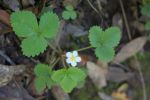
A happy sight for many a hiker, our native strawberry peeks from the edges of shrubs and woodlands. Not as tasty or as luscious as a storebought berry, this tiny fruit is better recognized for its good looks. Pretty white flowers with yellow centers are accented by a few dark green, serrated leaves. As spring moves into summer, the flowers give way to fruit, which are quickly nibbled by insects, rodents and other critters.

Fragaria vesca can be found across most of California. Marin is also home to the beach strawberry, that grows close to the coast – mostly in sandy places. In the northern and eastern parts of the state you also might see the very similar Fragaria virginiana, or mountain strawberry. And if the plant has yellow blooms instead of white, you may be looking at a non-native mock strawberry. This looks very similar to Fragaria species, but is actually in an entirely different genus!


Leave a comment

Filed under Edible, Good for gardens, Native, Plant of the day

Plant of the day: sticky monkey flower

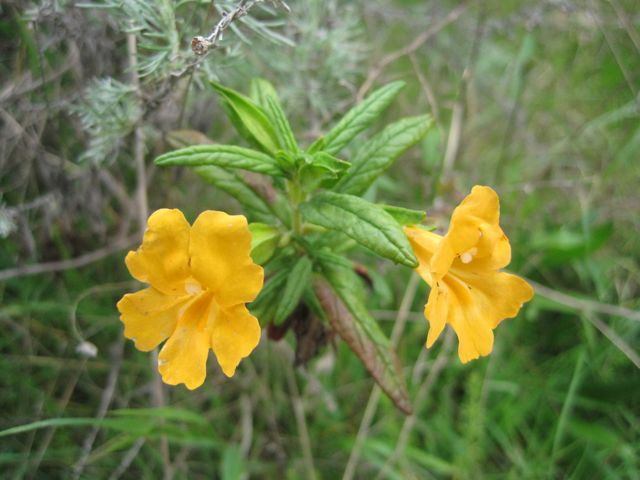
Have you seen those pale orange flowered bushes that are common in the hills of Marin? Yes, the ones with the dark green and the tubular flowers with a flaring rim like a musical instrument. This is Mimulus aurantiacus (aka bush monkey flower or sticky monkey flower). You won’t find it in the Peterson guide, since it’s technically a bush not a wildflower – but the blooms are pretty and if you pick it for a bouquet you’ll learn where it got its name from when your hands come away sticky. It likes to grow in brushy areas and chaparral, flat places and narrow steep ravines.

Leave a comment

Filed under Good for gardens, Native, Plant of the day

Plant of the day: western star flower

These “woodland stars” twinkle along forested trailsides in the springtime. They are like a high-end graphic designer’s version of a flower, with their many delicately pointed pale pink petals and curving yellow-tipped stamen. The blossom is usually displayed singly, rising from the center of a ring of spring-green leaves. Trientalis latifolia is the only one of its kind found in Marin, and usually grows under redwoods or other evergreens. Though it often can be found in wetlands and moist hillsides it can also thrive in drier spots.

This slideshow requires JavaScript.

2 Comments

Filed under Good for gardens, Native, Plant of the day

Plant of the day: blue eyed grass

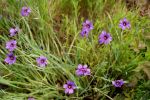
Sisyrinchium bellum, and isn’t it just? Bellum, that is. Or bellisima. On just about every springtime walk you take in Marin you’ll see these striking dark blue/purple flowers so they are a good one to know. Blue eyed grass are almost always blue, though once, last year, I found a pale morph (photo included below). Though they have five regular petals, they are in the iridaceae family along with iris. I see the similarity most in the way the uppermost leaves form a crisscrossing sheath (or “spathe valve“?) around the bottom of the flower.

Leave a comment

Filed under Good for gardens, Native, Plant of the day