Category Archives: Invasive

Plant of the day: English ivy

It climbs up brownstones and turns fences into bushy green hedges. It also smothers tree trunks and sometimes can carpet large stretches of ground. Wherever you find it, English ivy (Hedera helix) is a vigorous plant. It’s considered a serious invasive; in some places the carpet of ivy is so vast–and uninhabited by other species– that it’s called an “ivy desert”.

Ivy is best known for the strongly lobed, three-pointed leaves it sprouts when young. At first, I didn’t recognize the unlobed, “adult” leaves as the same plant–but they are. Older branches get thick and woody, and can have furrowed bark. Right now these mature vines are sprouting pom-pom-like flower buds; eventually these will give way to clusters of dark purple berries.

When English ivy grows on the ground, it only reaches a height of 8 inches or so as the single leaves reach toward the sky. But once it reaches something to climb, it can easily ascend 90 feet into the air, clinging to root-like structures that produce an adhesive glue-like goo. Some particularly robust plants can climb up to 300 feet! Individual plants have been found to be over 60 years old.

I once worked for a restoration company where one of our jobs was to clear ivy. One of the best ways to get rid of it where it had covered the ground was to chop into a leading edge with a hoe or shovel, and then roll the whole mass up like a rug. It was hard work but oddly satisfying at the same time.


Leave a comment

Filed under Invasive, Non-native, Plant of the day

Plant of the day: panic veldtgrass

A thicket of green grass in the middle of a dense forest is a strange sight at any time of year but is especially odd now, in late summer. But here it is–going brown at the edges but still distinctly green (not so easy to see in these photos, unfortunately). This is panic veldtgrass, or Ehrharta erecta, which is a nasty invasive. It isn’t picky and can grow in all sorts of places, forming a thick green carpet that smothers a diversity of other more delicate plants. Once you start seeing Ehrharta, you realize that it grows in many parts of Marin. After it gets established it’s tremendously difficult to get rid of, so it’s a good one for homeowners to be aggressive about getting rid of if it shows up on their land.

Leave a comment

Filed under Invasive, Non-native, Plant of the day

Plant of the day: woolly mullein

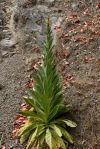
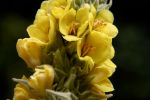
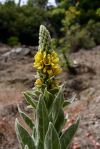
A tall spire of wooly leaves is topped with many bright yellow flowers. Each five-petaled bloom has two lower, straightened stamens and the remaining three are smaller and hairy. This is woolly mullein, or Verbascum thapsus, an invasive species that is now found throughout much of California and the rest of the country.

This plant prefers to grow in dry places, and can grow to more than six feet tall. The leaves are furry like lamb’s ears, and taper progressively smaller towards the top of the stem–giving the whole plant the shape of a narrow christmas tree. In addition to being an invasive, woolly mullein is also a host to insect species that can damage crops. It’s a persistent plant, with seeds that can survive up to 35 years in the soil.

Leave a comment

Filed under Invasive, Non-native, Plant of the day

Plant of the day: pampas grass

Cortaderia jubata

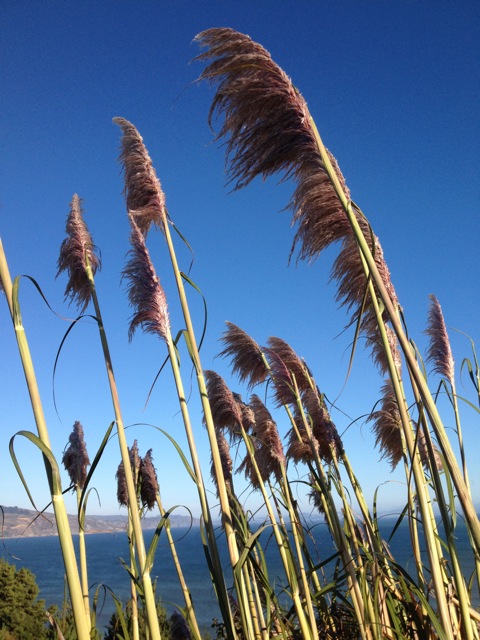
People who don’t know better think that pampas grass is beautiful–and in most ways, it is. The flowers of this gigantic grass are showy plumes that wave in the wind like horses’ manes or pennants. The leaves are long and trailing, and as wide as a large man’s finger. The whole plant, including the lofty bloom, can be up to 20 feet tall.

But this striking plant is also a noxious invasive, imported from Argentina and the Andes. It grows quickly in disturbed areas like cliff faces and road cuts, and forms large patches that crowd out smaller or slower growing native species.

There are actually two species that are commonly called pampas grass–Cortaderia jubata and C. selloana. Both thrive along the coast, but jubata (sometimes also called jubata grass) is restricted to coastal areas, while selloana also grows farther inland. Jubata plumes are purple or lilac, tending towards white as they age. This species can also be distinguished from its cousin because it holds its plumes quite high above the mound of leaves.

Both species of pampas grass bear their male and female flowers on separate plants (the botanical word for this is “dioecious,” as opposed to most plants which are “monoecious” and have their male and female parts on the same plant, often in the same flower). But while C. jubata reproduces asexually and lives for ten years or more, C. selloana can only reproduce if another plant of the opposite sex is nearby.

3 Comments

Filed under Invasive, Non-native, Plant of the day

Plant of the day: Indian teasel

Dipsacus sativus

The distinctive silhouette of teasel (Dipsacus sativus) is a familiar sight in the coastal parts of California. Thick, pointed bracts jut out, like splayed arms beneath the cone-shaped flower head. This structure stays standing long after the small white flowers have faded; people collect the dried stems for decoration. The spiny flower heads are so stiff they were used to card wool before metal carding combs were created!

Sadly this odd-looking plant is also a fairly nasty invasive. It can form dense chest-high thickets that are impassable to both people and animals. This European invasive likes to grow in disturbed areas: along roadways, in ditches and on grasslands. Another species, wild teasel (Dipsacus fullonum) is less common locally but more widespread throughout North America. It has pink-to-purple flowers and sharply upcurved bracts. Just to confuse things, both species also go by the common name of  Fuller’s teasel.

Leave a comment

Filed under Invasive, Non-native, Plant of the day

Plant of the day: bull thistle

One of the most common thistles around is bull thistle, an invasive species from Europe. Its showy purple flowers are beloved by bumble bees and other insects, but its spiny leaves are a bane to ranchers.

Bull thistle (Cirsium vulgare) grows most abundantly in coastal grasslands, along the edge of marshes, and in sunny openings in forests, according to the California Invasive Plant Council – but it is found in every state in the country. You can recognize this species because the leaves don’t stop when they meet the stem; instead they run down along it like little spiny wings.

This plant thrives on disturbance; it grows most readily when the soil is disrupted by plowing, logging, digging and so on. Even gopher activity can give it a boost!

Leave a comment

Filed under Invasive, Non-native, Plant of the day

Plant of the day: creeping buttercup

In low wet places, a mat of green leaves and yellow flowers grows. The flowers have five glossy, spreading petals and many stamens. Pale green splotches dot the leaves, which are three-parted and ragged at their ends.

This slideshow requires JavaScript.

This is creeping buttercup, or Ranunculus repens. It’s a mildly invasive plant that is becoming common along trails and roadsides where it can form large patches. Its stem can sprout roots where it touches the ground, enabling it to spread easily.

This flower is a relative of the taller, leggy California buttercup (a native).

Leave a comment

Filed under Invasive, Non-native, Plant of the day

Plant of the day: pennyroyal

As I walk down the marshy trail there is a strong minty smell in the air. This is coming from small purple-flowered plants: pennyroyal, or Mentha pulegium is in the mint family and almost always grows in wetlands. Even if the ground appears dry, it’s a strong indicator that a low summer-dried fields or valleys was wet in the spring, according to the Flora of Marin. Pennyroyal is another weedy non-native species native to Ireland and other parts of Europe.

This slideshow requires JavaScript.

There are a lot of other members of the mint family that have tuft-like purple flowers, but pennyroyal is the only one in the area that has discrete whorls of leafless (or small-leaved) flowers in stacks along the stem.

Leave a comment

Filed under Invasive, Non-native, Plant of the day

Plant of the day: fennel

It tastes great in salads, but fennel (Foeniculum vulgare) is an unfortunate weed in California. It grows avidly along roadsides and in other disturbed places. This plant grows up to ten feet tall, with feathery leaves and yellow umbrella-shaped umbels of flowers.

This slideshow requires JavaScript.

The leaves and the seeds have a distinctive licorice flavor, which is likely why the plant came to the Americas in the first place. It’s been used as a spice and a medicinal plant for centuries, and is thought to have escaped into the wild time after time.

Fennel is an invasive species, and takes over areas by forming dense stands where nothing else can grow. This isn’t just because the plants are so numerous that there is no room for any others. They also exude chemicals that actually prevent their competitors from growing!


Check out the above video for an musical animated interpretation of why fennel is a problem…
 

Leave a comment

Filed under Edible, Invasive, Non-native, Plant of the day

Plant of the day: yellow star-thistle

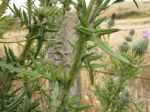
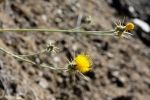
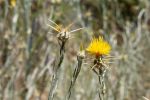
A wash of prickly, pale green stems is scattered across a dry field. Yellow flowers are surrounded by a mean halo of long narrow thorns. Here is yellow star-thistle (Centaurea solistalis) one of the nastiest invasive plants around. It’s a big problem on farmland and in wild places along the west coast. It interferes with grazing, and eventually leads to permanent brain damage in horses that eat it.

Introduced in the 1850s, this thistle is now the most widespread invasive plant in California, infesting between 10 and 15 million acres in the state. A native to southern Europe, it probably first came to the US indirectly, along with alfalfa seed imported from Chile. By the early 1900s it was a serious weed in the Sacramento Valley and was spreading quickly along roads, railways, trails and streams, according to the CalIPC. “It is a thousand times as common as ten years ago, and perhaps even six years ago,” observed Willis Jepson in 1919.

Things have only gone downhill from there! And it’s not surprising why. This deeply taprooted annual invades summer-dry grasslands across most of the US. A single large plant can produce nearly 75,000 seeds, and blooms from late spring through fall. It’s largely pollinated by honeybees but doesn’t have much in the way of predators, and so it continues to spread.


Leave a comment

Filed under Invasive, Non-native, Plant of the day