Category Archives: Medicinal

“Plant” of the day: old man’s beard

Usnea1Lichens litter the forest floor, shaken loose from the upper limbs of the trees by the winter storms. Old man’s beard is one of the most recognizable: a pale greenish tuft of long hair-like tendrils. My favorite thing about this lichen are the flat, fringed discs that are  some tufts. These are the apothecia, or fruiting bodies–I think they look like amoebas, or maybe stars, or maybe confetti. Delightful either way.

Old man’s beard is actually a generic name for the various members of the Usnea genus–which can be hard for a layperson to tell apart. But the genus itself is readily distinguished from others that look similar because it has a tough central cord running down each strand. If you gently tug on a piece of Usnea, the green outer covering cracks and separates, revealing the interior white cord which stretches like a bungee cord.

Usnea has long been used medicinally–as a bandage and antibiotic for rustic wound treatment, as sanitary napkins and in baby’s diapers. Western tribes such as the Makah used it to make mattresses in their seasonal camps. Modern herbalists have used it to treat lung and respiratory tract ailments. Usnea2

Leave a comment

Filed under Medicinal, Native, Plant of the day

Plant of the day: rattlesnake plantain

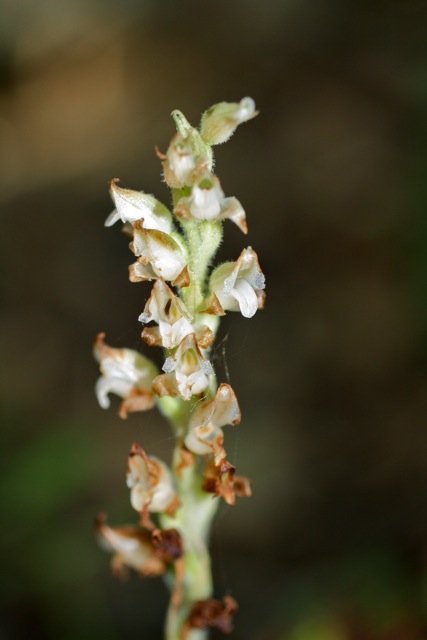
Vivid green leaves are bisected with a lightning-bolt of white. A tall pale stalk of white flowers rises from this small, ground-level rosette of leaves. This is rattlesnake plantain (Goodyera oblongifolia), a distinctive little plant that grows in Northern California (and many other parts of the country).It’s in the orchid family–look close and you’ll see the flowers have the typical orchid look, of a mouth gaping open with a cute little tongue hanging out. I’ve usually seen them growing in shady forested understories.

Apparently rattlesnake plantain can be used as a chewing gum, but though many places repeat that fact I haven’t yet found any information about which parts or how it is used. Traditionally, it was thought to have medicinal properties–particularly having to do with childbirth. It was chewed to help ease delivery and also to affect the sex of the baby–but again, there’s no details about this. It was also used in assorted other treatments for things such as colds, rheumatism, toothache and stimulating the appetite.

Leave a comment

Filed under Medicinal, Native, Plant of the day

Plant of the day: dusky willow

Dusky willow (Salix melanopsis) has long, narrow, hairless leaves. In general, willows are notoriously hard to identify–mostly because different species interbreed. Despite this confusion, it’s generally easy to tell when you’re looking at some species of willow. They can be shrubs or trees, but they often are found in wet areas–on the edge of wetlands, or along stream banks. They tend to have slim limbs. Most notably they sport small, rounded mini-leaves (stipules) thatgrow at the base of the larger leaf’s stalks. All willows have leaves that are alternate and in the spring they sprout silky catkins.

Willows have a lot of salycilic acid, which is essentially aspirin. You can buy willow bark capsules at health food stores as a more natural alternative painkiller.


Leave a comment

Filed under Medicinal, Native, Plant of the day

Plant of the day: giant horsetail

Along a damp ditch, bristly green bottle-brushes grow to my knees. This is giant horsetail, or Equisetum telmateia. Some call it a weed, but horsetail is one of my all-time favorite plants. They form low thickets of supple green stalks with long, skinny stick-like leaves that sprout out in all directions. When I was a kid I’d pick my teacher bouquets of them on my way to school—my quirky version of the proverbial apple.

As an adult I learned there are even more reasons to love horsetails than their good looks. The Equisetum species are considered “living fossils”, which means that they have changed very little over the last hundred million years or so (though they have shrunk some; back then they grew as tall as trees!).

Grab a handful of horsetail plants next time you walk past a patch. It scrunches pleasantly in your palm, but the slim stalk and leaves tend to bend, not break. They are jam-packed with silica, which makes them strong as well as flexible. This earned the plant the alternate name of scouringrush–it’s been used to scrub dirty dishes, to polish metal, to clean floors, and even as sandpaper. Some herbalists recommend drinking a tea made from the dried young stalks for strong and supple hair, skin and bones. Watch out, as large amounts of the raw plant can be harmful or toxic.

The bottle-brush part of the plant that you usually see is sterile, but in the spring giant horsetail sprouts a fertile stalk that is leafless and topped by a pale cone-like structure that releases spores. It also spreads by rhizome, which may be why some call it a weed—it can be dense and hard to get rid of since new plants sprout up from the roots.

There are four species of Equisetum in the SF bay area, but only two of the brushy type. Giant horsetail is probably more common in these parts, though its bushy cousin Equisetum arvense snagged the  official nickname of “common horsetail”. You can identify giant horsetail because its stem is larger–generally greater than 5mm across–and if you look close at its twiggy leaves, you’ll see that each is ribbed with several grooved ridges. The grooves also are a way to identify it, though the giant-ness is easier.

Leave a comment

Filed under Medicinal, Native, Plant of the day

Plant of the day: white alder

White alder looks almost the same as its cousin, red alder, which I wrote about in my last post. This tree grows a bit taller, but the main way to tell them apart is by looking at the underside of the leaf. In white alder (Alnus rhombifolia) the leaf margin is flat instead of tightly rolled underneath. It also produces its catkins slightly earlier, in January instead of from February through March.

White alder has flat leaf margins

Red alder has inrolled leaf margins

Both species are common in Marin, but you’re less likely to see white alder growing right along the coast.

Leave a comment

Filed under Medicinal, Native, Plant of the day

Plant of the day: red alder

Tall, straight tree trunks line the banks of the stream–each trunk elegantly splotched with patterns of white and gray. This is red alder, or Alnus rubra, one of the two common species of alder in this area.

This fast growing species is important as an early colonizer of disturbed habitats–landslides, stream banks, logging sites, or even forest clearings where a big old tree has fallen down and made a gap. I’ve seen hundreds of young alder sprouting up on the gravel left behind a retreating glacier, and it was one of the first plants to grow back in the wasteland left by the Mt. St. Helens volcanic eruption back in the 80s.

Around here, alder tends to prefer the moist soils of canyons, streamsides and wetlands. Besides the characteristically blotchy bark you will know alder by its tiny woody cones and its broadly serrated leaves that seem almost dented by the lateral veins that run across them from midrib to margin.  Red alder can be identified by the way the edge of the leaf rolls tightly under itself, so when you flip one over you see a dark green ridge running around the rim of its paler underbelly. The other local species of alder (white alder, or Alnus rhombifolia) has a flat edge.

Red alder contains the compound salicilin, which is similar to acetylsalicylic acid–aka aspirin. Native Americans used extracts of the bark to treat a wide range of maladies from tuberculosis to headache (as well as stomachache, wounds, eczema, diaper rash and more). Cones and catkins were also used. Some tribes rubbed rotten wood on limbs to sooth aching bones. A red dye can be made from the bark–one use for this was to dye fishing nets, supposedly making them invisible to fish. 

Leave a comment

Filed under Medicinal, Native, Plant of the day

Plant of the day: San Francisco gum plant

Its easy to tell if you’re looking at a gum plant. All the different species have big yellow daisy-like flowers perched atop a green nub that is studded with fleshy hooks. Before the young buds bloom they ooze a white sap that looks exactly like fresh Elmer’s glue.

San Francisco gum plant (Grindelia hirsutula var. maritima) only grows near the coast, on hills and bluffs from Marin to Monterey. I spotted these specimens on a recent hike to Chimney Rock on Point Reyes. Distinguish this plant from its cousin, coastal gumplant, because it grows on the hills instead of the salt marshes–but mainly because it doesn’t have perennial woody stems. San Francisco gum plant can vary dramatically in size, from 8 inches to nearly 5 feet. The plants I saw had hairy leaves, but according to the Marin Flora the leaves are usually hairless (aka “glabrous” in botany-speak).

Surprisingly, the Elmer’s glue doesn’t seem to have had any historical uses (that I’ve been able to unearth). But the dried leaves and buds were used to treat bronchial conditions including asthma.

Though there are three different species listed in the Marin Flora, it’s worth noting that some experts think that they all are actually part of the same species, Grindelia hirsutula.

Leave a comment

Filed under Good for gardens, Medicinal, Native, Plant of the day

Plant of the day: curly dock

Dock is a striking roadside sight, especially now as it is in fruit or beginning to die. The tall stalks of red or dark brown stand out in bold contrast to the dry grasses they often grow in. Curly dock likes to grow in damp areas that have standing water in the winter.

I had a lot of trouble telling curly dock (Rumex crispus) from Western dock (Rumex occidentalis) using my key. But I am now pretty sure that I’ve figured out a good seat-of-the-pants way to tell them apart: look at the tiny fan-like fruit. Curly dock, shown here, has a little nub at the center of every one–sort of like a baseball lodged in a mitt (see the photo above). Western dock looks more like a reddish leaf with a thickened vein at the center.

Young leaves are edible in small quantities, and have high levels of oxalic acid which give it a lemony flavor (like redwood sorrel). Eating it may aggravate people with rheumatism, arthritis, gout, or kidney stones so be careful! It also can be used as a gentle laxative.

Leave a comment

Filed under Edible, Invasive, Medicinal, Non-native, Plant of the day

Plant of the day: California goldenrod

Small golden spires are scattered across a coastal bluff. This little plant has soft gray-green leaves and many bright yellow flowers. California goldenrod (Solidago velutina) is an occasional sight in this area but I stumbled into a patch of it recently along the bluffs near Palomarin.

Solidago velutina

This is one of the late-blooming flowers of the season, flowering mostly from August through October. It’s often blamed for hay fever, but that may be a myth–supposedly ragweed and other plants are more likely culprits.

Goldenrod was used by Native Americans to keep hair from falling out, and also as a poultice or wash for sores, burns, toothaches and “feminine hygiene”.

Leave a comment

Filed under Medicinal, Native, Plant of the day

Plant of the day: coastal sagebrush

The haunting smell of sagebrush is iconic for anyone who has spent time outdoors in the west. There are many different species, and though they go by different names (sagebrush, sagewort, wormwood) the smells are all similar. It’s a pungent, spicy fragrance that speaks of campfires and starry nights and open spaces.

This slideshow requires JavaScript.

Coastal sagebrush (Artemisia californica) is the only shrubby sagebrush in Marin; the species grows only in California and Baja. You can usually find it along the coast or in chaparral communities. It has narrow, linear leaves that sometimes branch like the tines of a pitchfork. The flowers are unobtrusive–small yellowish-green or reddish-green discs. The smell is classic sagebrush.

Historically, some tribes used a tea made from Coastal sagebrush as a female tonic. It was used to induce menstruation, as well as to ease and recover from childbirth. Women drank the tea at the start of their cycle, and it was fed to one-day-old newborns to cleanse their system. It was also used to treat colds, headaches, and to desensitize those suffering from hay fever. Dried leaves were smoked in a mix with tobacco, and used in sweathouses. Bundles of sagebrush branches were hung along trails leading to shrines. The wood was also used for arrows, fire sticks and windbreaks.

Dusky-footed woodrats love to eat it.

Leave a comment

Filed under Medicinal, Native, Plant of the day