Category Archives: Medicinal

Plant of the day: California rose

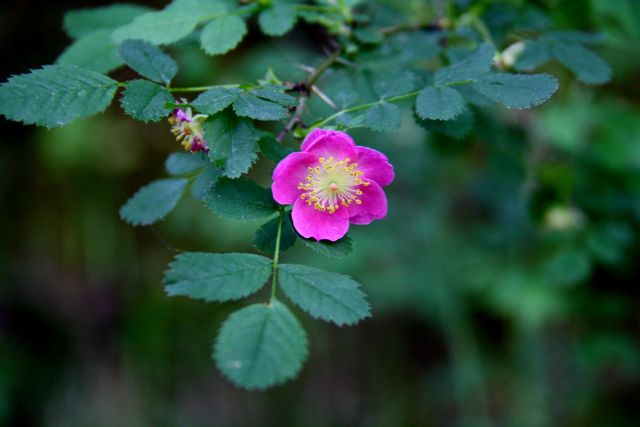
This wild rose is a favorite sight in spring and summer, as pink blossoms give way to ripe red fruit. This is the California rose (or as it is conversely known in Latin, Rosa californica), which grows in nearly every county in California, as well as in parts of Oregon.
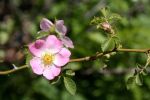
This hardy shrub can look scraggly, but also can be groomed into a good garden plant, with pale green leaves and colorful fruit and flowers. It grows to 8 feet tall but is usually smaller. The tangle of thorny branches make excellent shelter for birds, and I’ve spotted many a nest by peering into a wild rose bush.

Rose hips are a renowned source of Vitamin C, and you can make an immune-boosting tea just by pouring boiling water over the red fruit. The hips can also be eaten fresh, though the inner bit is unappetizing, filled with seeds and strange stiff hairs. But the thin outer layer of flesh is tasty–I usually eat it by splitting the fruit open with a fingernail and scraping out the seeds. But this is labor intensive, and rose hips were never a significant food source for Native Americans. There was some medicinal use, though. A tea of wild rose hips was used to treat fever, sore throats and stomach aches–as well as to wash sores and sooth the pain of babies.

There are several different kinds of wild roses in California, and they all look fairly similar. The California rose (according to the Marin Flora) has the brown remains of its sepals at the tip of its ripe hips, and also tiny hairs visible on the stems of its leaves. It grows in full sun and partial shade, and in both wet and dry areas.

Leave a comment

Filed under Edible, Good for gardens, Medicinal, Plant of the day

Plant of the day: toyon

Heteromeles arbutifolia

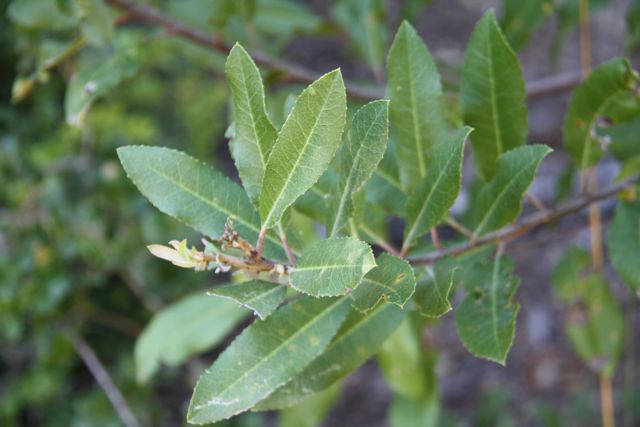
Small, dark green trees with clusters of white flowers are scattered here and there across the hillsides. This is toyon (Heteromeles arbutifolia). It will truly come into its own in a few months, when clusters of brilliant red berries begin to ripen. Toyon is also called “christmas berry” for these cheerful December fruit, which once were sold as a local substitute for similarly colored holly sprigs.

Don’t get any ideas about collecting your own–it’s now illegal to harvest wild toyon. This species is often a part of the scrubby chaparral community, but you can also see it in oak woodlands and other forests and shrublands across the state. The berries are described as having a “sweet and spicy” flavor, and a tea made from the leaves was used for irregular menses, aches, pains, stomachaches, and to wash wounds. Californians once ate the fruit regularly–roasted, toasted and fresh. Spanish settlers made a drink from the bark, and Channel Island fishermen used it to tan their fishing lines.

Leave a comment

Filed under Edible, Medicinal, Native, Plant of the day

Plant of the day: blue elderberry

Clusters of grayish-blue fruits hang from the branches of a small tree. Blue elderberry (Sambucus nigra) is a beautiful plant with arching branches. Its shaggy bark is wrapped around with furrows in older plants. The leaves are a fresh green and paired; each pinnate leaf actually looks like several leaves, since it is composed of 3–9 little leaflets.

Elderberry has a rich history of being used in cuisine, crafts, and medicine–but it must be approached with caution since the green parts of the plant and the unripe berries are quite toxic. The roots are the most toxic of all. But ripe berries make a delicious syrup, jam or wine, and the plant has long been cherished by traditional cultures. Petals can be eaten raw, made into a tea, or used to flavor pancakes. Some have even dipped the entire flower head in batter and fried it! Elderberry syrup is said to be an effective treatment for the flu; you can buy bottles of it at most health food stores. Native Americans used the branches for baskets, flutes and arrow shafts, and the fruit was a main food source.

Before the fruit is ripe, you can tell blue elderberry from its cousin, red elderberry, by the shape of the flower head. Blue elderberry has a flat-topped cluster, whereas red elderberry flowers are arranged in a pyramidal or roundish shape.

Notice the flower head is flat, not cone-shaped

Leave a comment

Filed under Edible, Good for gardens, Medicinal, Native, Plant of the day, Poisonous

Plant of the day: white clover

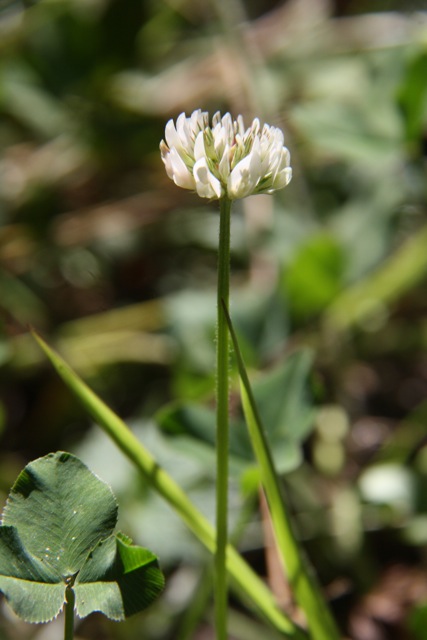
White heads of flowers dot the unmowed ball field like cotton balls scattered freely. But look close and the blooms are not at all cottony; this is a clover, each head a cluster of dozens of small pea-type flowers. The leaves are distinctively bisected with a faint crescent line that looks like a watermark, or the pattern left behind on paper that was soaked and then dried.

Everpresent in lawns and weedy berms, white (Trifolium repens) clover is one of the most common (and dare I say overlooked) plants around. Rare, shy, or temperamental flowers are a treat to find and behold–but I also like to take the time to get to know the species that are so common that they are easy to ignore. This little European invader is certainly one of those. But it turns out that not only is it a favorite snack for livestock, but humans can eat it too! Young leaves can be used in salads or soups, or it can be cooked like spinach. Dried flowers and seed pods have been ground into a high-protein flour that can be used on its own or as a garnish. The plant can be boiled for a tea, either just because its tasty or as a traditional Cherokee treatment for fever. Roots can be cooked and eaten, and evidently the leaves give baked goods a vanilla-like flavor. Who knew.

Trifolium repens

Leave a comment

Filed under Edible, Medicinal, Non-native, Plant of the day

Plant of the day: wood rose

Rosa sp.

In spring, the native roses bloom with graceful pink blossoms. In the summer, they are decked with clusters of red fruit. And year-round, the elegant bushes are lush with small round leaves. A wild rose is a treat in any season or any setting, whether forest or garden. Telling the different species apart can be tricky (the local key requires fruit which isn’t helpful in spring). But at this time of year, the wood rose–Rosa gymnocarpa–stands out because it loses its sepals as its fruit begins to ripen; other species retain the sepals (and sometimes the dried remains of the stamens too) on the ends of the fruit. One of its other common names is “bald hip rose”.

Though technically edible, the small red hips are packed full of seeds that are nestled inside a dense layer of hair that grows on the inside of the fleshy shell. Not exactly succulent, they have a tart, good-for-you, vitamin-C kind of tang. I read that the seeds are a good source of Vitamin E. The petals also can be eaten, and both petal and hip can be steeped for a tea. Historically, leaves were sometimes chewed as a remedy for bee stings, while the soaked bark was a wash for sore eyes.

See how the end of the fruit is smooth?

Leave a comment

Filed under Edible, Good for gardens, Medicinal, Native, Plant of the day

Plant of the day: California poppy

If you learn only one plant as a Californian, it should probably be this one. Our state flower is simply stunning. Rich orange flowers bloom lushly atop feathery foliage. The cup-shaped blossoms were originally pollinated by beetles, but they have also become a favorite of the introduced European honeybee.

This slideshow requires JavaScript.

California poppy (Eschscholzia californica) is one of the most beautiful flowers of the spring, and it blooms well into the summer with good showings still going on. In this area they usually grow in scattered patches, but in places you will see them blanketing hillsides or valleys in a carpet of orange (eg Santa Barbara’s Figueroa Mountain). In harsh places the flowers can be on the small side, but in good conditions each of the four petals can be over two inches long. This poppy is native to the west coast of North America, but because it is a beautiful and hardy garden flower it has been introduced to many other parts of the country and the world.

Native Americans are said to have used the pollen as a cosmetic. They also ate the leaves, and used the plant as a mild pain-killer to treat insomnia and toothache. Extract of poppy is still sold today, and was touted as an alternative to Oxycodone by television personality Dr. Oz.


Leave a comment

Filed under Good for gardens, Medicinal, Native, Plant of the day

Plant of the day: coyote mint

A purple crown of flowers above dusty gray-green leaves: here is a coyote mint in bloom. In the center of the exuberant lilac ring of flowers, a round green bulge of unopened buds looks like a clown’s pate peeking through. Each flower is tube-shaped, its sprawling petals accented by many long stamens. The entire flower head approaches two inches across, and the plant grows one to two feet high, slightly sprawling.

One very charming thing about this coyote mint (Monardella villosa) is that it sports a twin pair of tiny leaves at the base of each pair of larger leaves.

This flower grows only in Oregon and California, and is a great addition to a well-drained garden since it attracts bees and butterflies. You can tell it’s in the mint family by taking a look at the square, four-sided stem. Every time I’ve seen it I’ve forgotten to take a sniff, but I hear that it has a characteristic toothpaste-like aroma as well… It was used by the Spanish as a cure for sore throats.

Leave a comment

Filed under Good for gardens, Medicinal, Native, Plant of the day

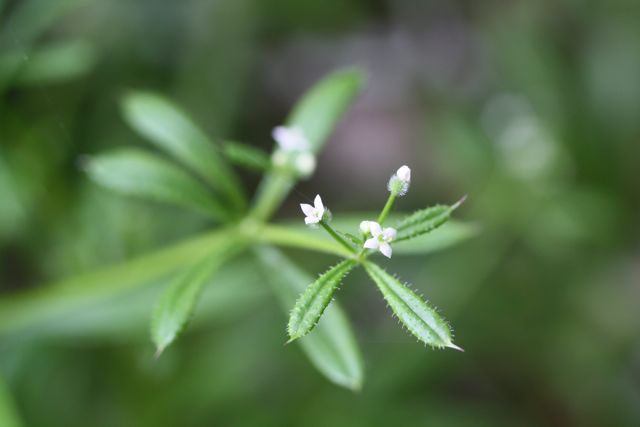
Plant of the day: common bedstraw

Bedstraw – a.k.a goose grass, cleavers, or stickywilly

If you walk through a patch of bedstraw, you’ll know it right away. The stalks grow long and sprawling, and will wrap around your ankles. But they also are sticky! And the leaves are studded with tiny hook-like bristles! They don’t hurt to brush up against, but they certainly do cling. Its other names include goose grass, cleavers – and stickywilly.

The flowers of Galium aparine are tiny, white, four-petalled stars. But the plant’s most distinctive feature is its leaves: they stick out all around the stem like the spokes on a wagon wheel. Bristly, green, tongue-shaped spokes.

Bedstraw is widespread – not only across California, but throughout the US and southern South America, as well as Europe. A Scottish friend was just telling me that kids will grab handfuls and stick it on one another as a game. It’s listed as a native both in California and in Europe, but is described as an invasive/non-native in other states (like Arizona), so it is clearly aggressive. Bedstraw is used as a medicinal plant, taken as a tincture, juice or tea to treat maladies such as adenoids, nodules, kidney stones, roseola, and cough. It’s also been used on the skin to treat psoriasis, and eczema.

1 Comment

Filed under Medicinal, Native, Plant of the day

Plant of the day: California spikenard

Here is a big, tall plant of the shadows. Smallish, round tufts of flowers are surrounded by large jagged-edged leaves. The unopened flowers are particularly beautiful – they look like a sculptor’s version of the childhood game of Jacks.

Usually this plant, which grows up to nine feet tall, is found in deep shady woods. I saw it deep in the Mt. Tam watershed, growing on a hillside among redwoods and tanoaks. California spikenard (Aralia californica) is in the ginseng family, and is used by herbalists as a tonic. The roots (and sometimes other parts of the plant) were used extensively by various Native American tribes to treat a wide variety of ailments from cancer to fainting to stopping periods. Most commonly it seems it was used to prevent skin infection, or as a tonic for colds. It has also been called elk’s clover or prairie sagewort.

Spikenard in fruit (September)

2 Comments

Filed under Medicinal, Native, Plant of the day

Plant of the day: selfheal

These small sturdy towers of purple flowers are usually found in meadows and wet places. Though it only grows to be about five inches tall, it’s a hardy and versatile little plant – Prunella vulgaris is found in every state in the continental US as well as in Europe, Asia and many parts of Canada.

As the name suggests, this is also a traditional medicinal plant that has been used in teas, in stews and for compresses.The square stem and two-lipped flower reveals this flower as a member of the mint family.

Leave a comment

Filed under Edible, Medicinal, Native, Plant of the day