Category Archives: Native

Plant of the day: bigleaf maple

The subtle colors of California fall are washing across the landscape. The scattered patches of yellow you see starting to show up in the forest are probably bigleaf maple, or Acer macrophyllum. This native tree drops its  leaves in the fall, and it is one of the few species around here that turns yellow before it turns brown.

This slideshow requires JavaScript.

Bigleaf maple is found along the west coast from central California to the Alaska panhandle. The sap can be made into maple syrup–but this isn’t done often since the yield is lower than from the eastern sugar maple. The timber is harvested commercially. The largest known bigleaf maple is eight feet in diameter.

This tall tree drops piles of soft leaves, and is used for wildlife habitat year-round. Bugs live in its furrowed bark, and birds (including harlequin duck and pileated woodpecker, where they occur) sometimes nest in the bigleaf maple–as does the dusky footed woodrat. Deer forage and bed down in the understory of the mixed forest that this tree generally grows in.

Leave a comment

Filed under Good for gardens, Native, Plant of the day

Plant of the day: dune goldenrod

Nature lies disheveled, pale,
With her feverish lips apart,—
Day by day the pulses fail,
Nearer to her bounding heart;
Yet that slackened grasp doth hold
Store of pure and genuine gold;
Quick thou comest, strong and free,
Type of all the wealth to be,—
Goldenrod!
(by Elaine Goodale)


Solidago spathulata

Late-blooming goldenrod flowers are rooted so deep into cultural consciousness (witness the somewhat overwrought poem, above, and many more like it) that I”ve always assumed that they are more common than they actually are in these parts. But here in Marin, the three species of goldenrod only appear occasionally, singly or in patches that are so sparse that they don’t really deserve the name. Yet in other parts of the country, the hundred or so species  that go by this name are weedy and abundant, washing fields and roadside ditches with yellow. Goldenrod is the state flower of Nebraska, Kansas, South Carolina, Delaware, and (formerly) Alabama.

But back on the bluffs of Point Reyes, a goldenrod sighting is more likely to mean a tattered straggler like the one pictured here. This is dune goldenrod, or Solidago spathulata. It has leathery, slightly sticky leaves and a small spike of the characteristic yellow flowers. It is found growing near the coast, in rocky or sandy soils.

Leave a comment

Filed under Native, Plant of the day

Plant of the day: San Francisco gum plant

Its easy to tell if you’re looking at a gum plant. All the different species have big yellow daisy-like flowers perched atop a green nub that is studded with fleshy hooks. Before the young buds bloom they ooze a white sap that looks exactly like fresh Elmer’s glue.

San Francisco gum plant (Grindelia hirsutula var. maritima) only grows near the coast, on hills and bluffs from Marin to Monterey. I spotted these specimens on a recent hike to Chimney Rock on Point Reyes. Distinguish this plant from its cousin, coastal gumplant, because it grows on the hills instead of the salt marshes–but mainly because it doesn’t have perennial woody stems. San Francisco gum plant can vary dramatically in size, from 8 inches to nearly 5 feet. The plants I saw had hairy leaves, but according to the Marin Flora the leaves are usually hairless (aka “glabrous” in botany-speak).

Surprisingly, the Elmer’s glue doesn’t seem to have had any historical uses (that I’ve been able to unearth). But the dried leaves and buds were used to treat bronchial conditions including asthma.

Though there are three different species listed in the Marin Flora, it’s worth noting that some experts think that they all are actually part of the same species, Grindelia hirsutula.

Leave a comment

Filed under Good for gardens, Medicinal, Native, Plant of the day

Plant of the day: California goldenrod

Small golden spires are scattered across a coastal bluff. This little plant has soft gray-green leaves and many bright yellow flowers. California goldenrod (Solidago velutina) is an occasional sight in this area but I stumbled into a patch of it recently along the bluffs near Palomarin.

Solidago velutina

This is one of the late-blooming flowers of the season, flowering mostly from August through October. It’s often blamed for hay fever, but that may be a myth–supposedly ragweed and other plants are more likely culprits.

Goldenrod was used by Native Americans to keep hair from falling out, and also as a poultice or wash for sores, burns, toothaches and “feminine hygiene”.

Leave a comment

Filed under Medicinal, Native, Plant of the day

Plant of the day: seaside daisy

This pretty purple daisy prefers excellent views. It grows along the coast, often clinging to rocky cliffs or sunbathing on sandy beaches. I photographed the ones shown here on the Point Reyes Peninsula, growing on the top of Arch Rock–a lovely vantage point looking down on the long stretch of coast to the north and south.

Seaside daisy (Erigeron glaucus) has rounded, grayish green leaves that are soft to the touch. The flowers heads are purple, ranging towards white or pink, with a yellow center. It’s native to California and Oregon, and it’s often seen in rock gardens as well as in the wild. Other names include beach daisy and seaside fleabane.

3 Comments

Filed under Good for gardens, Native, Plant of the day

Plant of the day: common cattail

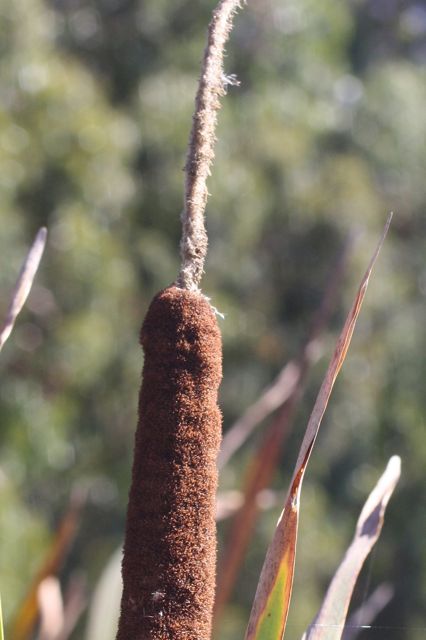
Common cattail is a common sight in wetlands, ponds and roadside ditches. These tall reeds have blossoms that look more like sausages, with long brown cigar-shaped flower heads that really look nothing like flowers. But the sausages are actually flower heads, with the female flowers clustered in the lower, plumper segment while the male flowers are clustered together above. This is common cattail, or Typha latifolia, which is also known as broadleaf cattail or soft flag.

In this species, the skinnier (female) flower head is stacked immediately above the fatter one with no gap of stem visible in between.If you see a segment of stem you’re looking at narrowleaf cattail (T. domingensis or T. angustifolia). These two species are harder to tell apart–look for orange or yellow flowers, and dark dots on the inside of the lower leaf, to ID T. domingensis.

Leave a comment

Filed under Native, Plant of the day

Plant of the day: turkey tangle fogfruit

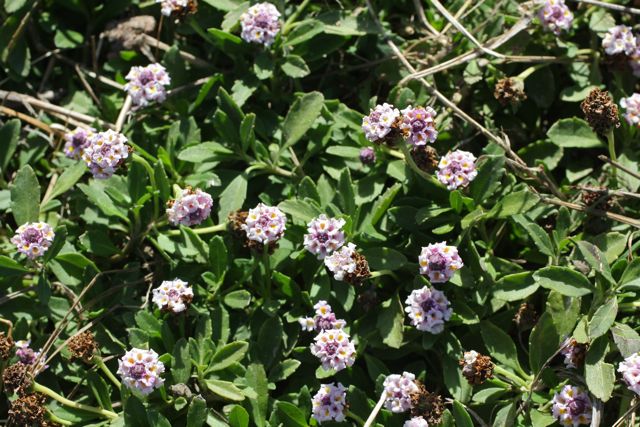
A low mat of green leaves speckled with small purple flowers is growing on the hard-packed soil between the trail and the water. This plant has the wackiest plant name I’ve ever heard: turkey tangle fogfruit! Phyla nodiflora has squat spires of small purple blossoms, each with a pale yellow splotch inside. The lowest parts of the spire bloom first, so as the flowers seem to be set on a ever-expanding brown pedestal as the season progresses. The whole package is only about a half an inch tall.

I’ve only seen turkey tangle fogfruit growing in a few places–always right on the edge of a trail alongside water. These photos were taken yesterday in Inverness, on the bank of Papermill Creek. It also grows along the edge of Bon Tempe lake, but has already finished blooming there. I always thought it was probably an escaped ornamental garden plant, which is exactly what the Marin Flora says that it is. But the CalFlora database lists it as native, and the Jepson lists it as native with the caveat that it is “questionably native” and may have been introduced multiple times from multiple places, including South America. Either way, it’s a quirky little plant to keep your eye out for! The leaves apparently are edible, and can be used to make a tea with a grassy flavor. It is used to treat colds and coughs. The plant is said to have antiparasitic properties and has been used to treat hookworm and other problems.

Leave a comment

Filed under Native, Non-native, Plant of the day

Plant of the day: pitgland tarweed

A dry meadow has turned into a sea of blooming yellow tarweed. But when I look close, I see that there are two shades of yellow here: lemon and saffron. Pitgland tarweed is growing intermixed with the (more common?) hayfield tarweed, which I wrote about a few weeks ago.

Many pitgland tarweed (Holocarpha virgata) flowers grow along a single stem. Because this is a composite, each petal is actually a three-lobed ray flower. The anthers of the central disc flowers are dark, and tipped with yellow pollen. The leaves are tiny, looking more like the needles of a tree than like flower leaves. The main stalk is essentially leafless, but each flower head grows on a side-stalk that is densely spiked with yellow-green leaves.

Leave a comment

Filed under Native, Plant of the day

Plant of the day: Mt. Tamalpais lessingia

Tiny pale pink flowers are scattered throughout the grasses and serpentine rocks of Carson Ridge. They grow singly and in small clusters at the end of highly branched, wiry stems. When you look close you see that they form a cobwebby network throughout the brown grass. This is Mt. Tamalpais lessingia (Lessingia micradenia var. micradenia).

This slideshow requires JavaScript.


This plant prefers shallow gravely soil on serpentine outcrops, according to the Marin Flora. This variety grows only in Marin, and is listed as a rare species. It also is very counterintuitive to identify. Though it appears to have single blossoms with five petals, it’s actually in the Asteraceae family along with sunflowers, daisies and other composites. But the Lessingia species tend to be sneaky this way–check out this list and see for yourself.

Leave a comment

Filed under Native, Plant of the day, Rare

Plant of the day: coastal sagebrush

The haunting smell of sagebrush is iconic for anyone who has spent time outdoors in the west. There are many different species, and though they go by different names (sagebrush, sagewort, wormwood) the smells are all similar. It’s a pungent, spicy fragrance that speaks of campfires and starry nights and open spaces.

This slideshow requires JavaScript.

Coastal sagebrush (Artemisia californica) is the only shrubby sagebrush in Marin; the species grows only in California and Baja. You can usually find it along the coast or in chaparral communities. It has narrow, linear leaves that sometimes branch like the tines of a pitchfork. The flowers are unobtrusive–small yellowish-green or reddish-green discs. The smell is classic sagebrush.

Historically, some tribes used a tea made from Coastal sagebrush as a female tonic. It was used to induce menstruation, as well as to ease and recover from childbirth. Women drank the tea at the start of their cycle, and it was fed to one-day-old newborns to cleanse their system. It was also used to treat colds, headaches, and to desensitize those suffering from hay fever. Dried leaves were smoked in a mix with tobacco, and used in sweathouses. Bundles of sagebrush branches were hung along trails leading to shrines. The wood was also used for arrows, fire sticks and windbreaks.

Dusky-footed woodrats love to eat it.

Leave a comment

Filed under Medicinal, Native, Plant of the day