Category Archives: Native

Plant of the day: ranger’s button

Woolly beige tufts rest on umbels of stout stalks. This is ranger’s button (Sphenosciadium capitellatum), a common mountain plant with flowers are clustered into dense and symmetrical heads. Each round and wooly heads is then clustered into an umbel, at the end of a branching stalk. The umbel stalks also are woolly, and the overall effect is highly stylized and geometric.

Ranger’s button likes to grow in the wet soil of meadows, or near lakes and streams. It grows at 3,000 to 10,400 feet in elevation. This plant is in the celery family (Apiaceae) along with poison hemlock and angelica, which it somewhat resembles. It’s toxic to livestock, and an infusion made from the root was used by the Paiute tribe to treat lice… and venereal sores.

Leave a comment

Filed under Native, Plant of the day

Plant of the day: giant blazing star

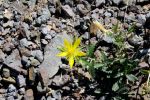
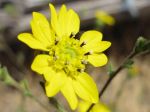
This yellow-flowered plant grows everywhere on the east side of the Sierras, like a weed. But how can any weed be this beautiful? The pale yellow blossom is as big as my palm, with long delicate petals, and a spreading bouquet of yellow stamens rises from the center. Five skinny “petals” that alternate with the wider ones are actually modified stamens that don’t produce any pollen. This extravagant bloom is surrounded by long green sepals  that peek out from between the petals. With a pale stem and scalloped green leaves, the entire package looks like a carefully wrought floral display. Yet nature did all of the arranging.

Giant blazing star (Mentzelia laevicaulis) can be found across much of California and across all of western North America. Despite its delicate looks, this beauty loves high heat and rocky habitats. It was also used by many native tribes for everything from skin wash to gravy. Roots were used to treat arthritis, earaches, bruises and fever. An infusion made from the leaves was used for stomachaches and skin disease. The gravy was made from fried seeds and water.

Leave a comment

Filed under Native, Plant of the day

Plant of the day: prickly poppy

Flamboyant white flowers are scattered across a sagebrush plain. Prickly poppy, or Argemone munita, has the large papery-thin petals–stark white around a brilliant yellow center. Insects flock and feed among the many yellow stamens. The whole plant has abundant gray-green leaves that are prickly to the touch, and stands as tall as my knee. It is truly a beauty! But you won’t see it in the Bay Area; it grows across the west but only between 4,000 and 8,500 feet. If you see a similar flower at low elevation, you’re probably looking at one of this bloom’s lovely cousins, such as the Matilja poppy.

Leave a comment

Filed under Native, Plant of the day

Plant of the day: hayfield tarweed

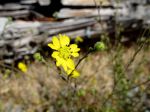
A pungent odor wafts across the flower-filled summer meadow. The smell is coming from the abundant yellow daisy-like flowers that are scattered everywhere. This is hayfield tarweed, or Hemizonia congesta. They look pretty, with three-lobed ray flowers encircling a soft yellow center. But if you pick one up you’ll get a sticky souvenir: this plant is incredibly resinous, and the smell and the stickiness will follow you until you can scrub off. Low-slung dogs will come back from hikes needing a bath, and the fragrance (strong but not unpleasant) lingers on fur and clothes.

Hayfield tarweed can be either white or yellow, and there are a number of other species of tarweed as well (though they are in several different genuses, and vary a fair amount in the way they look). The seeds of the Hemizonia and Madia tarweeds are edible–they were among the many types of seeds that Native American tribes collected and ground into flour. One miner described watching the Sierra Miwoks harvest in 1851: “During the months of August and September we often saw Indians coming and going. It was the time of their harvest; they came to our flats to gather all kinds of seeds, even hayseeds. It is the Indian woman who does this work; she has a big hamper or very open basket, of very fine reeds, and coated with a starch made of powdered seeds and warm water. She holds this hamper with one hand under the grass in seed; then with a sort of fan also made of reed… she pulls the grass over her hamper; the seeds, thanks to the shake given by the fan, are detached and fall.” (excerpt from California Grasslands, edited by Stromberg et al)

Leave a comment

Filed under Edible, Native, Plant of the day

Plant of the day: American speedwell

A little spring-fed stream is densely filled with the abundant deep green leaves of a low-growing plant. Petite blue-purple flowers bloom here and there in the foliage. This is American speedwell, or Veronica americana. A splayed pair of stamens surrounded by four small petals (the bottom one sometimes slightly smaller than the other three) are characteristic of the many species of speedwells.

American speedwell (also called brooklime) is native to temperate parts of North America and Asia. This plant loves to grow in slow-moving water, where its fleshy stems grow into a sprawling tangle. It is tart but edible, and high in Vitamin C.

Leave a comment

Filed under Edible, Native, Plant of the day

Plant of the day: water buttercup

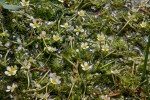
Petite cream-colored flowers peek above the still surface of a pond. Small white petals are banded with yellow at the center, surrounding a buttery cluster of yellow stamens. The flower has a glossy shine, akin to that of its land-locked buttercup cousins. Look close and you’ll see the flowers are rising from a mat of yellowish-green leaves just below the surface. Water buttercup (Ranunculus aquatilis) is also called whitewater crowfoot, likely because the narrow twiggy leaves look like the bony feet of a bird.

You can see this plant all over California and throughout much of the west. The photos shown here were taken in the high Sierra, where a spring had made a small pond in an otherwise very dry landscape of sagebrush and juniper; the seeds must have been deposited by a bird that stopped there for water.

Leave a comment

Filed under Botany basics, Native, Plant of the day

Plant of the day: chamise

Adenostoma fasciculatum

Chamise is a needle-leaved shrub of the chaparral. Right now it’s spikes of small white flowers are fading to brown, but the dried flowers will stay on the bush for most of the summer. A close look at those that are still blooming will show five little petals and the long splayed stamens. The flowers are so small that even when a bush is in full bloom it looks understated, not showy.

The small, leathery leaves of chamise (Adenostoma fasciculatum) are about a quarter of an inch long and grow in bunches off the stem. This is one of the most common chaparral plants, and its leaves secretes an oil that burns easily. Native tribes used the oil to treat skin infections (they also used an infusion of bark and leaves to treat syphilis, and collected scale insects from the plant to make a glue for arrows and baskets).

2 Comments

Filed under Native, Plant of the day

Plant of the day: golden chinquapin

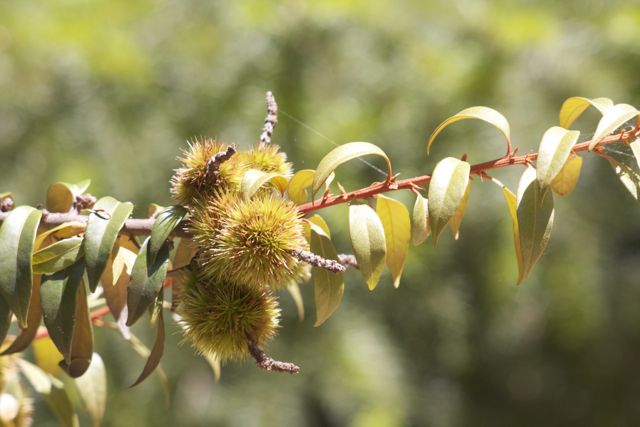
Golden chinquapin with nut

In the scrubby underbrush of dry hillsides is a shrub with velvety golden down on the underside of its shiny green leaves. This is the aptly named golden chinquapin (Chrysolepsis chrysophylla), which is a member of the oak family. It’s nuts, which are covered with a spiky golden husk, ripen in the summer time. The nuts are sweet-tasting and can be eaten raw or cooked; they were a common food for local tribes. If you plan to collect them, I recommend taking thick gardening gloves though–the spines are SHARP!!

Golden chinquapin is mostly found in coastal counties in California, but it does grow in scattered inland locations as well. It’s native to California, Oregon and southern Washington, where its range moves inland (and the plant gets larger). In our area it usually appears as a shrub, but don’t be fooled if you see a tree that fits the same description. The more widespread variety of this species is a tree that can grow up to 60 feet tall!

Leave a comment

Filed under Edible, Good for gardens, Native, Plant of the day

Plant of the day: coffeeberry

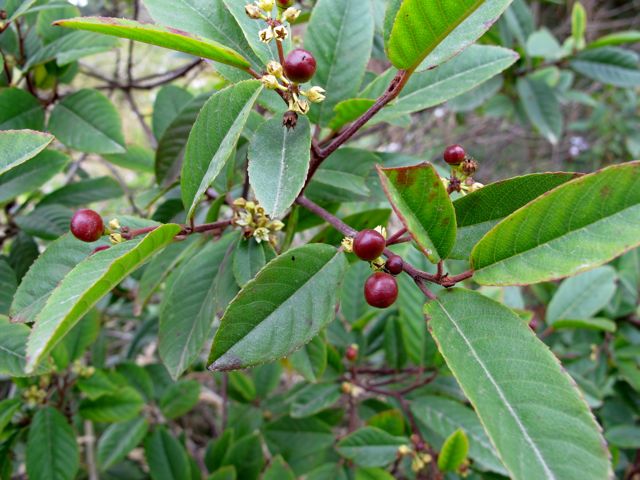
Frangula californica

Reddish berries are nestled among the dusky green leaves of coffeeberry (Frangula californica), a tremendously attractive shrub of dry hillsides, canyons and chaparral. Its stems are often reddish also, and the slightly shiny leaves dance up the twigs on alternating sides. In places it can look like a small tree, but more often I have seen it as a medium-sized shrub.

Coffeeberry is an important food for wildlife–mainly birds, but deer will eat it when tastier stuff isn’t around. Critters from pigeons to black bears (and deer too) enjoy the berries, and woodrats will eat limited amounts of the coffee-bean-like seeds inside. I’ve never tried the fruits, but apparently they are sweet and tasty, and were eaten by Native Americans. The bark has a laxative effect, and once was exported for medicinal use.

Unfortunately this pretty little native is vulnerable to Sudden Oak Death…

Leave a comment

Filed under Edible, Native, Plant of the day

Plant of the day: red elderberry

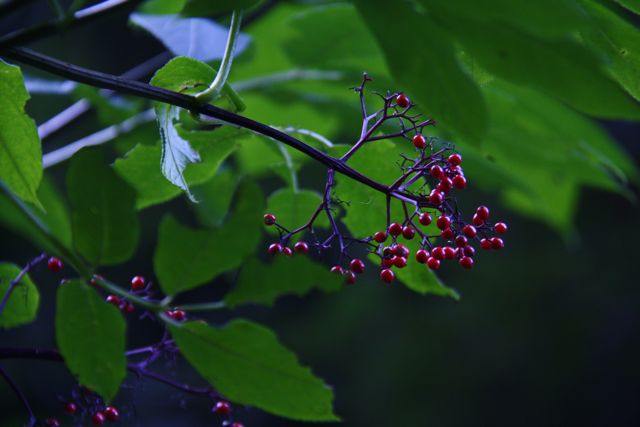
In the shade of the forest, clusters of brilliant red berries seem to glow with color. This is red elderberry (Sambucus racemosa), the cousin of blue elderberry which I wrote about yesterday. There is a lot less written about this beautiful plant–some sources say the berries are edible, some say they are not. My guess is that even if you can safely eat them they aren’t nearly as tasty as their blue cousins or more info would be available.

Despite their names, the Jepson database says that red elderberry can also be a blueish-black color; the way to tell it isn’t blue elderberry is that the dark form of the berries lack the glaucous white coating on their surface.

Leave a comment

Filed under Native, Plant of the day