
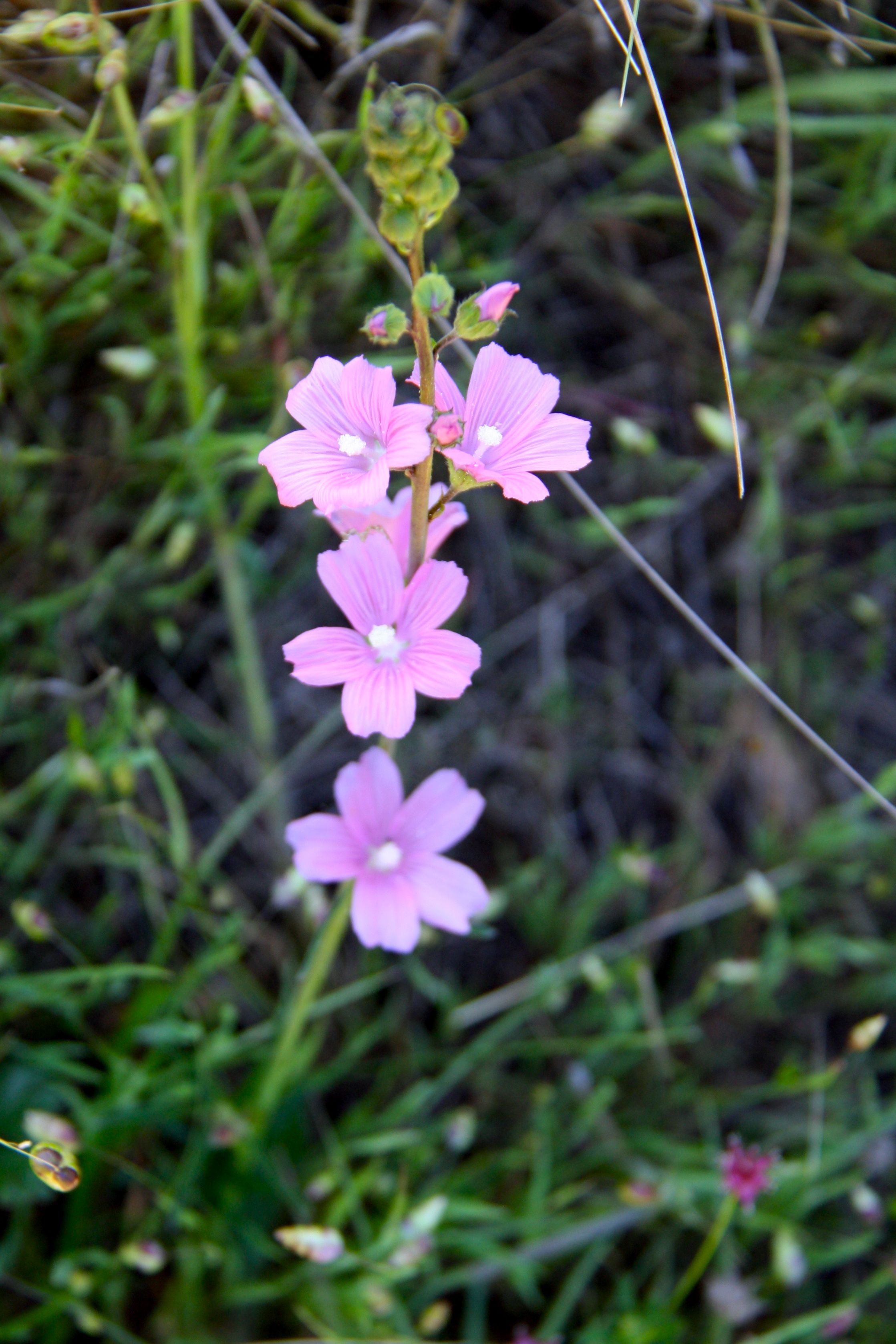
 An unexpected spray of pink caught my eye along the trail. Here is a checker bloom (or checker mallow) – scientific name Sidalcea malviflora. This showy flower can be found throughout most of California, and is pretty in a sculptural way that makes it look more like a cultivated variety than a wildflower. It can grow up to a foot tall, and sometimes grows en masse in open fields — or scattered singly or in small groups, as I saw it. The flowers are about an inch across, and each vibrantly pink petal is nearly translucent and streaked with numerous pale lines. The white stamens form a fused, fringed tube at the center. Each bloom unfurls above its older neighbor on a long raceme. At any time several are usually in bloom while a cluster of green buds hangs above them, waiting for their turn in the sun. Checker bloom has several other cousins in Marin, all of which look pretty similar, but this is the most common and widespread throughout the state. They are in the Malvaceae family – the fused, fringed male filaments are one of the key ways (“diagnostics”, in botany-speak) to recognize this family.
Category Archives: Native
Plant of the day: checker bloom
Filed under Native, Plant of the day
Plant of the day: poison oak
How about an easy one for a Monday! Common and important, unless you want to itch. Poison oak is easy/hard to identify, depending on how experienced you are in looking at plants. The leaves can range in color from dark green to light green to reddish, but they always have a glossy shine and another quality as well, one that’s distinct but hard to define. The leaves look… slightly luminous. Tender. As if, were you crazy enough to nibble on one, it would have a pleasant delicate texture.
The flowers of poison oak are small, inconspicuous, and not usually in bloom, so the leaves are what to look out for. These always come in groups of three, and they have a smooth surface, the veins only showing lightly and the surface not haired or spined. The edges are gently lobed or scalloped – to varying degrees, but they are neither straight nor serrated (like the edge of a bread knife). This helps you rule out other common plants, like blackberry, that some people confuse for poison oak. Once you get all those features down, really the only thing that looks similar are the leaves of a young true oak tree before it has grown tall.
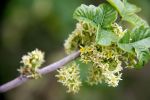

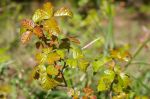
The Latin name is easy to remember as well (even though I had forgotten it). Toxicodendron diversilobum. Intuitive, right? Toxic leaf with diverse lobes. Thanks John Torrey, Asa Gray, and Edward Greene who did the naming. Torrey produced the Flora of North America in the 1800s, and Gray helped him out. And how do I know they named our toxic friend, a newbie may ask? It says so right on all the official listings of the species. Check the names after the italicized species name on the above link: you’ll see Torr. and A. Gray, who did the original naming, along with Greene, who came along later and made some change – I’m not sure but maybe he is responsible for the “Toxicodendron”, since I seem to remember poison oak was a “Rhus” when I first learned it. Anyway this convention is called an author citation, with the namers being the “taxon authors“.
Filed under Botany basics, Native, Plant of the day, Poisonous
Plant of the day: miner’s lettuce
This unassuming little plant is common in moist areas and in forest understories. Claytonia perfoliata also doubles as a tasty trailside snack, with a pleasantly plump and crisp leaf. The taste is mild and green, somewhere between spinach and lettuce. Native Americans and early western settlers ate it regularly, but now it is more of a novelty nibble.
Filed under Edible, Native, Plant of the day
Plant of the day: California goldenbanner
When I first saw the low-growing bush with yellow pea flowers, I thought it might be an odd form of the evil broom. But how wrong I was! Instead, it is Thermopsis californica, or California goldenbanner.
The leaves are what first clued me in that it isn’t a broom. Though they grow in threes, like French broom leaves do, they are much larger than any broom leaf — some as much as a few inches long. All are covered with soft grayish hairs that make you want to pet them, like the ears of some young animal.
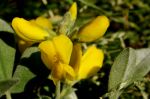
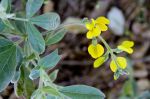

It’s been a while since I looked at a broom flower up close, but at first glance Themopsis blooms appear very similar. Each flower consists of an upflaring top petal, two lip-like lower petals, and a third, bottom-most petal like the keel on a ship. Come to think of it, the overall structure is roughly similar to yesterday’s plant, though the details are quite different. In the pea (or Fabaceae) family, lower petals clasp in around the top of the keel, as if in embrace or protection. You can see this similarity in broom, true lupine, and falselupine, among others. (When it comes to identifying the pea family, keep in mind that the flaglike upper petal can get very large, as you can see in the showy sweetpea).
(note: I originally identified this plant as T. macrophylla instead of T. californica. Thanks to Doreen, below, for correcting me)
Filed under Native, Plant of the day
Plant of the day: Chinese houses
Collinsia heterophylla, or Chinese houses, is a pretty little flower with multicolored purple flowers stacked in whorls. Each flower has two bright purple bottom petals that sandwich a third spurlike petal that points toward the ground like the keel on a ship. This petal is actually a pouch, and the reproductive organs (stamens and pistil) are stowed away inside. The two upper petals are a pale lavendar, decorated with a burgandy pattern of dots. On my specimen those formed a line, arching over the mouth of an inner chamber that – when pried open – proved to be lined with pale hairs.
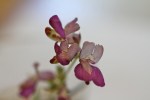


Collinsia is in the Plantaginaceae family, which didn’t exist back when I was learning my plants. That’s the thing about botany – as science progresses, names are changed to indicate our changing understanding of different species’ relationship to one another. So what now is Plantaginaceae once was Scrophulariaceae, which still exists but just with fewer members. Anyway many of the species found in the Plantaginaceae family are assymmetrical, like this one. Snapdragons are also notable members of the Plantaginaceae, but I’m getting a bit off-topic here.
Chinese houses tend to like open, brushy or wooded slopes in partial shade, according to the guidebook, but I saw it growing on a hot, rocky landslide face that the trail cut across.
Filed under Native, Plant of the day
 Flowers Of Marin

