Category Archives: Native

“Plant” of the day: caloplaca lichen

Caloplaca1Here is another cool lichen genus! The Caloplaca are orange crustose lichens that forms nubbly patches on exposed rocks. They are nitrogen-loving little organisms, so when you spot some you have a good hint that there is high nitrogen present (or so I learned on a hike last month with lichen expert Shelley Bensen). You might see it on rocks where birds like to perch and deposit their nitrogen-rich droppings. Caloplaca also is abundant along roadsides with heavy traffic, where car exhaust spews out nitrogen oxide as well as other pollutants.

Caloplaca is a crustose lichen; if you see a bright orange foliose lichen, then you’re probably looking at Xantharia. Look close, because the “leaves” of Xantharia might be very small; and they might look nubbly also, due to the presence of raised little fruiting bodies.IMG_5435

Leave a comment

Filed under Native, Plant of the day

“Plant” of the day: parmotrema lichen

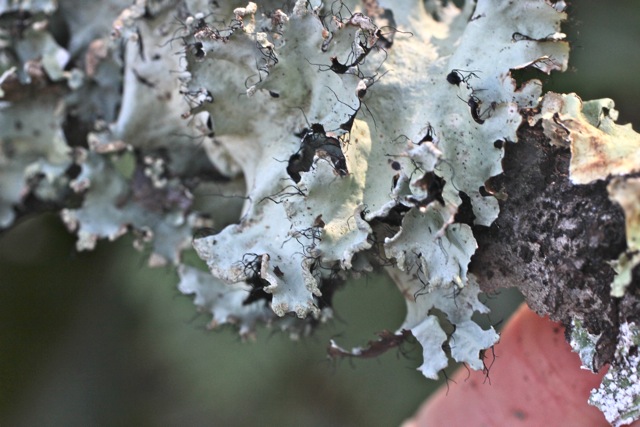
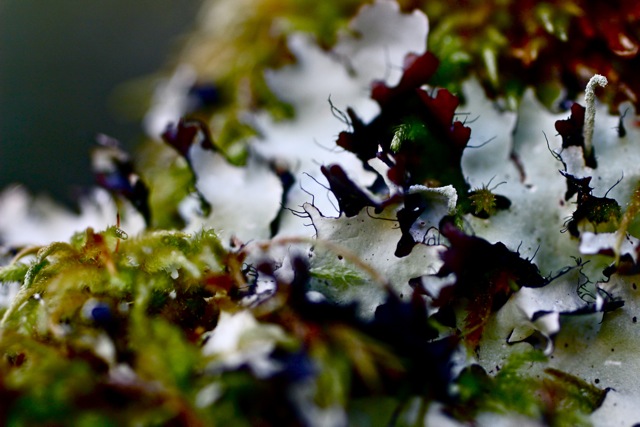
Parmotrema1Dead tree branches often bring lichens with them when they fall to the ground; sometimes a single branch will have many different types of lichen all growing close together. One of my favorites looks like papery lettuce-shaped leaves that are pale aqua-gray on top, and dark beneath. A fringe of eyelash-like hairs decorate the edges of the leaves. This is a genus known as parmotrema; there are well over two dozen species of it in the US, according to the USDA PLANTS database.Parmotrema2

1 Comment

Filed under Native, Plant of the day

Plant of the day: glossyleaf manzanita

Another manzanita to follow on the heels of yesterday’s. Glossyleaf manzanita (Arctostaphylos sensitiva, formerly known as A. nummularia) is a beautiful plant. Small, glossy leaves grow densely along slim branches that are often conspicuously covered in long pale hair. This is the only manzanita in the area to have only 4 petals, and the white lantern-shaped flowers have a paler patch at their base, so the flesh of the petal seems nearly translucent where it joins the stem.

Glossyleaf manzanita is also called shatterberry, because its fruits break into pieces while still on the plant. According to the Marin flora, the long berries look so unlike other (round) manzanita fruits that it was initially thought to be in a different genus entirely.

1 Comment

Filed under Native, Plant of the day

Plant of the day: Eastwood manzanita

A hillside is covered in a thick tangle of shrubs with slim red-barked trunks. These trunks are gorgeous, often growing close together and brilliant in the shadow of the dense foliage above. The deep red bark is so smooth that it looks like an artist has carved it from red clay; the curves and lines somehow remind me of strong human arms.

This slideshow requires JavaScript.

There are nearly a dozen species of manzanita growing in Marin County alone–and superficially they all look very similar, with red trunks; clusters of small lantern-shaped white flowers; and rounded and leathery leaves. They are a critically important part of California’s chaparral ecosystem.

Eastwood manzanita (Arctostaphylos glandulosa) has little, leaflike bracts that grow interspersed with the flowers of each cluster. This species resprouts after fire (which historically was very common in the chaparral) and at ground level it forms a flattened, platform-like burl which grows as it ages. Though sometimes this feature can be hidden under the duff. And lastly, the leaves have flat margins and look the same on both upper and lower surfaces. If a manzanita has all of these characteristics then you’re looking at an Eastwood. They often are hairy, but the species is very variable and as far as I know this isn’t a diagnostic feature.

Leave a comment

Filed under Native, Plant of the day

Plant of the day: California sword fern

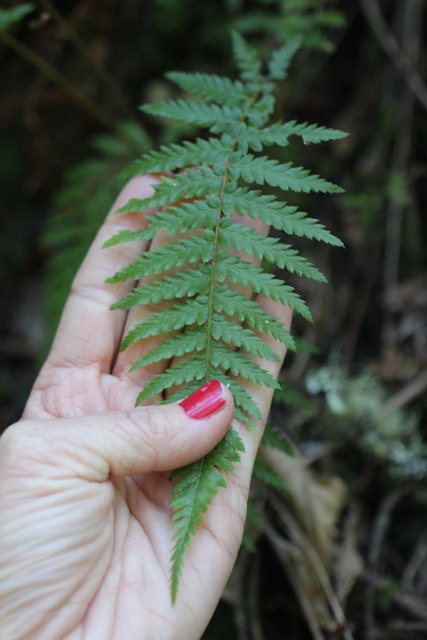
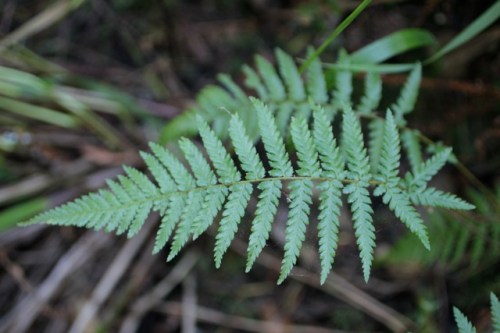
Polystichum_californicum2This elusive little fern is a rare sight in this area, unlike its common cousin, western sword fern. I’ve been looking for it for a while and was delighted to spot it recently, growing in a canyon among many other species of ferns.

California sword fern (Polystichum californicum) has leaflets that are deeply serrated but not cleft all the way to the midvein. The leaves have a slightly leathery, tough feel to the touch when compared with more frail wood ferns, lady ferns, bracken ferns, and the like. They also lack the prominent thumb or hilt that points dramatically towards the tip of some other sword ferns (though the upper lobe closest to the central stem is somewhat enlarged).

California sword ferns are endemic to California, and grow in the shade of deep canyons, as well as wet places near cascades and streams, according to the Marin Flora. The plant photographed here was seen along the Steep Ravine trail on Mt. Tamalpais.

For many years I didn’t know that there were other species of sword fern other than the abundant and lovely western sword fern. But there actually are four species in the Bay Area. In addition to California sword fern, the others are: western sword fern, whose leaves are only very slightly serrated; its smaller but quite similar cousin, rock sword fern; and Dudley’s sword fern, which resembles California sword fern but has pinnae that are so deeply serrate that they become separate leaflets–or fully tripinnate–at the base (or, as the key puts it, “pinnae pinnate; pinnules stalked”).

According to the key, California sword fern is a species resulting from an original hybridization between western sword fern and Dudley’s sword fern. Polystichum_californicum1
Leave a comment

Filed under Native, Plant of the day

Plant of the day: redwood violet

Viola_sempervirensA mat of green, heart-shaped leaves march along the side of a steep hillside, punctuated here and there with bright yellow blossoms that seem to glow in the shade of the forest. These are redwood violets (Viola sempervirens). These little flower grow from a creeping stem that sends out rooting stolons, which then grow a new rosette of leaves.

There are a couple of other species of yellow violets in the Bay Area so be sure to check a key before deciding which you’re looking at. Only one other species has heart-shaped (cordate) leaves, but it can easily be distinguished from redwood violet because the stems are upright (not creeping) and the leaves are located on the stem, right below the flower.

Leave a comment

Filed under Good for gardens, Native, Plant of the day

Plant of the day: Pacific trillium

Three green leaves surround three white petals surround a cream-colored, three-parted pistil–each part offset from the other to form a lovely pattern. The whole thing sits perched atop a slim stalk like an elaborate parasol. This large, striking flower is Pacific trillium (Trillium ovatum, also known as wake robin). Ankle-high groves of it are in bloom along the steep ravine trail on Mt. Tamalpais; a stunning sight beneath the towering redwoods: beauty above and beauty below.

This slideshow requires JavaScript.

This low-growing perennial thrives on shady hillsides and other places that stay moist but are well drained. Trillium is a member of the Melanthiaceae (the false hellebore family, which is a close relative of the lily family) and like lilies it has all of its parts in sets of three, including six yellow stamens. The white flowers turn purple as they age. Each year a fresh stalk sprouts from an underground rhizome.

The plant was used medicinally by various Native American tribes, but only externally–as far as I can tell. An infusion made from the roots was used as a wash for sore eyes, and to treat boils. The Skagit considered it poisonous.

Trillium has also been used as a love potion–the Makah tribe would apply a poultice made of pounded roots as a love medicine; unfortunately my reference doesn’t say what the desired result is, or where the poultice is applied.

Leave a comment

Filed under Good for gardens, Medicinal, Native, Plant of the day, Poisonous

Spectacular salmonberry

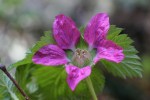
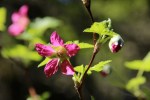
Flamboyant pink blossoms decorate the berry canes growing alongside a shady creek. This is salmonberry–a plant graced with both tasty fruit and beautiful flowers. The open-faced blooms have five delicately crinkled petals surrounding a pale cluster of stamens and pistils.

The berries ripen in the fall, and can be eaten raw or in pies or jellies (they are considered too seedy for jam). These attractive plants are nice in a garden, though should be placed carefully as they can get spindly and are also favored by deer.

While researching this plant I was delighted to learn that there are ailments brought on specifically by excess salmon consumption! I don’t know what these ailments are, but indigenous tribes considered the bark of salmonberry to be an excellent treatment for them. The bark was also used to disinfect wounds and (brewed, powdered or poulticed) to relieve pain, headaches, burns, toothaches, labor pain, and sores. The Kwakiutl tribe also encouraged childrens’ growth by applying chewed salmonberry sprouts to the top of the kids heads.

Leave a comment

Filed under Edible, Good for gardens, Native, Plant of the day

Plant of the day: common spikerush

A tough, grasslike plant grows in a wet marshy area. Many round stems of shiny dark green are clustered together; some are topped with a pointy little brown spike that is actually a head of unobtrusive flowers.

This slideshow requires JavaScript.

This is common spikerush, or Eleocharis macrostachya. Get out a hand lens and look at the flower heads–they are really quite spectacular. Feathery white styles  and nodding tongue-shaped stamens cover the little blooming spike in a complex tangle. There are no petals on this plant: the reproductive bits simply peek from behind a diminutive brown scale (see the close-up photo above). This is characteristic of the spikerushes, and other rushes, sedges, and grasses in general.

All the spikerushes (which are actually in the sedge family, Cyperaceae) have photosynthetic stems and no leaves to speak of. Unlike most sedges, the perennial common spikerush has a stem that can be either flat or round. A thin green sheath, several centimeters long, that is around the base of the stem is actually a modified leaf. Common spikerush has two feathery styles peeking from each brown scale, which has a green midrib running its middle. The flower spikes are more than 7 mm long, and often up to 25 mm long. The plant sometimes grows up to 9 feet tall (though the plants I saw were only a few feet tall).

This species is found in wetlands across most of the United States.Eleocharis_macrostachya4

Leave a comment

Filed under Native, Plant of the day

Plant of the day: redmaids

Tiny magenta blossoms are scattered on stalks of narrow, straplike leaves that blend in with the coarse grasses of a pasture. In the afternoon, five fragile petals are spread wide around a handful of little yellow pollen-dusted stamens and a dainty three-parted pistil. Later, as dusk closes in, each bloom folds closed inside a clamshell pair of sepals, fringed with small hairs.

These are redmaids, or Calandrinia ciliata, a tremendously variable little native. The flowers range from the magenta shown here to violet to white, sometimes in the same patch of blooms. There are usually five petals but the size can vary widely (from 4 to 15mm);  the number of stamens is also variable (from 3 to 15). The leaves can be linear or more paddle-shaped, and both leaves and sepals may be hairy or hairless.

So how do you know you’re looking at redmaids? The sepals are a solid clue–there aren’t many flowers with this feature. The three-parted ovary helps. But you also have to just mix-and-match the characteristics until you are confident that this is what you’re looking at!

Redmaids are common across the west, from New Mexico to BC. Indigenous people would eat the  tender greens and make pinole and other foods from the oily seeds.

Leave a comment

Filed under Edible, Native, Plant of the day