Category Archives: Non-native

Plant of the day: fennel

It tastes great in salads, but fennel (Foeniculum vulgare) is an unfortunate weed in California. It grows avidly along roadsides and in other disturbed places. This plant grows up to ten feet tall, with feathery leaves and yellow umbrella-shaped umbels of flowers.

This slideshow requires JavaScript.

The leaves and the seeds have a distinctive licorice flavor, which is likely why the plant came to the Americas in the first place. It’s been used as a spice and a medicinal plant for centuries, and is thought to have escaped into the wild time after time.

Fennel is an invasive species, and takes over areas by forming dense stands where nothing else can grow. This isn’t just because the plants are so numerous that there is no room for any others. They also exude chemicals that actually prevent their competitors from growing!


Check out the above video for an musical animated interpretation of why fennel is a problem…
 

Leave a comment

Filed under Edible, Invasive, Non-native, Plant of the day

Plant of the day: yellow star-thistle

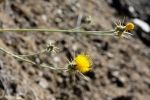
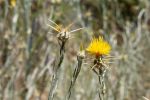
A wash of prickly, pale green stems is scattered across a dry field. Yellow flowers are surrounded by a mean halo of long narrow thorns. Here is yellow star-thistle (Centaurea solistalis) one of the nastiest invasive plants around. It’s a big problem on farmland and in wild places along the west coast. It interferes with grazing, and eventually leads to permanent brain damage in horses that eat it.

Introduced in the 1850s, this thistle is now the most widespread invasive plant in California, infesting between 10 and 15 million acres in the state. A native to southern Europe, it probably first came to the US indirectly, along with alfalfa seed imported from Chile. By the early 1900s it was a serious weed in the Sacramento Valley and was spreading quickly along roads, railways, trails and streams, according to the CalIPC. “It is a thousand times as common as ten years ago, and perhaps even six years ago,” observed Willis Jepson in 1919.

Things have only gone downhill from there! And it’s not surprising why. This deeply taprooted annual invades summer-dry grasslands across most of the US. A single large plant can produce nearly 75,000 seeds, and blooms from late spring through fall. It’s largely pollinated by honeybees but doesn’t have much in the way of predators, and so it continues to spread.


Leave a comment

Filed under Invasive, Non-native, Plant of the day

Plant of the day: moth mullein

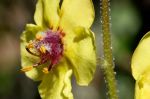
A flash of pale yellow underneath a coyote bush. Growing up under the gray branches of the shrub is a stalk holding several pretty, broad-faced flowers. The five petals surround a hairy, reddish-pink cluster of stamens. The stamens and pistil are flamboyant: the three upper stamens are clustered together, while the lower ones–and the pistil–scoop outward, presumably an invitation to insects.

This unusually striking flower is moth mullein (Verbascum blattaria), and unfortunately it’s not a native to California. It was introduced from Eurasia and has spread across much of the United States. Other species of mullein share the distinctive hairy-ness and the unusual stamen-and-pistil pattern, but otherwise look quite different.

Leave a comment

Filed under Non-native, Plant of the day

Plant of the day: Himalayan blackberry

In ditches and along river banks, the berries are beginning to ripen. Great green mounds of shrubs – all leaves and thorny branches – are speckled with dark purple fruit. Younger berries are still green or red, and most bushes still have flowers on them as well.

This is the Himalayan blackberry (Rubus armeniacus), one of the most common berries around. It is also one of the only non-native invasive berries in the area. Though it’s delicious in pies, smoothies and endless other treats, this shrub can be a nasty problem for native habitats: I’ve seen it smother entire fields, leaving no space for native plants and the animals that depend on them. Usually you’ll see it in disturbed places and on poor soils. Despite the name, the bush originally came from western Europe and there is “no evidence” that it came from the Himalayas.

One nifty thing about this “fruit” is that it’s actually a bunch of small fruits – each little nub on the berry is called a “drupelet” in botany-speak.

Leave a comment

Filed under Edible, Invasive, Non-native, Plant of the day

Plant of the day: salsify

With a spiky green sheath of bracts surrounding several layers of purple petal-like flowers, salsify (Trapopogon porrifolius) is a beautiful and slightly cruel looking plant. The inner flowers of the head are dusted with yellow pollen that is the perfect ornament on the dark purple petals. Each of the large-ish, showy flowers is actually many flowers, since this is a member of the Asteraceae family. Once the flower has gone to seed, it produces a big dandelion poof that can be a few inches across.

This slideshow requires JavaScript.

This plant is also called oyster-root, and it was introduced from Europe where the carrot-like root is eaten; the flavor is described as similar to oyster or artichoke. Here in California it is an escaped ornamental, and likes to grow in dry grassy areas. You usually will see it in disturbed places, not too far from town.

.

Leave a comment

Filed under Edible, Non-native, Plant of the day

Plant of the day: Spanish broom

With flamboyant, showy flowers, Spanish broom is probably the most beautiful of all the evil brooms. It is still evil, though. Don’t be fooled by the big yellow flowers with their many exuberant stamens and pretty wing-like petals.

This slideshow requires JavaScript.

This plant has the lean, linear look of Scotch broom but with even fewer leaves. The California Invasive Plant Council lists Spanish broom (Spartium junceum) as a species that can cause serious problems for native ecosystems. It can grow up to 15 feet tall and form dense stands that smother all other plants in the area. According the IPC, it is native to Spain, Morocco and other parts of southern Europe. It was introduced to California in 1848 as a decorative plant, and in the 1930s was planted along mountain highways in Southern California. Oops.

In Marin, it is one of the least common brooms. I saw the ones pictured here clinging to the slopes of what looks like an old rock quarry owned by the Marin Municipal Water District.

2 Comments

Filed under Invasive, Non-native, Plant of the day

Plant of the day: pride of Madeira

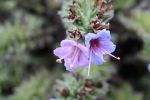
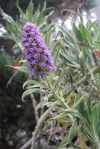
You’ll see these towering purple spikes looming from road cuts and clifftops. This is pride of Madeira, or Echium candicans. It’s a common sight – especially in more coastal areas. It grows to more than seven feet tall, and is very striking with its gray-green leaves and massive heads of flowers (easily over a foot long).

Sadly, this plant isn’t native to the US. It’s another escaped ornamental species that’s still commonly used in landscaping. Birds and butterflies love it, and deer don’t. In inland areas this isn’t a problem but in the coastal climate it spreads on its own, gradually creeping into wild areas. Because it spreads slowly it is only considered to be moderately invasive, but it’s still not recommended for local gardens.

Leave a comment

Filed under Invasive, Non-native, Plant of the day

Plant of the day: oxeye daisy

Hiking across a remote meadow, I suddenly find myself in a knee-high field of daisies. This is the invasive oxeye daisy (Leucanthemum vulgare), a striking flower with stark white petals around a yellow center.

This bloom was introduced from Europe and is now widespread throughout Marin and much of California. It has a cousin, Shasta daisy, which is less common and has (very slightly) larger flowers and leaves. Oxeye daisy is a moderately problematic invasive, growing so densely in places that it excludes other native vegetation. It also is known for giving cows’ milk an unpleasant taste if they eat it.

Leave a comment

Filed under Invasive, Non-native, Plant of the day

Plant of the day: little rattlesnake grass

Briza minor

Tiny brown wedges float on delicately branched stems like a minute Calder mobile. This is little rattlesnake grass, or Briza minor. The wedges are actually tiered heads, very similar to those I wrote about yesterday that you see on (big) rattlesnake grass. But at first glance, they don’t look at all alike, since the little rattler has heads too small to easily see, and a delicate, lacy structure when it grows.

Like its larger cousin, little rattlesnake grass was also introduced from Europe. Though Briza minor is more widespread, it is less aggressive and is not listed as invasive (while big rattlesnake grass IS invasive).

Rattlesnake grasses are in the Poaceae family, the group that essentially all grasses belong to (with the exception of some plants with the name “grass,” like eelgrass). This is one of the largest plant families, with over 9,000 different species, including many of our vital food sources like wheat, corn, barley, and rice!

Leave a comment

Filed under Non-native, Plant of the day

Plant of the day: rattlesnake grass

The brown hills of California are far from monochromatic. Look closely and you’ll see a complex tapestry of colors, textures, shapes, sizes–and sounds! Do you hear that rustling rattle as you brush through the grass? Look close and you’ll see graceful stalks of rattle-shaped grass heads.

This is rattlesnake grass, or Briza maximaone of my favorite plants of the summer. Sadly this nice-looking plant is also fairly invasive (introduced from Europe, and occasionally planted as an ornamental). It’s now become naturalized in the Coast Range and in scattered other parts of California, which is why you see it almost everywhere.

Leave a comment

Filed under Invasive, Non-native, Plant of the day