Category Archives: Plant of the day

Plant of the day: bigleaf periwinkle

You know those moments where you think you know something–until suddenly you realize you don’t? Well this happened to me recently with periwinkle. I’ve seen this shrubby, large-flowered vine my entire life, but it wasn’t until I went to key it out that I realized I didn’t know its name. And when I finally came to periwinkle I couldn’t have been more surprised. This familiar plant is periwinkle? The periwinkle of literature, of blues and eyes and dresses? I always thought it would be some delicate British daisy; instead, it’s this coarse and common invasive!Vinca_major1
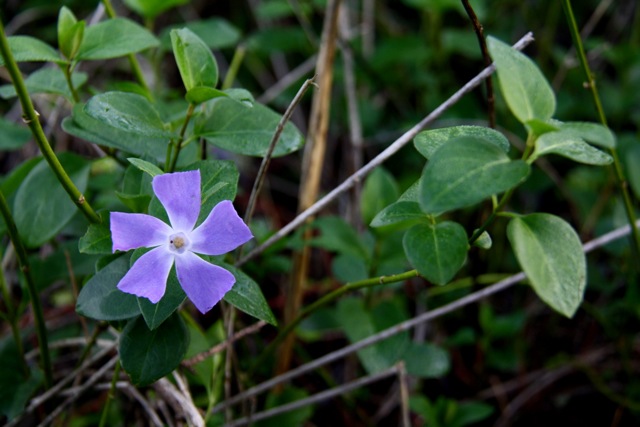
The bigleaf periwinkle of real life is Vinca major, a dark-leaved vine with a milky, sticky sap. This  invasive ground cover escaped from garden plantings and now is creeping across the U.S. In California you can see it in coastal areas, foothill woodlands, the Central Valley, and even in the desert. It forms dense mats, crowding out natives, and can resprout from bits of broken stem or root–a particular problem because it likes to grow on stream banks, where it regularly gets washed away in high water, taking root wherever the broken piece lands.
Leave a comment

Filed under Non-native, Plant of the day

“Plant” of the day: lipstick cladonia

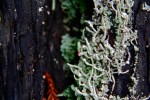
I’ve always been entranced with the tiny gardens–lush yet austere–that grow on fallen logs. Ferns, lichens, fungi, tree seedlings and more all fall on stumps and fallen trees. On the edge of a redwood forest is a log hosting a minute forest of lichens. Small, dusty gray-green leaves cling to the wood, while tiny upright spires rise into the sunshine. At the tip of each little trunk is a red dot: a saucy salute to the world, if one looks close enough.

This is lipstick cladonia (Cladonia macilenta), one of my all-time favorite plants. Though of course, being a lichen, it is actually a symbiotic growth of fungi and algae–and not a plant at all. It is found on dead wood, the base of trees, and sometimes on rocks. It grows on every continent in the world (with the possible exception of Antarctica); mainly in temperate to boreal regions.


Leave a comment

Filed under Plant of the day

Plant of the day: scouring-rush horsetail

A tangle of plants like tall, green soda straws stick out of the ground on the same stream bank where yesterday’s wild ginger grows. This is scouring rush horsetail, Equisetum hyemale. It’s a cousin of the more common giant horsetail, which looks like an oversized bottle brush with wiry arms that stick straight out from a slim central stalk. But instead of looking brushlike, scouring-rush horsetail is unbranched; it consists solely of a tall, single, hollow stalk. It can grow up to nearly 7 feet tall, always in a dense cluster, spreading throughout the area by slim black rhizome.

This slideshow requires JavaScript.

The stems of scouring rush are remarkably tough–if you try to break one off you’ll find it unexpectedly hard to do. Equisetum’s flexible strength is due to silicon dioxide, and native Americans used it to polish wood such as canoes, bone tools, soapstone pipes, arrow shafts, and fingernails, or to make mats and baskets; later, settlers and 49’ers used it to scrub their pots and pans. Kids used it as a whistle, and the strawlike stem was used as a straw, particularly to give medicine to infants and others.

Scouring rush tea had a large number of medicinal uses, including for irregular menses, poison ivy, bleeding, infection, kidney problems, backache, lumbago, gonorrhea, and to treat lice. It’s described by Plants for a Future as “anticancer, anti-inflammatory, antispasmodic, diaphoretic, diuretic, expectorant, febrifuge, haemostatic, hypotensive and styptic…with an appetite-stimulating effect.”

The roots and young spring shoots were sometimes eaten; but large quantities are toxic due to the silica.

Leave a comment

Filed under Good for gardens, Medicinal, Native, Plant of the day

Plant of the day: wild ginger

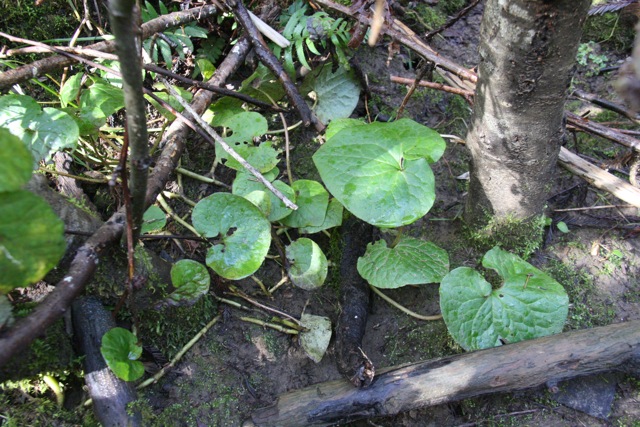
PAsarum_caudatum2alm-sized, heart-shaped leaves grow in a thick patch under a grove of alders on the river bank. This is wild ginger, or Asarum caudatum. The leaves and root, when crushed, release a sweet spicy smell; to me it’s not quite ginger-like but others disagree. In the old days the root was used as a substitute when ginger couldn’t be found.

Wild ginger root can be harvested year-round, but is supposedly best in the fall. The leaves can be made into a tea. Leaf and root were used both internally and externally  to treat headache, joint pain, indigestion and head colds. It was also used as a laxative, and a poultice of warmed leaves was applied to toothaches and boils.

Though these little plants are low-growing and seem fragile, they are actually an evergreen. They spread by rhizome in moist areas, forming clonal patches that are actually all one plant. This dense growth makes wild ginger a good groundcover for shady, moist native gardens–but it spread slowly, so is only for those with patience.

Asarum_caudatum1

Plucked wild ginger leaves showing a chunk of underground stem, or rhizome

There are several other species of wild ginger,  all in this genus, that grow elsewhere in California, but this is the only one in the greater Bay Area. It also goes by the common names of longtail wild ginger and creeping wild ginger. It can be distinguished from its cousins in several ways, such as its small reddish-brown flower whose three petals have a long, dramatic taper like a showman’s waxed moustache.

Leave a comment

Filed under Good for gardens, Medicinal, Native, Plant of the day

Plant of the day: red flowering currant

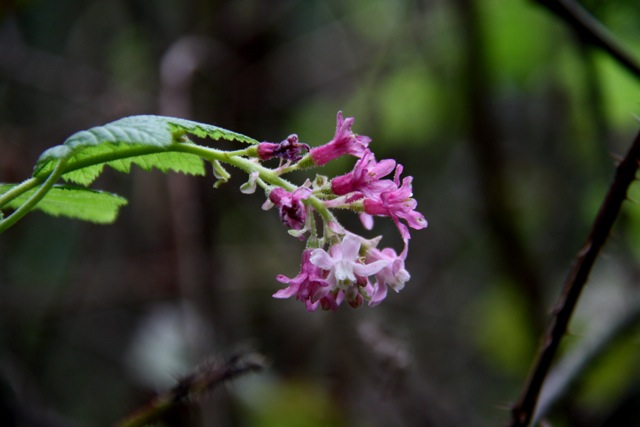
Ribes_sanguineum1Pink cascades of flowers dangle from the nearly-bare branches of a tall shrub. This is red flowering currant, or Ribes sanguineum, an early bloomer that usually blossoms from January on throughout the spring. Up to 20 small flowers unfurl from each raceme, varying shades of pink near the end of each branch where last year’s brown twig has given rise to a new shoot of green.

The blue-black berries of this shrub are edible but not particularly tasty.


Leave a comment

Filed under Native, Plant of the day

“Plant” of the day: old man’s beard

Usnea1Lichens litter the forest floor, shaken loose from the upper limbs of the trees by the winter storms. Old man’s beard is one of the most recognizable: a pale greenish tuft of long hair-like tendrils. My favorite thing about this lichen are the flat, fringed discs that are  some tufts. These are the apothecia, or fruiting bodies–I think they look like amoebas, or maybe stars, or maybe confetti. Delightful either way.

Old man’s beard is actually a generic name for the various members of the Usnea genus–which can be hard for a layperson to tell apart. But the genus itself is readily distinguished from others that look similar because it has a tough central cord running down each strand. If you gently tug on a piece of Usnea, the green outer covering cracks and separates, revealing the interior white cord which stretches like a bungee cord.

Usnea has long been used medicinally–as a bandage and antibiotic for rustic wound treatment, as sanitary napkins and in baby’s diapers. Western tribes such as the Makah used it to make mattresses in their seasonal camps. Modern herbalists have used it to treat lung and respiratory tract ailments. Usnea2

Leave a comment

Filed under Medicinal, Native, Plant of the day

“Plant” of the day: yellow coral mushroom

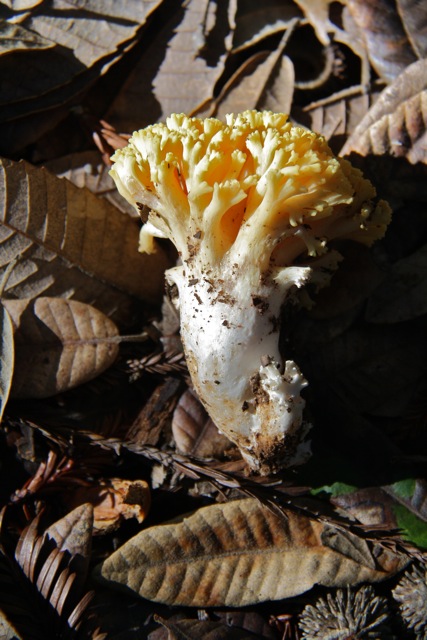
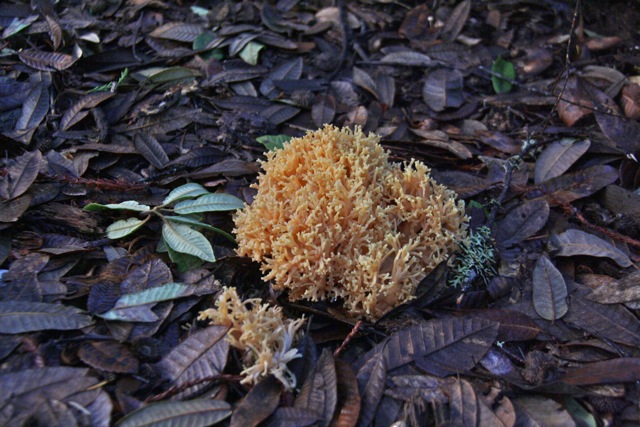
Ramaria_rasilispora1This fungus looks like a discarded bit of sea sponge or foam rubber was left lying on the forest floor. Upon closer inspection, it looks exactly like its name: yellow coral-like arms diverge and split into ever smaller branches.

Yellow coral mushroom (Ramaria rasilispora) is the most common fungus to meet this description—though there are several others. Its lower branches and “trunk” are white, don’t stain green or brown when bruised, and are solid rather than gelatinous. It’s common throughout the west, and in our area is mainly found under tanoaks or live oaks. Interestingly this preference changes with region and elsewhere it is most often found beneath conifers, according to my field guide.Ramaria_rasilispora2

Leave a comment

Filed under Native, Plant of the day

Plant of the day: coast live oak

Scattered across a grassy slope are twisty-trunked, round-topped, beautiful oak trees. Get closer and look at the leaves–if they are cup-shaped and slightly shiny on the  underside this is coast live oak (Quercus agrifolia)–another of California’s best trees.

The acorns are edible once the unpalatable, bitter tannins have been leached out. Acorns were historically a major food source for local Native American tribes, and still are a major part of the food chain for wildlife. People generally remove tannins by soaking the nut in water (or a running stream). But some tribes would plant the acorn in a bog and wait until it sprouted in the spring–a system which apparently got rid of most tannins but preserved more nutrients than the water method.

Acorns can be eaten whole, or ground into a floury powder for cooking. Roasted acorns can be used as a coffee substitute.

Leave a comment

Filed under Plant of the day

Plant of the day: coast redwood

HAPPY 2013!!!! HEY, IS THIS THE FUTURE?!

The bonfire spits and crackles, sending glowing sparks drifting upward. Above and behind these rising embers towers a cluster of dark silhouettes. We are in the middle of a grove of redwoods, ushering the new year in among their timeless company, along with friends and family.

This slideshow requires JavaScript.

This isn’t just a beautiful place–it’s a great spot for the reflections on time that the new year so often leads to. Redwoods (Sequoia sempervirens) are some of the most impressive of all the terrific trees in California, with their tall straight trunks and thickly shaggy red bark. Each tree can live to more than 2000 years old. And they are big; often well over 300 feet tall, and as much as 30 feet in diameter. Redwoods are versatile, surviving even after being burned partially through by fire. When cut down or killed, the stump will still have enough energy to send up sprouts that grow into mature trees of their own. This adaptability lends itself to exploration–you can find trees you can walk through because fire burned through them, or groves tens of feet across that will be genetically the same as the long-vanished parent tree.

These trees are home to abundant wildlife, including pileated woodpeckers, marbled murrelets, and spotted owls–as well as other birds, deer, rodents, salamanders, foxes, and more.  Humans have used redwoods for shelter from tribal times until the modern day. Many of the old houses in San Francisco and throughout California were built with old growth redwood logged in 1800s and into the twentieth century; high-quality redwood is now a pricey and scarce commodity. Settlers would use the cavities created in the trunk by wildfires as livestock pens, particularly for geese–giving these fire scars name “goosepens“.

Redwood leaves are of two dramatically different types–they appear to be from totally different types of tree. The “shade leaves” are flat needles about a half an inch long, that stick straight out from either side of the branchlet. They are often the lowest growing, and are semi-deciduous–the tree sheds them regularly, every few years. The “sun leaves” are small and scaly, pressing closely to the branch. These tend to grow higher on the tree and are shed much less often.

These trees are dependent on the fog and rain coming in from the sea–they only grow in a comparatively narrow band along the coast, growing up to 450 miles inland (but no more) from southern Oregon to Monterey. A lot of their water comes from fog drip, and they prefer moister areas–canyons and rain pockets. All of which begs the question–what will become of these majestic survivors as the climate changes?

2 Comments

Filed under Plant of the day

Plant of the day: blue gum (Eucalyptus)

Tall straight trunks shed shaggy, papery sheaths of bark in the eucalyptus grove. The forest floor is covered with long, sickle-shaped leaves and hard, blue-tinted nuts. Young sprouts–and sprouts from mature trunks–have rounded, blue-gray leaves that are completely from those of mature trees. This is Eucalyptus (Eucalyptus globulus, Tasmanian blue gum): beautiful, flammable and invasive.

This slideshow requires JavaScript.

Blue gum was first planted in Marin as a fast-growing windbreaks and for a brief time as a commercial crop (though as far as I know this never was lucrative). As a native to southern Australia, it thrives in California and spreads quickly. No native plants can grow in Eucalyptus stands–either because the leaf litter is so thick, or because they are killed off by the strong-smelling oils the tree produces. The same oils and abundant shedding of bark and leaves can turn these trees into torches during a wildfire, increasing the danger for homes and people nearby; though they are lovely it’s a good idea to cut them down and stop their spread wherever possible.

There are several other species of Eucalyptus that can be found in Marin, but this is the most weedy and common.

Leave a comment

Filed under Plant of the day