Category Archives: Plant of the day

Plant of the day: winter speedwell

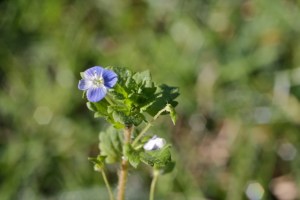
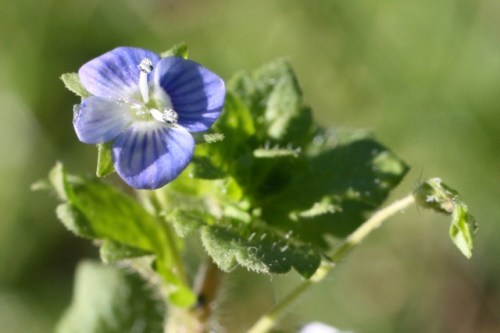
Veronica_persica2Patches of small blue flowers are blooming between the rows of winter beets and chard on a friend’s farm. This is winter speedwell, or Veronica persica. The local speedwells are easy to identify: look for little flowers with four petals, one noticeably smaller than the others. The other distinctive feature is a protruding pair of antenna-like stamens.

Winter speedwell has flowers that rise from the stem on long stalks (aka pedicels), so they stick out beyond the roundish, scallop-edged leaves. Some speedwells are native, but this one is not–though neither is it particularly invasive. Veronica_persica1

Leave a comment

Filed under Non-native, Plant of the day

“Plant” of the day: orange jelly

Dacrymyces_palmatus1Which witch is which? As mentioned on Halloween, the slimy and wonderful witch’s jellies can be hard to tell apart. Orange jelly Dacrymyces palmatus (also called orange witch’s butter or witch’s jelly) is the only one that lives on the dead wood of conifers. It often looks very much like a brilliantly colored, tiny brain–but it can become more flattened as well, so the best way to ID it is to know what kind of tree it is growing on. In this photo you can see the tiny blisters of sap under the bark that let you know you’re looking at a young Douglas fir tree.

Leave a comment

Filed under Native, Plant of the day

“Plant” of the day: sudden oak death

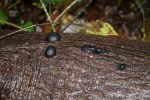
The killer that is laying waste to the oak trees of California is almost invisible. Sudden oak death got its name before anyone knew why the trees were dying; eventually the cause turned out to be Phytophthera ramorum. The only outward sign of infection is a dark, bleeding ooze that leaks down the bark. But a second fungus, hypoxylon, is almost always associated with the disease–this one fruits into a distinctive black growth that emerges from the bark and looks like a mound of dark, hardened foam. But inside the tree the infection is running rampant.

While tanoaks and several species of oaks are the most likely to die from the disease, several other species are carriers–including redwoods, rhododendrons, and pepperwood. The spores of Phytophthera can’t travel far; they rely on the splash and flow of rainwater to carry them. But hikers, bikers, and ATVs do a much more effective job of moving the infection from place to place. It can also spread on firewood and the equipment used to do tree work. The sad truth is that even if it moves slowly, certain trees–like tanoaks–have no resistance to this disease. Once it reaches them, they will die, and someday they are almost certainly going to be locally (if not totally) extinct.

Leave a comment

Filed under Invasive, Non-native, Plant of the day

Plant of the day: tan oak

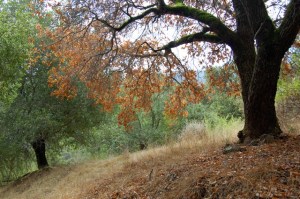
Notholithocarpus_densiflorus1

Notholithocarpus densiflorus

The beautiful tree is dying.

From Big Sur to Brookings, entire groves have browned and fallen. Single snags stand in forests like wisps of smoke, like ghosts.

Sudden Oak Death is old news these days – but how does news of a plague become old? The beautiful tree is dying, and eventually it will be gone. With it, a piece of California will be gone as well.

There is a reason the Kashaya-Pomo tribe called the tan oak Chishkale, or “beautiful tree”. Its bountiful harvest of acorns was one of the best foods around. The Kashaya and other native people soaked and beat the nuts into breads and cakes, gruel and soup. During a flu, they sucked acorns like cough drops. For celebration, strung acorns were twirled in the air to make music.
Notholithocarpus_densiflorus2Chishkale has been a generous neighbor to humans and non-humans alike. Northern flying squirrels, dusky footed woodrats and black salamanders are just a few of the myriad creatures that call its roots and limbs home. Their nutrient-packed nuts are a key fuel driving the engine of the ecosystem here in the coastal hills where it lives; deer, squirrels, woodpeckers and jays all dine on the bitter fruit. They were a favorite snack for grizzlies, before the bears were driven from the state. And when feral pigs arrived, acorns became a rooting prize for the hogs as well.

Other creatures eat the creatures that eat the acorns, and when fruit and flesh decay, still more creatures dine on that. Their offal enriches the soil, from which more plants rise. Without them, the engine will falter – and then, because nature eternally adapts, it will change. But something precious will be gone for good.

So, if you aren’t from around here, go outside now. Go and spend time with the tanoaks while groves still live. While they still stand in crowds or pairs and or singly among other trees on a hillside.

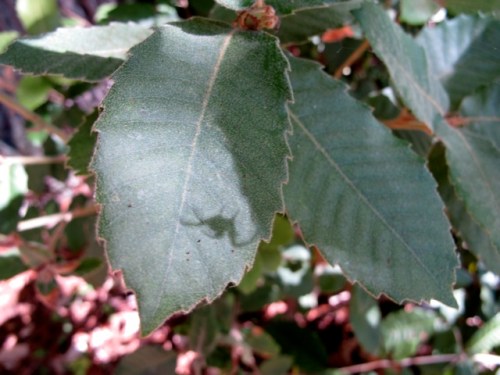
Ideally, do this in late summer, when the acorns have fallen and you can see how thick they are on the ground. Find somewhere that the trees grow closely. In places the acorns crunch under your feet like gravel. Notice how dark green the leaves are: serrated like a bread knife, with undersides coated with a soft beige fuzz.

Leave the trail; you are on a brown carpet of leaf and twig. The air smells uniquely dusty and a little soft, thick with the down from the leaves. Sunlight filters down in shifting patches, and squirrels and jays chatter and call. Sometimes a raven swoops through with a heavy push of wings, a dignified awk awk. With a breeze, you may notice that the sound these particular branches make in the wind is like all branches in all wind, and also like no other branches on the planet.

If it is a warm day maybe you will want to find a nice tree, an old one with a broad trunk, and take a nap at its base. When you wake up, you may think of how long your companion has been in this spot, of what it has stood witness to. And mourn for a minute that soon it – and all of its kin – will be gone.Notholithocarpus_densiflorus3
Leave a comment

Filed under Edible, Plant of the day

Plant of the day: five finger fern

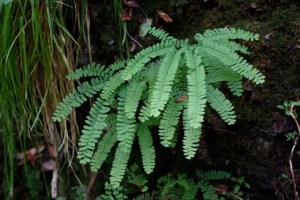
Adiantum_aleuticum1A lacy fern parasol hangs from the side of an earthen cliff. Each slim stem is topped with a spreading fan of fronds. This is five finger fern (Adiantum aleuticum), found most often in canyons and moist, shaded hillsides.

It’s in the same genus as the striking maidenhair fern, and one of its traditional uses is as a wash to make hair more shiny. Five finger fern tea was also used by Native Americans as a general tonic to treat congestion, sore throats, and other ailments. Chewed leaves were applied to wounds to stop bleeding. One source says it was highly valued as a medicine up through the 1800s.

It is said to grow readily in moist and shaded gardens, and is generally resistant to deer.

Leave a comment

Filed under Good for gardens, Native, Plant of the day

Plant of the day: threecorner leek

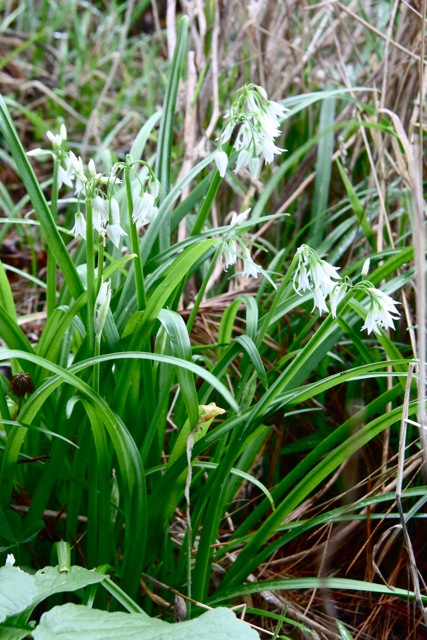
Allium_triquetrum2Is this little bloom early or late? We’re at the time of the year when it can be hard to tell. Threecorner leek (Allium triquetrum, also known as white flowered onion) is a pretty little weed that can cover entire meadows in the spring. The nodding white blossoms have six pointed petals, each decorated with a single green vein, and usually grow in clusters at the end of a leafless stalk.  The fleshy stem is triangular in cross-section, giving rise to its name. The rest of its name comes from its mild garlicky flavor and smell.

The flowers, leaves and bulb of the threecorner leek are all edible–you can add the leaves and flowers to a salad or eat them along the trail. Older leaves and the small bulbs are best cooked.

Allium_triquetrum1

Threecorner leek is native to Europe and Africa.

1 Comment

Filed under Edible, Non-native, Plant of the day

“Plant” of the day: feather boa kelp

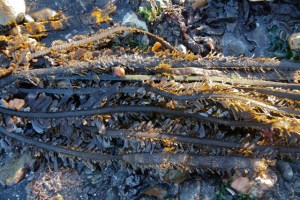
Looking just like its name, feather boa kelp lies draped across the exposed rocks at low tide. This brown alga (Egregia menziesii) grows its “feathers” off of a long, straplike stalk that can be up to 15 feet long. Small air-filled floats are scattered among the feathers like bangles. The feathers are usually 2 to 4 inches long and can vary widely in shape; from flat (either broad or narrow) to cylindrical to threadlike.

Leave a comment

Filed under Plant of the day

“Plant” of the day: rockweed

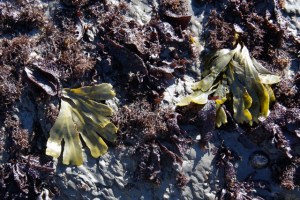
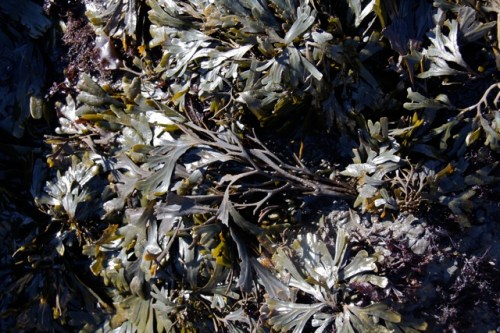
Lacy mounds of flat, greenish-brown leaves stand out in the cacophony of intertidal life. This is rockweed (Fucus gardneri), another brown alga that is widespread from Alaska to California. The mature tips  puff up and act as a float–and as the nursery where sperm and eggs develop before being released to find one another in the water. These tips are edible, and were called “Indian popcorn” by settler because local tribes liked to eat them dried. Other sources recommend eating them young (either fresh or blanched); but always in moderation.

Other names for rockweed include bladderwrack and popweed.  It has several lookalikes (F. spiralis, Hesperophycus californicus and Pelvetiopsis limitata), but rockweed can be identified by the central midrib running down each hairless, mitten-shaped leaf.

Leave a comment

Filed under Edible, Plant of the day

Plant of the day: surfgrass

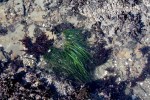
Tufts of surfgrass grow in the sandy channel between tidepools. With their long leaves waving gracefully, they look like a mop of green tossed in the water; the hair of a submerged mermaid. There are two species of surfgrass in California; the flat leaves of Phyllospadix scouleri (pictured here) are 2-4mm wide, while its cousin P. torreyi has round, wiry leaves that are only about 2mm wide.

These plants serve as a nursery and general home for many species of fish, invertebrates and algae. Native Americans would eat the rhizome–and occasionally the leaf, which was preferred when it had herring eggs on it. The dried leaves were used in basketmaking.

Leave a comment

Filed under Plant of the day

Plant of the day: sea lettuce

Sea lettuce looks exactly like its name: ruffled, brilliant green leaves that grow in tufts from shallow rocks. It’s usually found in calm waters. There are many species of sea lettuce in the Ulva genus, and as of right now I have no idea how to tell them apart–but from what I’ve read, that’s because they are all quite similar in looks and habit.

Sea lettuce is a green alga, and is edible though sometimes a little tough and bland. Some enjoy it for salads. One warning if you are planning to eat some Ulva is that it grows particularly profusely in water that’s been “enriched” by sewage or other pollution. So if you see a dense patch of the stuff, take a close & skeptical look at the nearby landscape before you harvest it…

Leave a comment

Filed under Plant of the day