Category Archives: Plant of the day

Plant of the day: California fuchsia

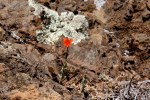
It’s a treat to see a whole cliff-full of flowers blooming at this time of year–but that’s just what I found on Mt. Tam the other day. California fuchsia (Epilobium canum) is a late bloomer that you can see in scattered spots throughout the bay area.

Hummingbirds pollinate this flower, attracted by the scarlet, trumpet-shaped blooms. Other common names include hummingbird flower or hummingbird trumpet. It sports these flowers at the end of long stalks densely covered with small, slightly wooly leaves. This perennial plant can be woody at the base (the technical term for this is suffrutescent) but it is usually fairly low growing, with several sprawling stems that are around one foot long. California fuchsia is in the Onagraceae family along with other showy blooms like fireweed, clarkia, and evening primrose.

I saw it growing on a hot, southwest-facing road cut as Pantoll climbs up towards Rock Springs.


Leave a comment

Filed under Good for gardens, Native, Plant of the day

Plant of the day: goldenfleece

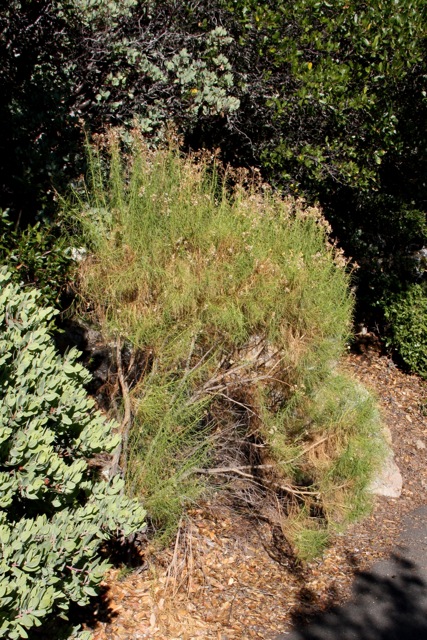
A leggy shrub is common in the scrubby chaparral atop the east peak of Mt. Tamalpais. Right now it is dressed in puffy tufts of seed heads and the last remains of unobtrusive yellow flowers. It has lemony-green, needle-like leaves that release a pungent smell when crushed.

This is goldenfleece, or Ericameria arborescens. It’s endemic to California, and is an important part of the chaparral community, growing up to 9,000 feet.

There is also a near-total lack of information about it. Goldenfleece is one of the few plants that appears to not have been used for much traditionally. “While of no grazing value, its abundance is noteworthy,” one text reports. It has never been investigated for medicinal value. Native Americans bound hot stones and the twigs of closely related species onto sore feet to relieve them; leaves were used to make a plaster for blisters. But no uses are recorded for goldenfleece itself.

Leave a comment

Filed under Native, Plant of the day

Plant of the day: common velvetgrass

In a sheltered ravine near the coast I find some late-flowering velvetgrass (Holcus lanatus). This invasive grass is a good indicator of a wetland or stream; I saw it growing on the edge of a trail with a seep spring on the uphill side.

This tufted, perennial grass has velvety gray-green leaves and a pretty, purple-tinted grass head (really, clusters of tiny flowers). It is very common near the ocean but less common inland, according to the Marin Flora. Velvetgrass reproduces quickly and grows in dense clusters; it’s a bad neighbor because the roots interweave so tightly that they become impenetrable to any other sort of seed.

Leave a comment

Filed under Plant of the day

Plant of the day: box elder

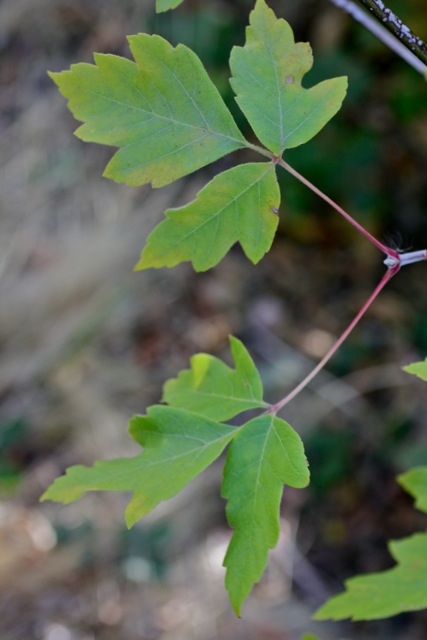
Along streambanks and ponds, the box elder (Acer negundo) is yellowing and losing its leaves–one of the many subtle signs of California fall.

Despite its name the box elder is one of the two maple species growing in our area. Unlike the classic maple, box elder leaves are divided into three–or sometimes more–leaflets; they are also known as cutleaf maple or ash maple. The picture shown here is a single leaf composed of three separate leaflets. The leaves are usually smooth on top, with a velvety fur on the underside. The trees can be low and shrubby or a graceful tree nearly 70 feet tall. They aren’t a common sight, but they are a California native. Keep your eye out for them in the springtime, when abundant drooping racemes of rose-purple flowers appear alongside the budding new leaves.

Cute li’l box elder beetle

incidentally, these trees are host to adorable little red and black box elder bugs which mainly feed on this and other Acer species.

Leave a comment

Filed under Native, Plant of the day

Plant of the day: calla lily

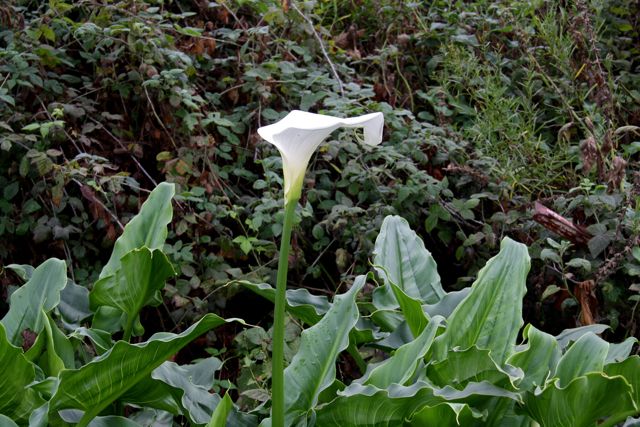
Here is another pretty out-of-season bloom. Calla lilies are a gorgeous sight with large cream-colored blossoms rising from clusters of dark green leaves. They usually flower from May through June, but recently there has been a pretty cluster of them growing near the neighborhood farm stand in Bolinas–is it climate change? Or just the variable microclimates in the Indian summer of California?

The stark white “flower” of the calla lily is actually a spathe, or bract–a leafy appendage below the flower that is usually green. The actual flowers are clustered on a yellow nub that rises from the center of the creamy white sheath. Each spathe is nearly 10 inches across.

This plant is native to east Africa, and grows in scattered locations here in California–usually near places that are (or were historically) inhabited.

Calla lily (Zantedeschia aethicopia) is mildly toxic to eat. It is also called Arum lily and (according to Wikipedia) “varkoor”, which aptly means “pig’s ear” in Africaans.

Leave a comment

Filed under Non-native, Plant of the day, Poisonous

Plant of the day: dusky willow

Dusky willow (Salix melanopsis) has long, narrow, hairless leaves. In general, willows are notoriously hard to identify–mostly because different species interbreed. Despite this confusion, it’s generally easy to tell when you’re looking at some species of willow. They can be shrubs or trees, but they often are found in wet areas–on the edge of wetlands, or along stream banks. They tend to have slim limbs. Most notably they sport small, rounded mini-leaves (stipules) thatgrow at the base of the larger leaf’s stalks. All willows have leaves that are alternate and in the spring they sprout silky catkins.

Willows have a lot of salycilic acid, which is essentially aspirin. You can buy willow bark capsules at health food stores as a more natural alternative painkiller.


Leave a comment

Filed under Medicinal, Native, Plant of the day

Plant of the day: giant horsetail

Along a damp ditch, bristly green bottle-brushes grow to my knees. This is giant horsetail, or Equisetum telmateia. Some call it a weed, but horsetail is one of my all-time favorite plants. They form low thickets of supple green stalks with long, skinny stick-like leaves that sprout out in all directions. When I was a kid I’d pick my teacher bouquets of them on my way to school—my quirky version of the proverbial apple.

As an adult I learned there are even more reasons to love horsetails than their good looks. The Equisetum species are considered “living fossils”, which means that they have changed very little over the last hundred million years or so (though they have shrunk some; back then they grew as tall as trees!).

Grab a handful of horsetail plants next time you walk past a patch. It scrunches pleasantly in your palm, but the slim stalk and leaves tend to bend, not break. They are jam-packed with silica, which makes them strong as well as flexible. This earned the plant the alternate name of scouringrush–it’s been used to scrub dirty dishes, to polish metal, to clean floors, and even as sandpaper. Some herbalists recommend drinking a tea made from the dried young stalks for strong and supple hair, skin and bones. Watch out, as large amounts of the raw plant can be harmful or toxic.

The bottle-brush part of the plant that you usually see is sterile, but in the spring giant horsetail sprouts a fertile stalk that is leafless and topped by a pale cone-like structure that releases spores. It also spreads by rhizome, which may be why some call it a weed—it can be dense and hard to get rid of since new plants sprout up from the roots.

There are four species of Equisetum in the SF bay area, but only two of the brushy type. Giant horsetail is probably more common in these parts, though its bushy cousin Equisetum arvense snagged the  official nickname of “common horsetail”. You can identify giant horsetail because its stem is larger–generally greater than 5mm across–and if you look close at its twiggy leaves, you’ll see that each is ribbed with several grooved ridges. The grooves also are a way to identify it, though the giant-ness is easier.

Leave a comment

Filed under Medicinal, Native, Plant of the day

Plant of the day: white alder

White alder looks almost the same as its cousin, red alder, which I wrote about in my last post. This tree grows a bit taller, but the main way to tell them apart is by looking at the underside of the leaf. In white alder (Alnus rhombifolia) the leaf margin is flat instead of tightly rolled underneath. It also produces its catkins slightly earlier, in January instead of from February through March.

White alder has flat leaf margins

Red alder has inrolled leaf margins

Both species are common in Marin, but you’re less likely to see white alder growing right along the coast.

Leave a comment

Filed under Medicinal, Native, Plant of the day

Plant of the day: red alder

Tall, straight tree trunks line the banks of the stream–each trunk elegantly splotched with patterns of white and gray. This is red alder, or Alnus rubra, one of the two common species of alder in this area.

This fast growing species is important as an early colonizer of disturbed habitats–landslides, stream banks, logging sites, or even forest clearings where a big old tree has fallen down and made a gap. I’ve seen hundreds of young alder sprouting up on the gravel left behind a retreating glacier, and it was one of the first plants to grow back in the wasteland left by the Mt. St. Helens volcanic eruption back in the 80s.

Around here, alder tends to prefer the moist soils of canyons, streamsides and wetlands. Besides the characteristically blotchy bark you will know alder by its tiny woody cones and its broadly serrated leaves that seem almost dented by the lateral veins that run across them from midrib to margin.  Red alder can be identified by the way the edge of the leaf rolls tightly under itself, so when you flip one over you see a dark green ridge running around the rim of its paler underbelly. The other local species of alder (white alder, or Alnus rhombifolia) has a flat edge.

Red alder contains the compound salicilin, which is similar to acetylsalicylic acid–aka aspirin. Native Americans used extracts of the bark to treat a wide range of maladies from tuberculosis to headache (as well as stomachache, wounds, eczema, diaper rash and more). Cones and catkins were also used. Some tribes rubbed rotten wood on limbs to sooth aching bones. A red dye can be made from the bark–one use for this was to dye fishing nets, supposedly making them invisible to fish. 

Leave a comment

Filed under Medicinal, Native, Plant of the day

Plant of the day: cape weed

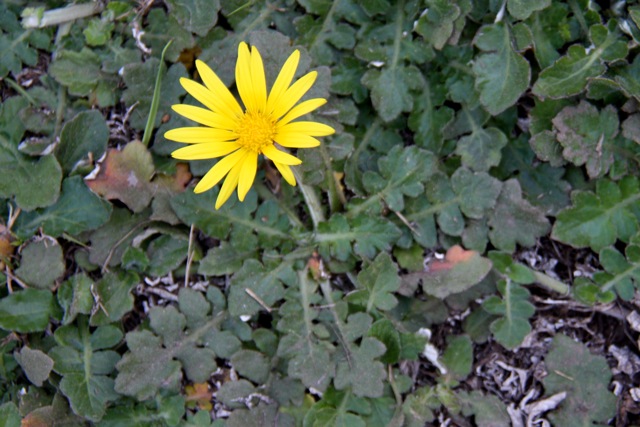
A coastal bluff is carpeted with a mat of yellow daisies. The leaves are grayish green, woolly, and shaped like deeply lobed arrowheads. The flowers are bright yellow, blooming a few inches above the rosette of leaves.

This is cape weed, or Arctotheca calendula, an invasive species introduced from South Africa. It spreads via underground stems called stolons, as well as by seed. It has often been planted as an ornamental because of its flashy flower and long blooming period, but ecologists discourage this because of its tendency to invade delicate coastal prairies.

Traditionally, cape weed was considered to be one species but it is now actually identified as two separate species–the fertile Arctotheca calendula and infertile (or, rarely fertile) Arctotheca prostrata which can only reproduce via stolon and not by seed. The leaves of the infertile species, prostrate cape weed, are either entirely yellow on their underside–or they are tinted a reddish to brownish hue on the outer half of the leaf. The petals of the fertile, “standard” cape weed are a steely blue color underneath.

Leave a comment

Filed under Invasive, Non-native, Plant of the day