
 A thicket of green grass in the middle of a dense forest is a strange sight at any time of year but is especially odd now, in late summer. But here it is–going brown at the edges but still distinctly green (not so easy to see in these photos, unfortunately). This is panic veldtgrass, or Ehrharta erecta, which is a nasty invasive. It isn’t picky and can grow in all sorts of places, forming a thick green carpet that smothers a diversity of other more delicate plants. Once you start seeing Ehrharta, you realize that it grows in many parts of Marin. After it gets established it’s tremendously difficult to get rid of, so it’s a good one for homeowners to be aggressive about getting rid of if it shows up on their land.
Category Archives: Plant of the day
Plant of the day: panic veldtgrass
Filed under Invasive, Non-native, Plant of the day
Plant of the day: seaside daisy
 This pretty purple daisy prefers excellent views. It grows along the coast, often clinging to rocky cliffs or sunbathing on sandy beaches. I photographed the ones shown here on the Point Reyes Peninsula, growing on the top of Arch Rock–a lovely vantage point looking down on the long stretch of coast to the north and south.
Seaside daisy (Erigeron glaucus) has rounded, grayish green leaves that are soft to the touch. The flowers heads are purple, ranging towards white or pink, with a yellow center. It’s native to California and Oregon, and it’s often seen in rock gardens as well as in the wild. Other names include beach daisy and seaside fleabane.
Filed under Good for gardens, Native, Plant of the day
Plant of the day: common cattail
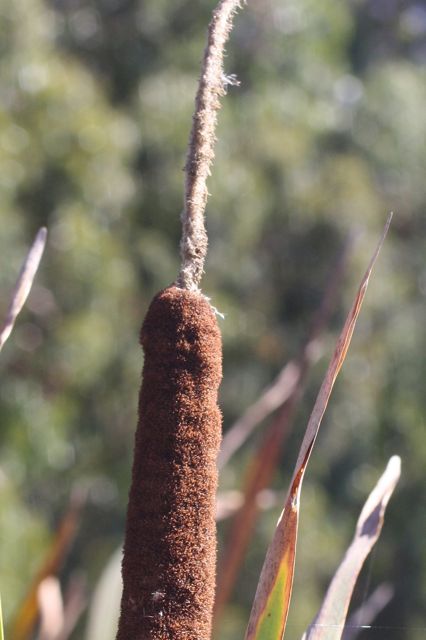 Common cattail is a common sight in wetlands, ponds and roadside ditches. These tall reeds have blossoms that look more like sausages, with long brown cigar-shaped flower heads that really look nothing like flowers. But the sausages are actually flower heads, with the female flowers clustered in the lower, plumper segment while the male flowers are clustered together above. This is common cattail, or Typha latifolia, which is also known as broadleaf cattail or soft flag.
In this species, the skinnier (female) flower head is stacked immediately above the fatter one with no gap of stem visible in between.If you see a segment of stem you’re looking at narrowleaf cattail (T. domingensis or T. angustifolia). These two species are harder to tell apart–look for orange or yellow flowers, and dark dots on the inside of the lower leaf, to ID T. domingensis.
Filed under Native, Plant of the day
Plant of the day: turkey tangle fogfruit
 A low mat of green leaves speckled with small purple flowers is growing on the hard-packed soil between the trail and the water. This plant has the wackiest plant name I’ve ever heard: turkey tangle fogfruit! Phyla nodiflora has squat spires of small purple blossoms, each with a pale yellow splotch inside. The lowest parts of the spire bloom first, so as the flowers seem to be set on a ever-expanding brown pedestal as the season progresses. The whole package is only about a half an inch tall.
I’ve only seen turkey tangle fogfruit growing in a few places–always right on the edge of a trail alongside water. These photos were taken yesterday in Inverness, on the bank of Papermill Creek. It also grows along the edge of Bon Tempe lake, but has already finished blooming there. I always thought it was probably an escaped ornamental garden plant, which is exactly what the Marin Flora says that it is. But the CalFlora database lists it as native, and the Jepson lists it as native with the caveat that it is “questionably native” and may have been introduced multiple times from multiple places, including South America. Either way, it’s a quirky little plant to keep your eye out for! The leaves apparently are edible, and can be used to make a tea with a grassy flavor. It is used to treat colds and coughs. The plant is said to have antiparasitic properties and has been used to treat hookworm and other problems. 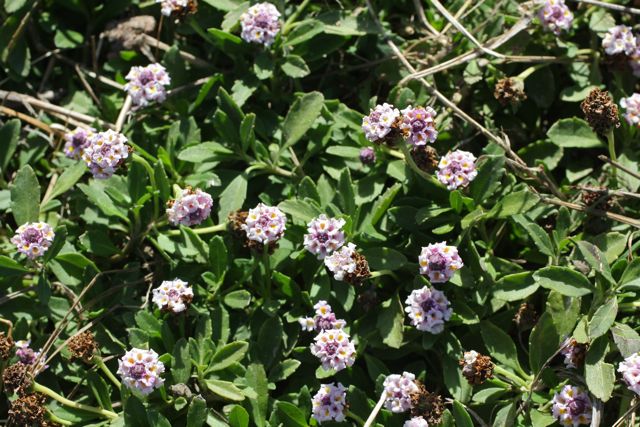
Filed under Native, Non-native, Plant of the day
Plant of the day: pitgland tarweed
A dry meadow has turned into a sea of blooming yellow tarweed. But when I look close, I see that there are two shades of yellow here: lemon and saffron. Pitgland tarweed is growing intermixed with the (more common?) hayfield tarweed, which I wrote about a few weeks ago.


Many pitgland tarweed (Holocarpha virgata) flowers grow along a single stem. Because this is a composite, each petal is actually a three-lobed ray flower. The anthers of the central disc flowers are dark, and tipped with yellow pollen. The leaves are tiny, looking more like the needles of a tree than like flower leaves. The main stalk is essentially leafless, but each flower head grows on a side-stalk that is densely spiked with yellow-green leaves.
Filed under Native, Plant of the day
Plant of the day: nasturtium
 These brilliant orange flowers are so brightly colored they can almost seem to glow. Nasturtium (Tropaeolum majus) is a garden plant that can sometimes escape into nearby forest–usually near the coast. It’s never seen growing far from human habitation.
The flowers are large, edible and very beautiful. They range in color from buttery yellow to pale orange, and the upper petals often have dark stripes that run into the throat of the blossom. The three lower petals are dramatically fringed at the entry to the throat. Each flower has five pale sepals. The upper several sepals are fused into a long spur that extends backwards behind the bloom like a gnome’s cap.
When they are happy, nasturtium plants can grow into dense mats, sprawling across the ground and climbing up fences, buildings and other plants. Fortunately they don’t appear to take over large areas, so gardeners don’t have to feel too guilty about planting this potential invasive.
All parts of the plant are edible, and they have a sweet, spicy flavor that is somewhat like arugula. The seed pods are even spicier–some people harvest them young to use like capers, and others dry the mature seeds and grind them like pepper. I love to nibble the flowers raw or add them to salads. In the Andes, the nasturtium’s native range, they were used medicinally to disinfect and heal wounds, and to treat chest congestion. It is described as having properties that are antibacterial, antifungal, antibiotic and possibly even anti cancer.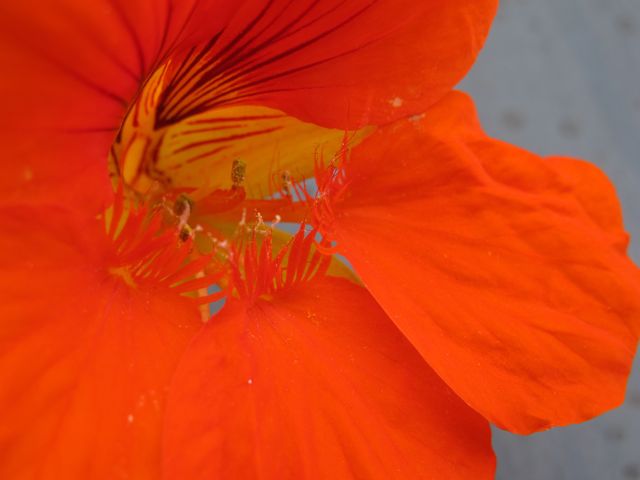
Filed under Edible, Non-native, Plant of the day
Plant of the day: Mt. Tamalpais lessingia
Tiny pale pink flowers are scattered throughout the grasses and serpentine rocks of Carson Ridge. They grow singly and in small clusters at the end of highly branched, wiry stems. When you look close you see that they form a cobwebby network throughout the brown grass. This is Mt. Tamalpais lessingia (Lessingia micradenia var. micradenia).
This plant prefers shallow gravely soil on serpentine outcrops, according to the Marin Flora. This variety grows only in Marin, and is listed as a rare species. It also is very counterintuitive to identify. Though it appears to have single blossoms with five petals, it’s actually in the Asteraceae family along with sunflowers, daisies and other composites. But the Lessingia species tend to be sneaky this way–check out this list and see for yourself.
Filed under Native, Plant of the day, Rare
Plant of the day: English plantain
 English plantain are supposed to be done flowering, but a few are still blooming along the coast. These green grass-like torpedos were one of my favorite childhood plants. You can make a loop out of the stem, and if you slide the flowering stalk through the loop quickly then the head will pop off–a missile to bombard another kid with.
Plantago lanceolata is in the group of low-growing plants known as plantains–and is not at all related to the banana-like plantains. This little herb sprouts a long stalk bearing a single flower, extending up from a low rosette of ground-level leaves. It is not a native to California.
Though technically edible, the leaves are described as fibrous, and removing the fibers is hard work for a somewhat bitter green. The plant is better used medicinally, as it has antibacterial properties. English plantain is used to treat ulcers, rattlesnake bites and myriad other maladies. The seeds are mucilaginous and swell up if eaten–apparently this makes them good as laxatives and treatments for indigestion. 


Filed under Non-native, Plant of the day
Plant of the day: narrowleaf trefoil
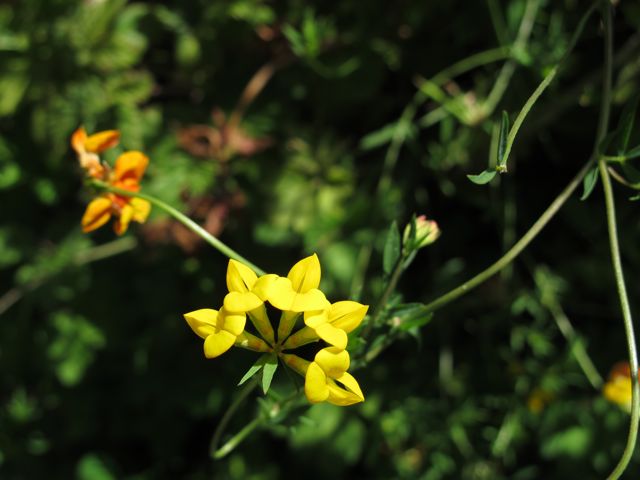
 Bright yellow pea flowers grow scattered and in mounds. Narrowleaf trefoil (Lotus tenuis) is an oft-overlooked plant, common to roadsides and meadows. A native to Europe, it escaped from cultivation and is now a common sight in Marin.
Several blooms grow clustered together at the end of low, sprawling branches that are largely leafless. Leaves consist of five leaflets, which can sometimes look like only three since the lowest two grow very close to the stem.
Narrowleaf trefoil is common across most of California and much of the US, particularly on both the east and west coast. 
Filed under Non-native, Plant of the day
Plant of the day: bristly ox-tongue
It looks like a dandelion on steroids–a big, mean, nasty dandelion. The flowers are sunny little composites that dry into carefree puffs. But it grows to be six feet tall… and the entire plant is prickly. This is bristly ox-tongue, or Helminthotheca echioides.

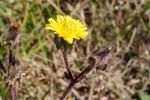
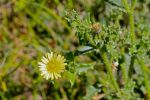
One of the most unique aspects of bristly ox-tongue are the pale blister-like bumps on its leaves. I have seen a huge variation in size; often it is only ankle-high, but sometimes (even in the same general area as the smaller versions) the stalks can grow as tall as my shoulder.
This species is a late bloomer, with flowers beginning in June but continuing in places all the way until December. It is native to the Mediterranean but isn’t highly invasive. You will usually see it growing it seasonally wet or damp soils. It has no medicinal or traditional uses that I know of.
Filed under Non-native, Plant of the day
 Flowers Of Marin