Category Archives: Plant of the day

Plant of the day: naked lady

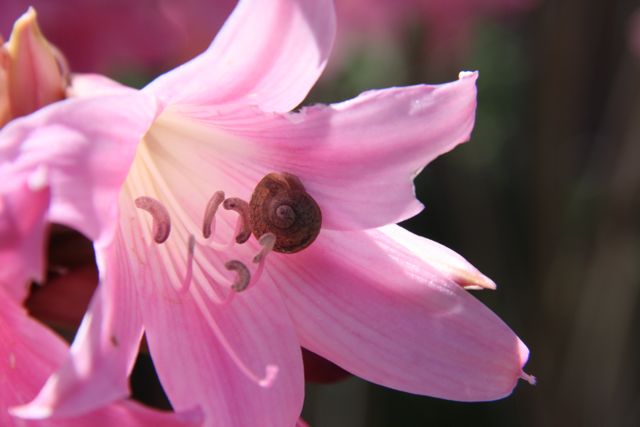
Amaryllis belladonnaTall, garish pink lilies are blooming in the dry grass of hillsides and fencelines. These are naked ladies (also known as pink ladies, Latin name Amaryllis belladonna), which are one of the classic sights of late summer in California. Their name comes from the fact that they don’t flower until after their lush mound of spring leaves have died back and disappeared. Then each single blossom rises on a long naked stalk.

The large horn-shaped blossoms have six pointed petals, six stamens topped with crescent-shaped anthers, and a delicate scent. This non-native lily was planted widely by early settlers, and patches of the flower on remote hillsides can be a clue that a garden or homestead once stood there. They are hardy, handling transplanting well and spreading locally so that eventually a few scattered plants can grow into a dense and colorful patch. Luckily it doesn’t spread widely and so it remains a colorful novelty and not a full-blown invasive species…
3 Comments

Filed under Non-native, Plant of the day

Plant of the day: fivefinger cinquefoil

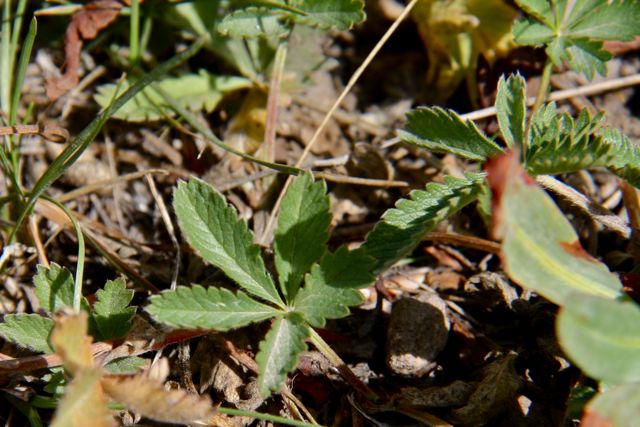
Here in a moist mountain meadow I find a little yellow flower with five petals surrounding many stamens. Five jagged-edged leaves spread like a palm at the end of their stalk (and the term for this leaf arrangement is, indeed, “palmate”). This is fivefinger cinquefoil, or Potentilla gracilis.

The flower, plus the deeply creased, jagged leaves, are the signature of most Potentilla species. But unlike our lowland silverweed cinquefoil, which I wrote about a few months ago, the fivefinger cinquefoil can’t be found at sea level (though it does have quite a wide range, growing as low as 400 feet in elevation and up to nearly 12,000 feet). Look at that post, here, to see the similarities and differences between the leaves.

It’s also called northwest cinquefoil and slender cinquefoil. Native American tribes used the roots medicinally (either pounded or as a poultice) to treat aches and pains.

Note the fan-shaped “palmate” pattern of leaves

Leave a comment

Filed under Native, Plant of the day

Plant of the day: primrose monkeyflower

Mimulus primuloides

On a mossy lake shore, a small yellow flower gapes its red-spotted tongue towards passing insects. It stands only a few inches tall, balancing a single bloom on a thread-thin, leafless stalk. A rosette of green leaves surrounds it at the base. This is primrose monkeyflower (Mimulus primuloides), which only likes to grow above 2,000 feet in elevation.

At first glance, this little yellow monkeyflowers of the alpine country look a lot like those of the lowlands–but look close! Even though we are used to seeing Mimulus guttatis around here, there are many other species with bright yellow blossoms that are dotted with red… But this is the only one (that I know of) to bear a single flower on a leafless stem.

1 Comment

Filed under Native, Plant of the day

Plant of the day: desert mountain mahogany

From a distance, the small trees seemed to be covered in gray flowers. Once up close, the “flowers” turned out to be curlicue seedpods covered in long silver hairs. The pods are striking, each tipped with a long curling tail like that on a squirrel or a frightened cat. This is desert mountain mahogany (Cercocarpus ledifolius), which grows in dry parts of California at 4,000+ feet in elevation. 

This slideshow requires JavaScript.

This small evergreen tree has oval, leathery leaves that are slightly hairy. I didn’t see it in bloom, but the flowers are described as unobtrusive–small and slightly hairy, with many stamens indicative of its membership in the Rosaceae family.

Mountain mahogany was used medicinally by Native American tribes such as the Paiute and the Shoshone to treat colds, burns, heart troubles and diarrhea. The inner bark was used as a red dye for buckskins Fish spears and bows were made from the wood, which is so hard and dense that it won’t float in water.

Leave a comment

Filed under Native, Plant of the day

Plant of the day: explorer’s gentian

Beautiful deep-blue flowers top tufts of green on an alpine slope. The vase-shaped blossom spreads into five gracefully rounded petals at the mouth; each petal is dotted with pale yellow spots that fade into green deeper in the throat of the flower.

This is explorer’s gentian, or Gentiana calycosaanother high-elevation beauty (also called the Ranier gentian, or the Ranier pleated gentian). It likes cold climates and wet soil near streams or in low meadows (although I saw it outside this typical range, growing on an exposed and rocky slope, so this can happen as well). Bees and other insects love to rummage in it’s deep flowers, and it has been cultivated as an ornamental. In the Bay Area, you can keep your eye out for the similar-looking pleated gentian (Gentiana affinis), a cousin that prefers low elevation.

Leave a comment

Filed under Native, Plant of the day

Plant of the day: ranger’s button

Woolly beige tufts rest on umbels of stout stalks. This is ranger’s button (Sphenosciadium capitellatum), a common mountain plant with flowers are clustered into dense and symmetrical heads. Each round and wooly heads is then clustered into an umbel, at the end of a branching stalk. The umbel stalks also are woolly, and the overall effect is highly stylized and geometric.

Ranger’s button likes to grow in the wet soil of meadows, or near lakes and streams. It grows at 3,000 to 10,400 feet in elevation. This plant is in the celery family (Apiaceae) along with poison hemlock and angelica, which it somewhat resembles. It’s toxic to livestock, and an infusion made from the root was used by the Paiute tribe to treat lice… and venereal sores.

Leave a comment

Filed under Native, Plant of the day

Plant of the day: giant blazing star

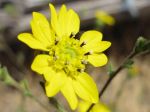
This yellow-flowered plant grows everywhere on the east side of the Sierras, like a weed. But how can any weed be this beautiful? The pale yellow blossom is as big as my palm, with long delicate petals, and a spreading bouquet of yellow stamens rises from the center. Five skinny “petals” that alternate with the wider ones are actually modified stamens that don’t produce any pollen. This extravagant bloom is surrounded by long green sepals  that peek out from between the petals. With a pale stem and scalloped green leaves, the entire package looks like a carefully wrought floral display. Yet nature did all of the arranging.

Giant blazing star (Mentzelia laevicaulis) can be found across much of California and across all of western North America. Despite its delicate looks, this beauty loves high heat and rocky habitats. It was also used by many native tribes for everything from skin wash to gravy. Roots were used to treat arthritis, earaches, bruises and fever. An infusion made from the leaves was used for stomachaches and skin disease. The gravy was made from fried seeds and water.

Leave a comment

Filed under Native, Plant of the day

Plant of the day: prickly poppy

Flamboyant white flowers are scattered across a sagebrush plain. Prickly poppy, or Argemone munita, has the large papery-thin petals–stark white around a brilliant yellow center. Insects flock and feed among the many yellow stamens. The whole plant has abundant gray-green leaves that are prickly to the touch, and stands as tall as my knee. It is truly a beauty! But you won’t see it in the Bay Area; it grows across the west but only between 4,000 and 8,500 feet. If you see a similar flower at low elevation, you’re probably looking at one of this bloom’s lovely cousins, such as the Matilja poppy.

Leave a comment

Filed under Native, Plant of the day

Beauties of the Sierra

In the next few posts, I’ll be writing about some of the spectacular plants of the High Sierra (as I spent several days roaming the stretch of Highway 4 between Lake Alpine and Markleeville last week). It’s a beautiful and varied landscape, cresting at Ebbett’s Pass at over 8,700 feet. There are granite slopes, windswept cliffs, pine forests, sagebrush deserts and wet meadows.

This slideshow requires JavaScript.

And the plants are varied as well, from the lush blooms of the desert to the tiny beauties of the meadows. And, of course, everything in between. Some of the flowers grow here in the lowlands as well (such as the water buttercup and speedwell I wrote about earlier this week) but they bloom later at high altitudes. Others look similar to our local varieties, but are different species. And some don’t look like anything around here at all!

Leave a comment

Filed under Plant of the day, TRAIL NOTES

Plant of the day: hayfield tarweed

A pungent odor wafts across the flower-filled summer meadow. The smell is coming from the abundant yellow daisy-like flowers that are scattered everywhere. This is hayfield tarweed, or Hemizonia congesta. They look pretty, with three-lobed ray flowers encircling a soft yellow center. But if you pick one up you’ll get a sticky souvenir: this plant is incredibly resinous, and the smell and the stickiness will follow you until you can scrub off. Low-slung dogs will come back from hikes needing a bath, and the fragrance (strong but not unpleasant) lingers on fur and clothes.

Hayfield tarweed can be either white or yellow, and there are a number of other species of tarweed as well (though they are in several different genuses, and vary a fair amount in the way they look). The seeds of the Hemizonia and Madia tarweeds are edible–they were among the many types of seeds that Native American tribes collected and ground into flour. One miner described watching the Sierra Miwoks harvest in 1851: “During the months of August and September we often saw Indians coming and going. It was the time of their harvest; they came to our flats to gather all kinds of seeds, even hayseeds. It is the Indian woman who does this work; she has a big hamper or very open basket, of very fine reeds, and coated with a starch made of powdered seeds and warm water. She holds this hamper with one hand under the grass in seed; then with a sort of fan also made of reed… she pulls the grass over her hamper; the seeds, thanks to the shake given by the fan, are detached and fall.” (excerpt from California Grasslands, edited by Stromberg et al)

Leave a comment

Filed under Edible, Native, Plant of the day