Category Archives: Plant of the day

Plant of the day: white clover

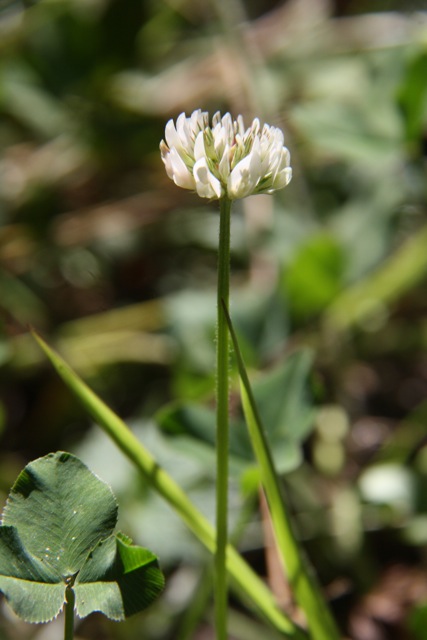
White heads of flowers dot the unmowed ball field like cotton balls scattered freely. But look close and the blooms are not at all cottony; this is a clover, each head a cluster of dozens of small pea-type flowers. The leaves are distinctively bisected with a faint crescent line that looks like a watermark, or the pattern left behind on paper that was soaked and then dried.

Everpresent in lawns and weedy berms, white (Trifolium repens) clover is one of the most common (and dare I say overlooked) plants around. Rare, shy, or temperamental flowers are a treat to find and behold–but I also like to take the time to get to know the species that are so common that they are easy to ignore. This little European invader is certainly one of those. But it turns out that not only is it a favorite snack for livestock, but humans can eat it too! Young leaves can be used in salads or soups, or it can be cooked like spinach. Dried flowers and seed pods have been ground into a high-protein flour that can be used on its own or as a garnish. The plant can be boiled for a tea, either just because its tasty or as a traditional Cherokee treatment for fever. Roots can be cooked and eaten, and evidently the leaves give baked goods a vanilla-like flavor. Who knew.

Trifolium repens

Leave a comment

Filed under Edible, Medicinal, Non-native, Plant of the day

Plant of the day: spearmint

Mentha spicata

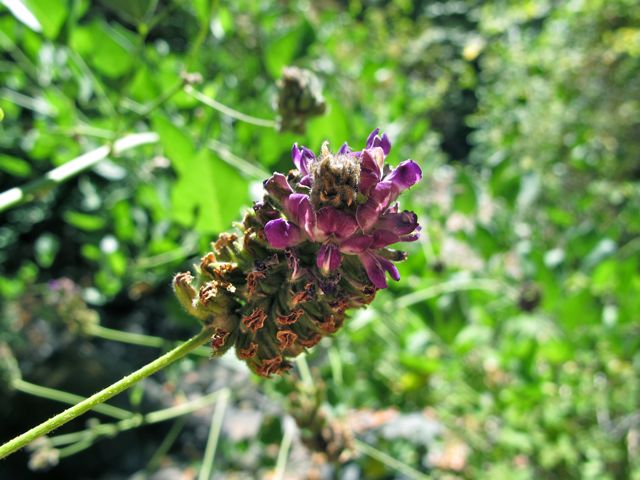
Purple spikes grow as high as my shoulder in the creek bed. This tall purple mint looks like the big brother of pennyroyal, which I wrote about last month. But its whorls of lavender purple flowers merge together towards the top of the spire, instead of remaining separated in distinct tiers. As with all the mints, it has a square stem and paired leaves.

Native to Europe, Mentha spicata is found across much of the United States and Canada.

Leave a comment

Filed under Plant of the day

Plant of the day: wood rose

Rosa sp.

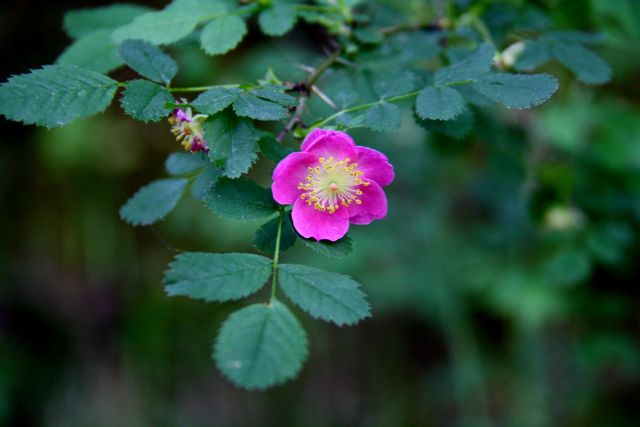
In spring, the native roses bloom with graceful pink blossoms. In the summer, they are decked with clusters of red fruit. And year-round, the elegant bushes are lush with small round leaves. A wild rose is a treat in any season or any setting, whether forest or garden. Telling the different species apart can be tricky (the local key requires fruit which isn’t helpful in spring). But at this time of year, the wood rose–Rosa gymnocarpa–stands out because it loses its sepals as its fruit begins to ripen; other species retain the sepals (and sometimes the dried remains of the stamens too) on the ends of the fruit. One of its other common names is “bald hip rose”.

Though technically edible, the small red hips are packed full of seeds that are nestled inside a dense layer of hair that grows on the inside of the fleshy shell. Not exactly succulent, they have a tart, good-for-you, vitamin-C kind of tang. I read that the seeds are a good source of Vitamin E. The petals also can be eaten, and both petal and hip can be steeped for a tea. Historically, leaves were sometimes chewed as a remedy for bee stings, while the soaked bark was a wash for sore eyes.

See how the end of the fruit is smooth?

Leave a comment

Filed under Edible, Good for gardens, Medicinal, Native, Plant of the day

Plant of the day: common nightshade

Solanum americanum

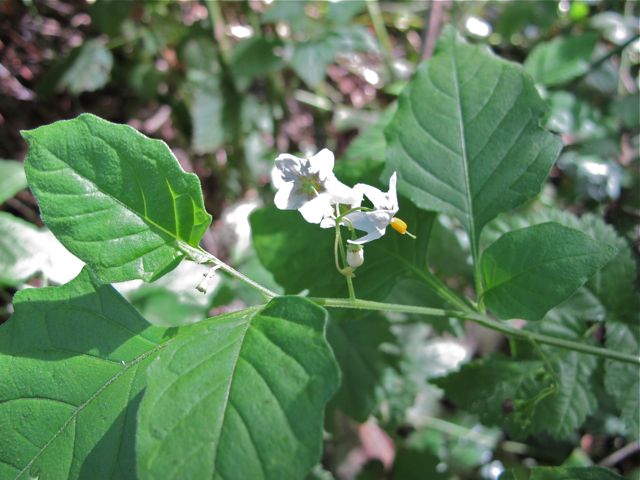
As a kid I called this plant deadly nightshade, which may be why it has always looked sinister to me. It likes to grow in shady places, where its white or purple flowers gleam like little stars. Solanum americanum twines its narrow stem up through bushes, or drapes over tree branches. The deep green leaves are arrow-shaped–like a weapon, or the head of a rattlesnake or pit bull. It may look pretty but its very outline says “don’t mess with me.”

Despite being in the same family as peppers, potatoes and tomatoes, nightshade is quite toxic. My childhood respect was well-founded; eating the unripe berries has been fatal to more hapless tots. But just how poisonous nightshade is can vary with population, environment, and the age of the plant. Farmers don’t like it because the berries can’t be separated from peas and some beans, it is resistant to some herbicides, and the vines can gum up the harvesting machinery as well (according to the CA Department of Food and Agriculture).

I’m not sure whether this is a plus or not, but nightshade also contains salasodine, a natural compound that is used in some countries to manufacture steroid hormones.

Common nightshade is considered native, but there is a chance that it was an early introduction from South America.

Leave a comment

Filed under Non-native, Plant of the day, Poisonous

Plant of the day: hedge parsley

This is one of the many unassuming plants that will be leaving souvenirs in your socks throughout the summer. With seed pods studded with hooked barbs, it catches easily on fabric and fur. Hedge parsley, or Torilis arvensis, is a mildly invasive species that has spread throughout much of the state (below 5,249 feet according to CalFlora, though such a precise number seems a tad arbitrary).

With tiny white flowers and only a few small leaves scattered along the stem, this calf-high plant is easily missed–though its burrs are more noticeable. Hedge parsley is in the large and diverse carrot family (or Apiaceae), landing on the untasty end of the spectrum that ranges from poison hemlock to culinary parsley.

Leave a comment

Filed under Non-native, Plant of the day

Plant of the day: California hemp

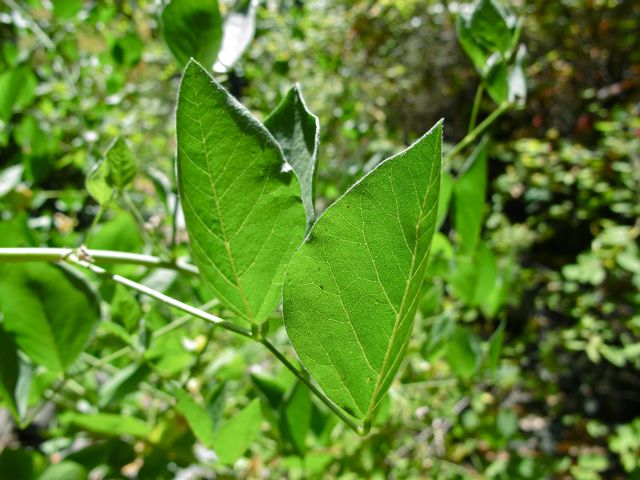
A tall, sprawling bush grows in a rocky creek bed, decorated with cone-shaped heads of purple pea flowers. Plain, broadly pointed leaves are arranged in threes. Often the leaves are folded slightly towards their central vein, and also bent at a sharp angle to the stem so they look upraised, like a hand cocked at the wrist.

This is California hemp (Hoita macrostachya). This leggy plant has hollow stems and likes to live in moist places and is a good indicator of wetlands. It is found almost exclusively in California, as are the other two species in the Hoita tribe. All have purple flowers and similar leaves, but one is a creeping, low-growing plant and the other is found in serpentine chaparral, not in wetlands.

The name California hemp likely derives from this plants historic use as a textile. The fibers of its stem are strong enough that they reputedly have been used for sewing, as well as been woven into ropes or bags. A yellow dye can be made from its roots.

Leave a comment

Filed under Native, Plant of the day

Plant of the day: coastal gumweed

Masses of yellow flowers are blooming beside the lagoon. Bees swarm over the blossoms, rummaging for pollen in their daisy-like centers. Nearby, white goo that looks like Elmer’s glue coats the younger, unopened buds. The green bracts surrounding the petals are fleshy spikes, curved strongly backward.

This slideshow requires JavaScript.

This is coastal gumweed, or Grindelia stricta. The species is highly variable, growing either upright to about waist height, or prostrate along the ground. You can find it along the Pacific coast from Los Angeles to Washington state. The erect version shown above (Grindelia stricta var. angustifolia) was photographed at the Bolinas Lagoon; it’s usually found in salt marshes. This is the only local species of Grindelia to have woody stems so it is easy to tell apart from other gumweeds. Other names for this species include Oregon gumweed and marsh gum plant.

Leave a comment

Filed under Native, Plant of the day

Plant of the day: sticky sandspurry

Spergularia macrotheca

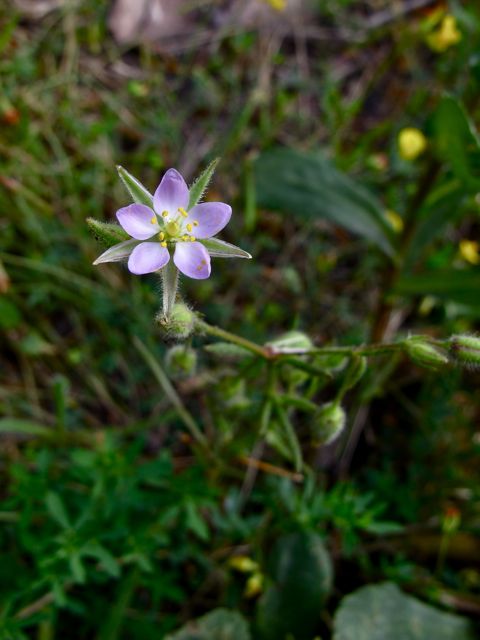
On the upper edge of a salt marsh, pale purple flowers grow low to the ground. This is sticky sandspurry, or Spergularia macrotheca. There are several different species of spurrys in the area, and all are very similar. To identify S. macrotheca I had to get out my hand lens and look close at the tiny seeds. In this species, each seed is surrounded by a narrow, papery halo (or “wing”).

With its five pale petals surrounding cheery yellow stamens, sticky sandspurry can be found along the Pacific coast states up to Canada and southeast Alaska. The plant earns its name by being covered with short, sticky hairs. Clustered leaves, rising from a swollen spot in the stem, give a clue that it’s in the Caryophyllaceae family.

It prefers to grow in wet places, often near saltwater, but it also can be found by freshwater seeps, springs and vernal pools–and in non-wetlands as well.

Notice the swollen stem at the leaf nodes


1 Comment

Filed under Native, Plant of the day

Plant of the day: chicory

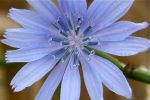
This tough, blue-eyed plant is a rugged survivor (aka, a weed). Chicory (Cichorium intybus) thrives on the edges of human activity: roadsides and empty lots. It was originally native to Europe, but now it is so well established across North America that it often is described as “naturalized”.

Chicory also has a long relationship with people as a food. It’s roots–roasted, toasted and ground–are a renowned coffee substitute. They also can be cooked and eaten like parsnips. The bitter leaves are used in salads or spaghetti; they are less bitter in the wintertime. Because chicory plants have plenty of inulin (a type of starch that diabetics can’t digest) they are a recommended food for people trying to limit their glucose.

Their pretty blue flowers are light sensitive, opening at dawn and closing by the afternoon.

Leave a comment

Filed under Edible, Non-native, Plant of the day

Plant of the day: saltmarsh dodder

Bright orange patches dot the green swath of a salt marsh. Look close and you will see what looks like a mat of fishing line or straw. Hundreds–thousands–of narrow orange threads are wrapped tightly around bright green pickleweed stems. Copious white flowers often bloom off the threads. This is saltmarsh dodder (Cuscuta salina), a parasitic native plant that mooches nutrients off its host plant. Instead of photosynthesizing its own food, it sinks tiny root-like organs (called haustoria) into the flesh of the plant. Once it taps into the vascular system it can suck out all the water, minerals and carbohydrates that it needs.

Dodder seeds are scattered by wind, tides and animals so there is no guarantee that they will germinate near a suitable host plant. But they die if they can’t find one quickly. It sounds impossible for a  brainless, eyeless, noseless  plant to do, right? Nope–not if a host is anywhere close. They can detect the volatile compounds emitted by the host (basically, its smell) and then they grow towards it.

There are a lot of species of dodder in the US, and some of them are parasitic to some of our favorite crops like alfalfa, potatoes and petunias. Though the group is much maligned as a result, some ecologists make a case for the role that parasitic plants can play in the natural environment. Species like dodder or mistletoe don’t decimate their hosts’ population, but they do create patchiness. And in ecology, patchiness tends to lead to diversity, which is a good thing!

1 Comment

Filed under Native, Plant of the day