Category Archives: Plant of the day

Plant of the day: mist maidens

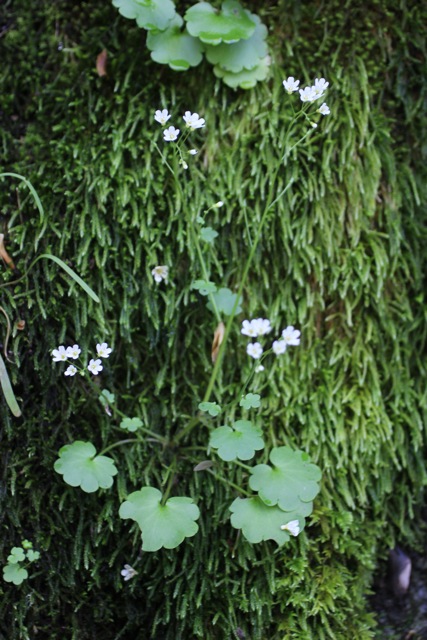
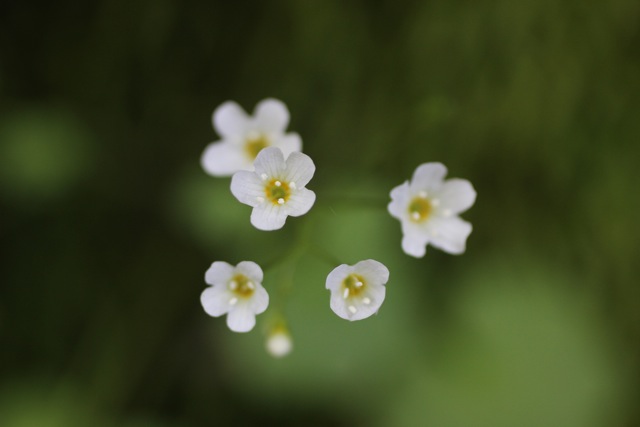
Romanzoffia_californicaIf it looks like a saxifrage and it grows like a saxifrage, then it’s a saxifrage… right? Well, no. Not in the case of mist maidens (Romanzoffia californica). The delicate spray of white flowers rises on long bare stalks from a rosette of scalloped leaves… which is the characteristic growth pattern of the Saxifragaceae. But this little moisture-loving plant is actually in the Boraginaceae family, along with forget-me-nots and fiddlenecks.

Mist maidens are found in shaded forests and moist, rocky slopes in Oregon and northern California. You’ll almost always see them in wetlands (or wet-hills?); the Marin Flora reports that they are especially spectacular on the Tomales Bluffs, where great masses of them grow. Romanzoffia_californica2
Leave a comment

Filed under Native, Plant of the day

Plant of the day: spring vetch

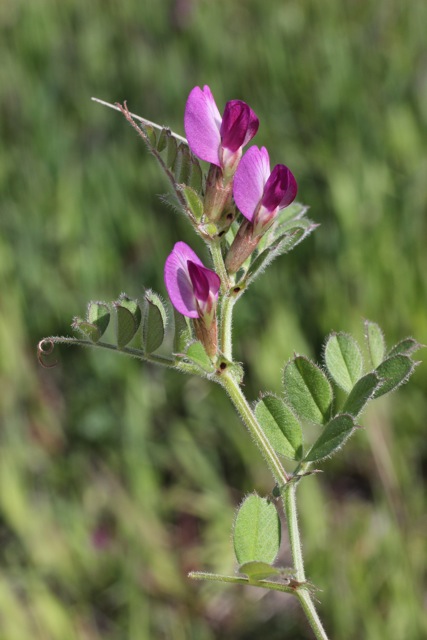
Vicia_sativa1This little vetch is in full bloom right now; you can see it everywhere. Low twining vines sport one to three magenta flowers, nestled among feathery leaves.

Spring vetch (Vicia sativa) is a nitrogen fixer in the pea family that was introduced to the US from Europe and North Africa. The leaves, seeds, shoots and pods are all edible; according to Wikipedia, evidence from  Neolithic sites in the Middle East suggest it was a part of the local diet of the time. It has also been reported from predynastic sites of ancient Egypt and several Bronze Age sites in Turkmenia and Slovakia. However, definite evidence for later vetch cultivation is available only for Roman times. If you trust Wikipedia, that is.

It is also known as garden vetch and common vetch.

Leave a comment

Filed under Edible, Non-native, Plant of the day

Plant of the day: fringe cups

The petals of fringe cups (Tellima grandiflora) look like they have been trimmed back into a geometric design, like a paper snowflake. The flowers of this common and lovely little blossom grow in a densely packed spike, and can be greenish-white or pale red. They tend to grow in shady forest, where the slightly translucent petals catch the light beautifully.

This slideshow requires JavaScript.

There are a few medicinal uses listed for the species in the Native American Ethnobotany Database. It’s a short but entertaining list: a decoction of the the pounded plant was taken to restore the appetite, or to treat “any kind” of sickness. Lastly, the Nitinaht tribe of Vancouver Island reportedly chewed the plant “as medicine to stop dreams of having sexual intercourse with the dead.”

Hm.

Fringe cups  grow on moist, rocky slopes and in shaded forest across the west, from California to BC and Alaska.

Leave a comment

Filed under Native, Plant of the day

Plant of the day: divaricate phacelia

Spotting a phacelia always makes me want to break into song: oh Phacelia, you’re breakin’ my heart… you’re shaking my confidence daily. I love these little members of the waterleaf family; often they have caterpillar-like, curlicue inflorescences that slowly unfurl as the blooms mature.

This slideshow requires JavaScript.

Divaricate phacelia doesn’t curl like some in the genus do, but it’s a very pretty little flower. Five-petalled blue blossoms grow in small clumps atop soft green stems. Though not particularly common in Marin,  it can be abundant in patches like one I stumbled into on a serpentine outcrop on Mount Tam. It also can put on showy displays after a fire burns through chaparral, according to the Marin Flora.

This flowers’ blossoms are as pretty as its names are dull: it’s dubbed either annual blue phacelia or divaricate phacelia (a not-so-inventive inversion of the scientific name  Phacelia divaricata).

It is only found in central California.

Leave a comment

Filed under Native, Plant of the day

Plant of the day: purple deadnettle

Lamium_purpureum1This little plant stands along the trail like a tiny, tiered pagoda. The upper leaves are a deep purple, but despite its name, purple deadnettle (Lamium purpureum, also known as henbit) doesn’t look at all dead.

The square stem and the shape of its leaves and flowers give it away as a member of the mint family. Purple deadnettle is native to Europe and Asia but has naturalized in California and many parts of the US. The young leaves are edible and used in salads and stir-fries.

Leave a comment

Filed under Edible, Non-native, Plant of the day

Plant of the day: bleeding hearts

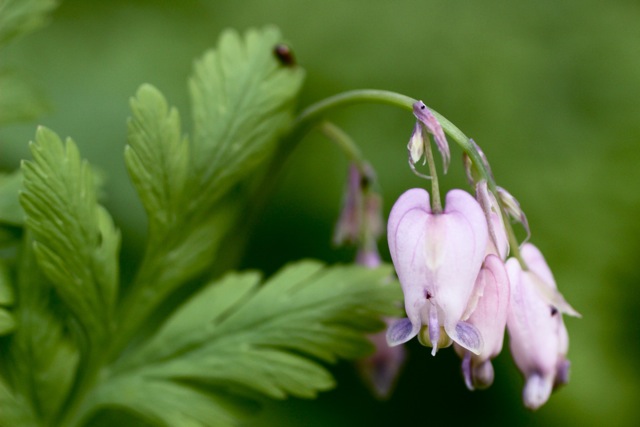
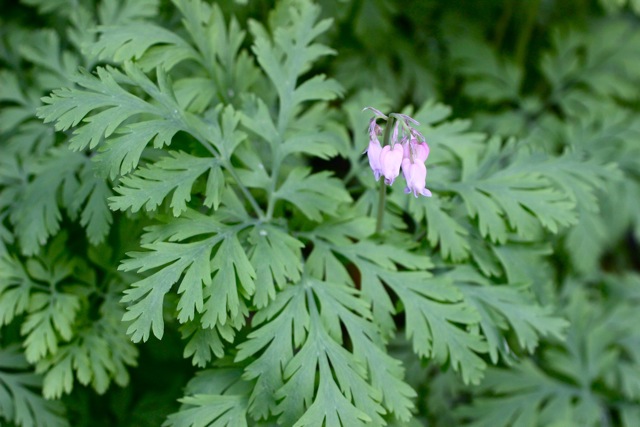
Dicentra_formosa1Pale pink, heart-shaped flowers are displayed above a feathery green mound of leaves. This is Pacific bleeding hearts (Dicentra formosa): one of the most distinctive blooms around. The flowers truly do resemble hearts–the upcurved shoulders look like valentines’ hearts, while a tracery of pink veins calls to mind the anatomical reference as well.

Pacific bleeding hearts are found in most of California, and north through the coastal states into Canada. Despite their unusual shape, this little flower is in the poppy family!Dicentra_formosa3

Leave a comment

Filed under Native, Plant of the day

Plant of the day: common woodland star

Lithophragma_affine2Common woodland star is a raggedy-petalled, white little flower–look for it in meadows, brushy slopes and forests. The long slender stalk is reddish and grows up to two feet tall.  It is sprinkled with round, scallop-edged leaves below, and a few white flowers above. This is Lithophragma affine, a native to California and Oregon

Hillside woodland star is another very similar species of Lithophragma that’s found in the area, but the green cup of sepals (where the flower joins the stalk) is dramatically flattened. With hillside woodland star, it is tapered or funnel-shaped.

The Mendocino Indians chewed the root for colds and stomachaches.Lithophragma_affine1

Leave a comment

Filed under Native, Plant of the day

Plant of the day: star-flowered false Solomon’s seal

Deep in the shaded understory, small star-shaped flowers gleam. Each spray of white blooms is arranged above symmetrical rows of corn-like leaves. This is star-flowered false Solomon’s seal (Maianthemum stellatum).

This pretty little flower is found across much of North America, and goes by a whole boatload of names including false lily of the valley, starry false Solomon’s-seal, star-flowered Solomon’s-seal, starry Solomon plume, starry smilac, and spikenard. The Nuxalk Indians of British Columbia, and many other tribes, collected the ripe berries for food; the root was often used medicinally. The most-cited use was for stomach ailments but it was also used for earache, cough, arthritis, boils, menstrual troubles, venereal disease, and to stupefy fish. It is a very versatile plant.

Leave a comment

Filed under Edible, Medicinal, Native, Plant of the day

Plant of the day: goldfields

A puddle of rich gold fills a dip in a meadow; a blanket of gold covers a hillside. Hundreds upon hundreds of little yellow daisies crowd out all other color. This is California goldfields (Lasthenia californica), an aptly named and spectacular spring bloom.

This slideshow requires JavaScript.

According the Jepson database, the plants can grow over a foot tall, but usually they are much smaller–generally just a few inches high. They look like minute sunflowers, with spreading rays around a mounded central disc of tiny flowers. Indigenous tribes would make a flour of the diminutive seeds, or eat them dried.

There are several other species of goldfields–which tend to look quite similar, and frankly are tough for beginners to key out. In Marin, one tip for a quick & easy way to narrow down what species you might be looking at is to check and see if CNPS has a plant list for the area (Rock Springs, in this case).

Leave a comment

Filed under Native, Plant of the day

Plant of the day: cream cups

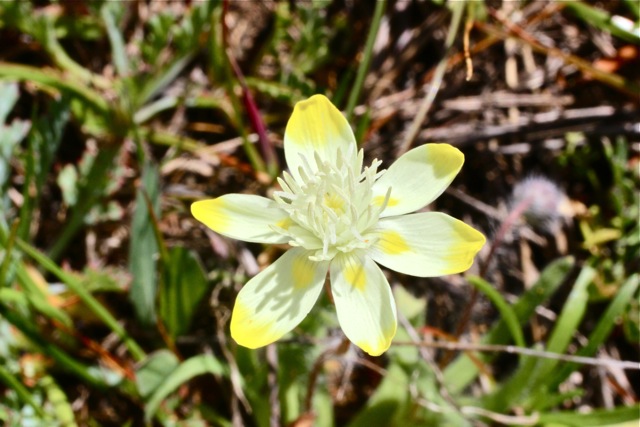
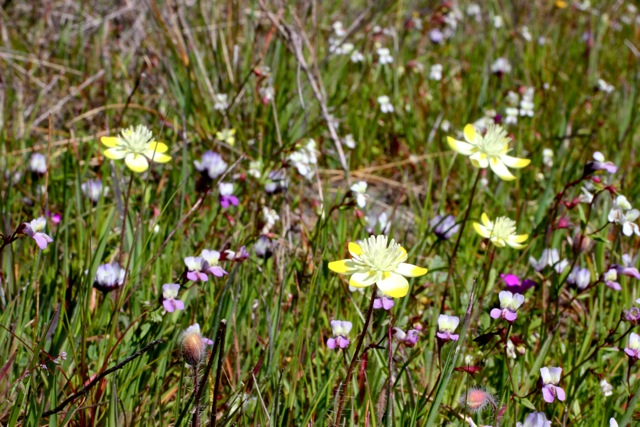
Platystemon_californica1This is another lovely flower of the open hillsides. Cream cups (Platystemon californica) have buttery yellow splotches on their tips and toward the middle of each pale yellow petal. Each blossom is perched atop a reddish, wiry stem that is covered with sparse but stout hairs. A mound of hairy, silvery-green leaves provides a base for this pretty showing.

Cream cups were once much more common in open fields, particularly following fire–but today they have been crowded out by more aggressive non-native grasses and weeds. Cream cups tolerate serpentine soils, which is one place you can find them growing in large numbers–because their invasive competitors can’t survive there.

There are some suggestions that the hirsute leaves are edible, but I would do more research before noshing on them. In fact, I might not eat them anyway–they don’t look very appetizing (but then, I don’t like peach fuzz, either).

Cream cups are in the Papaveraceae, the same family as poppies and bleeding hearts.

Platystemon_californica2 Platystemon_californica3Platystemon_californica4

Leave a comment

Filed under Native, Plant of the day