Plant of the day: California sword fern

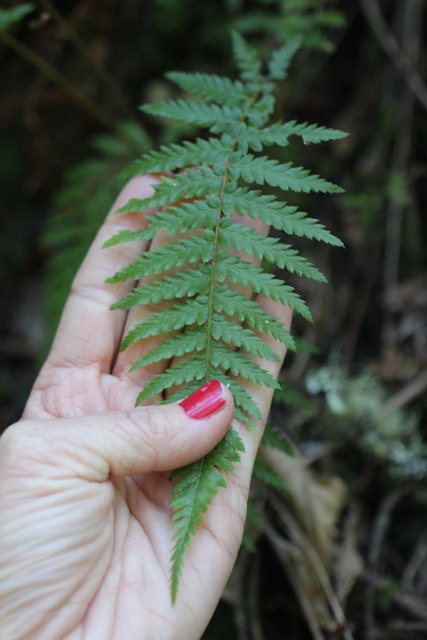
Polystichum_californicum2This elusive little fern is a rare sight in this area, unlike its common cousin, western sword fern. I’ve been looking for it for a while and was delighted to spot it recently, growing in a canyon among many other species of ferns.

California sword fern (Polystichum californicum) has leaflets that are deeply serrated but not cleft all the way to the midvein. The leaves have a slightly leathery, tough feel to the touch when compared with more frail wood ferns, lady ferns, bracken ferns, and the like. They also lack the prominent thumb or hilt that points dramatically towards the tip of some other sword ferns (though the upper lobe closest to the central stem is somewhat enlarged).

California sword ferns are endemic to California, and grow in the shade of deep canyons, as well as wet places near cascades and streams, according to the Marin Flora. The plant photographed here was seen along the Steep Ravine trail on Mt. Tamalpais.

For many years I didn’t know that there were other species of sword fern other than the abundant and lovely western sword fern. But there actually are four species in the Bay Area. In addition to California sword fern, the others are: western sword fern, whose leaves are only very slightly serrated; its smaller but quite similar cousin, rock sword fern; and Dudley’s sword fern, which resembles California sword fern but has pinnae that are so deeply serrate that they become separate leaflets–or fully tripinnate–at the base (or, as the key puts it, “pinnae pinnate; pinnules stalked”).

According to the key, California sword fern is a species resulting from an original hybridization between western sword fern and Dudley’s sword fern. Polystichum_californicum1

Leave a comment

Filed under Native, Plant of the day

Plant of the day: redwood violet

Viola_sempervirensA mat of green, heart-shaped leaves march along the side of a steep hillside, punctuated here and there with bright yellow blossoms that seem to glow in the shade of the forest. These are redwood violets (Viola sempervirens). These little flower grow from a creeping stem that sends out rooting stolons, which then grow a new rosette of leaves.

There are a couple of other species of yellow violets in the Bay Area so be sure to check a key before deciding which you’re looking at. Only one other species has heart-shaped (cordate) leaves, but it can easily be distinguished from redwood violet because the stems are upright (not creeping) and the leaves are located on the stem, right below the flower.

Leave a comment

Filed under Good for gardens, Native, Plant of the day

Plant of the day: Pacific trillium

Three green leaves surround three white petals surround a cream-colored, three-parted pistil–each part offset from the other to form a lovely pattern. The whole thing sits perched atop a slim stalk like an elaborate parasol. This large, striking flower is Pacific trillium (Trillium ovatum, also known as wake robin). Ankle-high groves of it are in bloom along the steep ravine trail on Mt. Tamalpais; a stunning sight beneath the towering redwoods: beauty above and beauty below.

This slideshow requires JavaScript.

This low-growing perennial thrives on shady hillsides and other places that stay moist but are well drained. Trillium is a member of the Melanthiaceae (the false hellebore family, which is a close relative of the lily family) and like lilies it has all of its parts in sets of three, including six yellow stamens. The white flowers turn purple as they age. Each year a fresh stalk sprouts from an underground rhizome.

The plant was used medicinally by various Native American tribes, but only externally–as far as I can tell. An infusion made from the roots was used as a wash for sore eyes, and to treat boils. The Skagit considered it poisonous.

Trillium has also been used as a love potion–the Makah tribe would apply a poultice made of pounded roots as a love medicine; unfortunately my reference doesn’t say what the desired result is, or where the poultice is applied.

Leave a comment

Filed under Good for gardens, Medicinal, Native, Plant of the day, Poisonous

Plant of the day: large-flowered fairy bells

Cream-colored flowers dangle from a stalk of broad leaves. These are large-flowered fairy bells (Prosartes smithii).

This slideshow requires JavaScript.

The plants were used as a love medicine.

Leave a comment

Filed under Plant of the day

Spectacular salmonberry

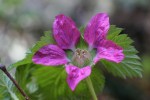
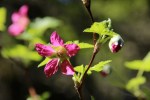
Flamboyant pink blossoms decorate the berry canes growing alongside a shady creek. This is salmonberry–a plant graced with both tasty fruit and beautiful flowers. The open-faced blooms have five delicately crinkled petals surrounding a pale cluster of stamens and pistils.

The berries ripen in the fall, and can be eaten raw or in pies or jellies (they are considered too seedy for jam). These attractive plants are nice in a garden, though should be placed carefully as they can get spindly and are also favored by deer.

While researching this plant I was delighted to learn that there are ailments brought on specifically by excess salmon consumption! I don’t know what these ailments are, but indigenous tribes considered the bark of salmonberry to be an excellent treatment for them. The bark was also used to disinfect wounds and (brewed, powdered or poulticed) to relieve pain, headaches, burns, toothaches, labor pain, and sores. The Kwakiutl tribe also encouraged childrens’ growth by applying chewed salmonberry sprouts to the top of the kids heads.

Leave a comment

Filed under Edible, Good for gardens, Native, Plant of the day

Plant of the day: mock strawberry

Duchesnea_indica1Small yellow flowers spring up from a patch of strawberry-like leaves. Each bloom has five rounded petals, widely spaced around a central mound of many stamens. This is mock strawberry, or Duchesnea indica. It is native to India, and is now found scattered occasionally throughout Marin and a few other parts of California where it has escaped from garden cultivation.

The small red strawberry-like fruits are edible but not particularly delicious. The collected reviews are uninspiring, particularly when taken all together. Mock strawberry is, variously: “dry and insipid”, “certainly rather tasteless, but it is not dry”,  “flavor somewhat like a water melon according to some people, but this is possibly the product of a strained imagination”, “the fruit contains about 3.4% sugar, 1.5% protein, 1.6% ash.” Ash?! Delicious. Let’s have a pie. Duchesnea_indica2

Leave a comment

Filed under Non-native, Plant of the day

Plant of the day: common spikerush

A tough, grasslike plant grows in a wet marshy area. Many round stems of shiny dark green are clustered together; some are topped with a pointy little brown spike that is actually a head of unobtrusive flowers.

This slideshow requires JavaScript.

This is common spikerush, or Eleocharis macrostachya. Get out a hand lens and look at the flower heads–they are really quite spectacular. Feathery white styles  and nodding tongue-shaped stamens cover the little blooming spike in a complex tangle. There are no petals on this plant: the reproductive bits simply peek from behind a diminutive brown scale (see the close-up photo above). This is characteristic of the spikerushes, and other rushes, sedges, and grasses in general.

All the spikerushes (which are actually in the sedge family, Cyperaceae) have photosynthetic stems and no leaves to speak of. Unlike most sedges, the perennial common spikerush has a stem that can be either flat or round. A thin green sheath, several centimeters long, that is around the base of the stem is actually a modified leaf. Common spikerush has two feathery styles peeking from each brown scale, which has a green midrib running its middle. The flower spikes are more than 7 mm long, and often up to 25 mm long. The plant sometimes grows up to 9 feet tall (though the plants I saw were only a few feet tall).

This species is found in wetlands across most of the United States.Eleocharis_macrostachya4

Leave a comment

Filed under Native, Plant of the day

Plant of the day: rosy sandcrocus

Romulea rosea growing among other leafy plants.

Romulea rosea growing among other leafy plants.

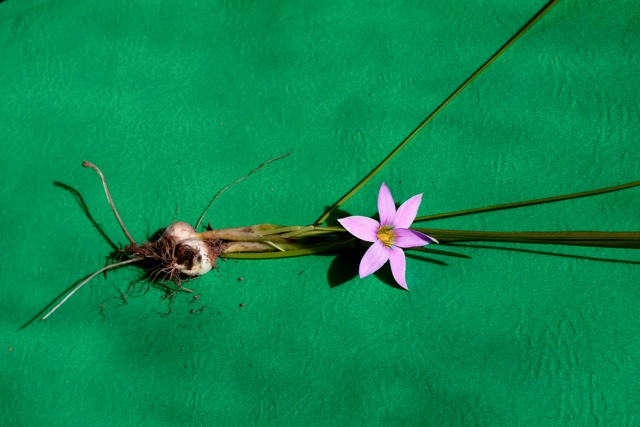
A flash of pink is nestled at ground level, surrounded by long grass-like leaves. This is rosy sandcrocus, or Romulea rosea, a South African native that is in the iris family. And though superficially it doesn’t look at all like an iris, there are certain similarities if you know what to look for.

Rosy sandcrocus has six pointed pink petals, and long linear leaves with parallel veins running all the way to the end. Beneath each flower is a slight bulge in the stem, which is actually the ovary where seeds will develop (many flowers have “superior” ovaries, which means they are snuggled in among the petals rather than below them. The “inferior” ovary is a characteristic of the iris family). Six petals, and leaves as described above, are also key characteristics of Iridaceae.

The rosy sandcrocus was first collected in Marin in 1979, and probably was accidentally brought to the area in a load of clover seed from Australia, according to the Marin Flora. In places, it takes over entire areas–looking a lot like a field of grass, except for when the pink flowers are blooming. Overall it isn’t abundant in California, and the places you do find it tend to be weedy, disturbed areas–often with dry, sandy, or compacted soils.

This little perennial sprouts from a pale, bulb-like corm. Romulea_rosea1

Leave a comment

Filed under Non-native

Plant of the day: field mustard

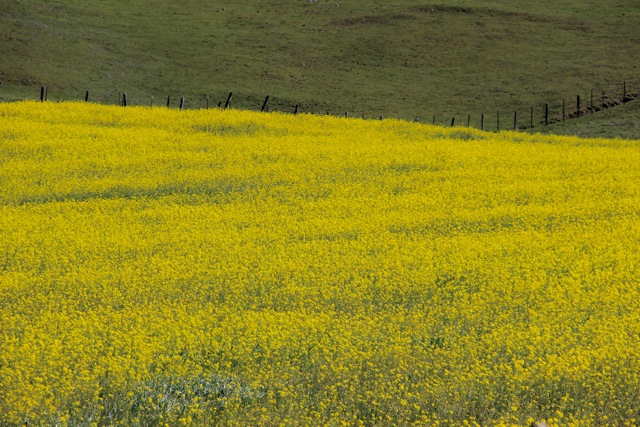
Brassica_rapa1A pasture is swamped in a sea of yellow. Millions upon millions of flowers cover the hills and flatlands, and straggle over the fenceline into neighboring fields and roadside ditches. This is field mustard–Brassica rapa, also known as common mustard or rape mustard. I have no idea if it is planted deliberately, or if it appears in certain pastures as a result of fertilization, compost, or some other agricultural technique. Whatever the source, it is a striking and dramatic part of the spring landscape throughout coastal California!Brassica_rapa2Brassica_rapa3

Leave a comment

Filed under Plant of the day

Plant of the day: blackwood acacia

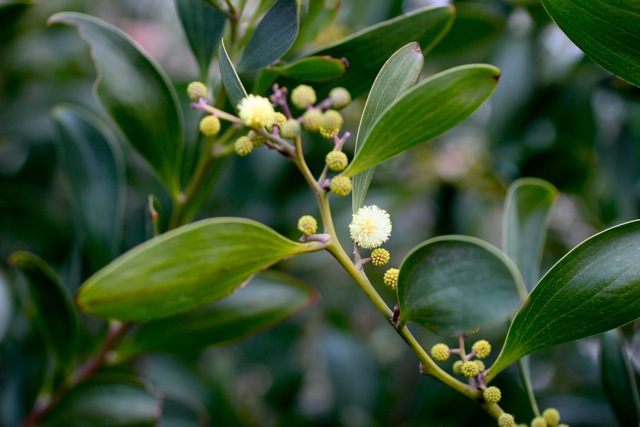
IMG_2230I’ve been regularly seeing yet another acacia on my strolls in and near town–on the mesa above Brighton Beach, along the Palomarin trail, on the back streets of Inverness. I first noticed this plant for its flamboyant seeds. When the pealike seed pods split open later in the year, they will reveal a shiny black seed surrounded by a wild curlicue of orange ribbon. I hate to love an invasive, but I think they are just beautiful.

At this time of year, the blackwood acacia (Acacia melanoxylon) can easily be identified by a quick look at its leaves and flowers. It has occurred to me that identifying acacia species is sort of like winning a game of Clue: but instead of people, rooms and weapons you mix and match flower and leaf type until you come to the only possible answer. So: if you’re looking at a small tree that has yellow pom-pom-like flowers as well as blade-like leaves that each have four prominent veins on them, then you are looking at a blackwood acacia. But walk down the street and it’s time for another round! A different species of acacia I saw around the bend from the Blackwood acacia had  blade-like leaves with bottle-brush-like flowers–so clearly it is golden wattle and Miss Scarlett didn’t do it. IMG_2237

Leave a comment

Filed under Plant of the day