Plant of the day: giant horsetail

Along a damp ditch, bristly green bottle-brushes grow to my knees. This is giant horsetail, or Equisetum telmateia. Some call it a weed, but horsetail is one of my all-time favorite plants. They form low thickets of supple green stalks with long, skinny stick-like leaves that sprout out in all directions. When I was a kid I’d pick my teacher bouquets of them on my way to school—my quirky version of the proverbial apple.

As an adult I learned there are even more reasons to love horsetails than their good looks. The Equisetum species are considered “living fossils”, which means that they have changed very little over the last hundred million years or so (though they have shrunk some; back then they grew as tall as trees!).

Grab a handful of horsetail plants next time you walk past a patch. It scrunches pleasantly in your palm, but the slim stalk and leaves tend to bend, not break. They are jam-packed with silica, which makes them strong as well as flexible. This earned the plant the alternate name of scouringrush–it’s been used to scrub dirty dishes, to polish metal, to clean floors, and even as sandpaper. Some herbalists recommend drinking a tea made from the dried young stalks for strong and supple hair, skin and bones. Watch out, as large amounts of the raw plant can be harmful or toxic.

The bottle-brush part of the plant that you usually see is sterile, but in the spring giant horsetail sprouts a fertile stalk that is leafless and topped by a pale cone-like structure that releases spores. It also spreads by rhizome, which may be why some call it a weed—it can be dense and hard to get rid of since new plants sprout up from the roots.

There are four species of Equisetum in the SF bay area, but only two of the brushy type. Giant horsetail is probably more common in these parts, though its bushy cousin Equisetum arvense snagged the  official nickname of “common horsetail”. You can identify giant horsetail because its stem is larger–generally greater than 5mm across–and if you look close at its twiggy leaves, you’ll see that each is ribbed with several grooved ridges. The grooves also are a way to identify it, though the giant-ness is easier.

Leave a comment

Filed under Medicinal, Native, Plant of the day

Plant of the day: white alder

White alder looks almost the same as its cousin, red alder, which I wrote about in my last post. This tree grows a bit taller, but the main way to tell them apart is by looking at the underside of the leaf. In white alder (Alnus rhombifolia) the leaf margin is flat instead of tightly rolled underneath. It also produces its catkins slightly earlier, in January instead of from February through March.

White alder has flat leaf margins

Red alder has inrolled leaf margins

Both species are common in Marin, but you’re less likely to see white alder growing right along the coast.

Leave a comment

Filed under Medicinal, Native, Plant of the day

Plant of the day: red alder

Tall, straight tree trunks line the banks of the stream–each trunk elegantly splotched with patterns of white and gray. This is red alder, or Alnus rubra, one of the two common species of alder in this area.

This fast growing species is important as an early colonizer of disturbed habitats–landslides, stream banks, logging sites, or even forest clearings where a big old tree has fallen down and made a gap. I’ve seen hundreds of young alder sprouting up on the gravel left behind a retreating glacier, and it was one of the first plants to grow back in the wasteland left by the Mt. St. Helens volcanic eruption back in the 80s.

Around here, alder tends to prefer the moist soils of canyons, streamsides and wetlands. Besides the characteristically blotchy bark you will know alder by its tiny woody cones and its broadly serrated leaves that seem almost dented by the lateral veins that run across them from midrib to margin.  Red alder can be identified by the way the edge of the leaf rolls tightly under itself, so when you flip one over you see a dark green ridge running around the rim of its paler underbelly. The other local species of alder (white alder, or Alnus rhombifolia) has a flat edge.

Red alder contains the compound salicilin, which is similar to acetylsalicylic acid–aka aspirin. Native Americans used extracts of the bark to treat a wide range of maladies from tuberculosis to headache (as well as stomachache, wounds, eczema, diaper rash and more). Cones and catkins were also used. Some tribes rubbed rotten wood on limbs to sooth aching bones. A red dye can be made from the bark–one use for this was to dye fishing nets, supposedly making them invisible to fish. 

Leave a comment

Filed under Medicinal, Native, Plant of the day

Plant of the day: cape weed

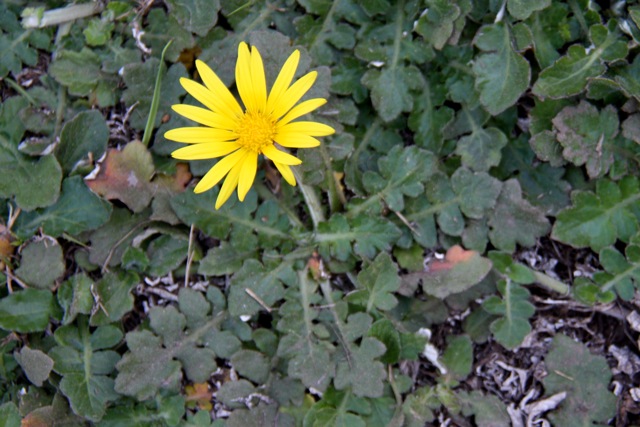
A coastal bluff is carpeted with a mat of yellow daisies. The leaves are grayish green, woolly, and shaped like deeply lobed arrowheads. The flowers are bright yellow, blooming a few inches above the rosette of leaves.

This is cape weed, or Arctotheca calendula, an invasive species introduced from South Africa. It spreads via underground stems called stolons, as well as by seed. It has often been planted as an ornamental because of its flashy flower and long blooming period, but ecologists discourage this because of its tendency to invade delicate coastal prairies.

Traditionally, cape weed was considered to be one species but it is now actually identified as two separate species–the fertile Arctotheca calendula and infertile (or, rarely fertile) Arctotheca prostrata which can only reproduce via stolon and not by seed. The leaves of the infertile species, prostrate cape weed, are either entirely yellow on their underside–or they are tinted a reddish to brownish hue on the outer half of the leaf. The petals of the fertile, “standard” cape weed are a steely blue color underneath.

Leave a comment

Filed under Invasive, Non-native, Plant of the day

Plant of the day: mugwort

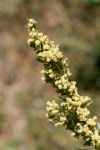
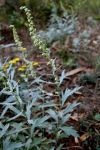
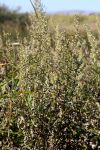
Spires of grayish-green leaves grow on the roadside, each topped with a spike of unassuming pale flowers. This is California mugwort, or Artemisia douglasiana. It’s flowers are rayless aster-type flowers, diminutive tassles of pale beige or yellowish threads. The leaves are velvety with white hairs that are especially dense on the underside. When you rip one in half it clings together with fibrous shreds.

Mugwort can grow to be 8 feet tall according to the Marin Flora, but I’ve usually seen it growing to about knee high. The plant has a pleasant sage-like smell when you crush it—not surprising since it’s a close cousin of California sagebrush. It’s also known as Douglas’ sagewort, or dream plant.

You’ll find mugwort growing in a wide range of habitats—from moist seep springs to toasty hillsides.

Leave a comment

Filed under Native, Plant of the day

Plant of the day: forget me not

I try to keep these posts seasonal, and write about flowers that people are likely to see right now. But this sight was strange enough that I’m going to break this rule.

This slideshow requires JavaScript.

Forget me nots (Myosotis latifolia) are common little weeds in the springtime. Cheerful blue flowers tend to grow in dense patches along moist stream banks and woodland clearings. Though not native to California, the plant has naturalized here and now is ubiquitous. Luckily it doesn’t cause too much ecological damage–as far as I know!

A few days ago hiking along the Arroyo Hondo in Bolinas, I saw several forget-me-nots in bloom. True, it’s shady there, along a canyon with a deep canopy of pepperwood and other trees. But still–I haven’t seen any of these plants for months, and they aren’t due to start blooming again until february. It’s a good reminder that even though there are general patterns to when things blossom, in the end each individual still marches to its own drummer. And there are always outliers…

1 Comment

Filed under Non-native, Plant of the day

Sunshiny morning wander

This morning, Bolinas is an island of sunshine in a sea of fog. Mist is spilling over the ridge. San Francisco is shrouded, as well as all of the Pacific. But all around the shore, the waves are sparkling and studded with surfers. A gentle and oddly warm wind has been blowing since dawn, and on my early-morning walk everything seems to glitter and dance.

This slideshow requires JavaScript.

I wrote this yesterday… but today is almost as lovely!

1 Comment

Filed under TRAIL NOTES

Plant of the day: sheep sorrel

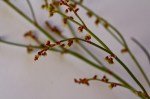
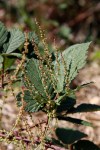
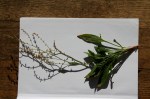
Almost all the year round you can see low green stalks studded with small red flower buds–a splash of color usually growing intermixed with grasses. This is common sheep sorrel, or Rumex acetosella, an invasive species that was introduced from Europe. It usually grows in weedy areas, and has a long bloom period from March all the way through November.

The tart leaves are edible, and taste like redwood sorrel or lemongrass. Try it in salad or steep the leaves for a tea. The acidy-lemon flavor comes from oxalic acid–small doses are fine, but eating a lot of it can lock up calcium and other nutrients in your body.

The root can be dried, ground and made into noodles but this seems like a lot of work and I’ve never heard of anyone actually doing it. The seeds are also edible, but they are so tiny that they also aren’t practical as anything other than a novelty.

Leave a comment

Filed under Edible, Invasive, Non-native, Plant of the day

Plant of the day: Oregon ash

Oregon ash is a stately tree of the riverbanks. It grows tall and upright, creating an umbrella of sweeping branches and bright green leaves. In the late summer the female plants become heavily decorated with winged seed-pods called samaras–these trees are dioecious, meaning each plant is either male or female (instead of both, as most plants are).

This slideshow requires JavaScript.

Right now, the seeds are ripening as the leaves are yellowing and beginning to fall.

The range of Oregon ash (Fraxinus latifolia) is from British Columbia to Riverside County near LA, in a belt along the coast. Look for pinnate leaves, where each “leaf” is composed of five to nine large, paired leaflets. The photos here were taken in Cascade Canyon of Fairfax, and also on the Marin Municipal Water District.

Leave a comment

Filed under Good for gardens, Native, Plant of the day

Plant of the day: beaked hazelnut

Broad, fuzzy leaves are beginning to turn brown on this charming shrub of the understory. In a month or so, the branches will be bare skeletons, ready for the winter.

Beaked hazelnut (Corylus cornuta) is found across the country–except for the south. Around here you usually see it in moist forest understories, shaded canyons or streamsides. It has slim, sometimes drooping branches decked with light green, jagged-edged leaves. The flowers are monoecious, meaning that each flower is either male or female–but both sexes appear on a single plant. The female flowers look like tassels of small crimson threads; the male flowers are drooping pale catkins. But often this plant reproduces clonally, growing in dense clusters that are genetically identical.

Grouse, deer, rabbits, voles, and other critters use these shrubs for food and shelter. The tasty nuts have been compared to filberts, and commercial hazelnuts, and can be eaten raw or cooked. Native Americans wove the slim and flexible branches into baskets and baby carriers.

It’s the only hazelnut found in California.

Leave a comment

Filed under Edible, Good for gardens, Native, Plant of the day