Tag Archives: California

Plant of the day: leather oak

Oaks are generally thought of as tall, graceful trees. But you can also find them in the sea of waist-high bushes known as chaparral. Leather oak (Quercus durata var. durata) is a common sight on serpentine soils in this area.

This slideshow requires JavaScript.

Leather oak can grow to around nine feet tall, but I have mainly noticed them growing much closer to the ground. Look close to spot acorns or clusters of catkin-like flowers among the small, grayish green leaves. The leaves of this species are dull, dusted with a pale fuzz (paler on the top than on the bottom). They also are concavely curled towards the ground–you could flip one over and use it for a little spoon, if they didn’t have a tendency to be spiny.

As with all acorns, the nut of the leather oak is edible once its bitter tannins have been leached out. Acorns were historically a major food source for local Native American tribes, and still are a major part of the food chain for wildlife. People generally remove tannins by soaking the nut in water (or a running stream). But some tribes would plant the acorn in a bog and wait until it sprouted in the spring–a system which apparently got rid of most tannins but preserved more nutrients than the water method.

Acorns can be eaten whole, or ground into a floury powder for cooking. Roasted acorns can be used as a coffee substitute.
Leave a comment

Filed under Edible, Native, Plant of the day

Plant of the day: water buttercup

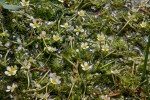
Petite cream-colored flowers peek above the still surface of a pond. Small white petals are banded with yellow at the center, surrounding a buttery cluster of yellow stamens. The flower has a glossy shine, akin to that of its land-locked buttercup cousins. Look close and you’ll see the flowers are rising from a mat of yellowish-green leaves just below the surface. Water buttercup (Ranunculus aquatilis) is also called whitewater crowfoot, likely because the narrow twiggy leaves look like the bony feet of a bird.

You can see this plant all over California and throughout much of the west. The photos shown here were taken in the high Sierra, where a spring had made a small pond in an otherwise very dry landscape of sagebrush and juniper; the seeds must have been deposited by a bird that stopped there for water.

Leave a comment

Filed under Botany basics, Native, Plant of the day

Plant of the day: sticky sandspurry

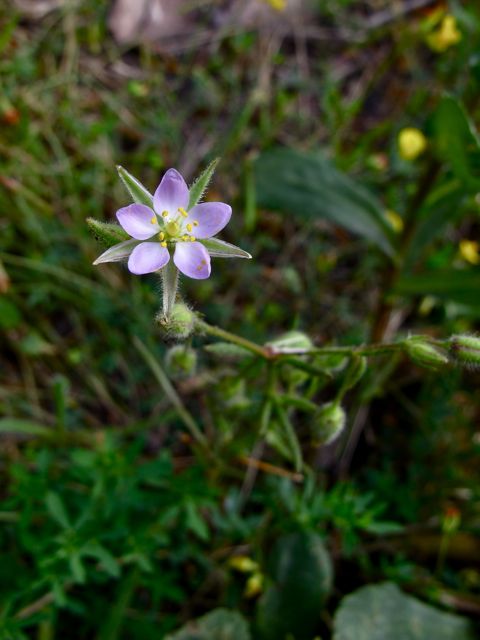
Spergularia macrotheca

On the upper edge of a salt marsh, pale purple flowers grow low to the ground. This is sticky sandspurry, or Spergularia macrotheca. There are several different species of spurrys in the area, and all are very similar. To identify S. macrotheca I had to get out my hand lens and look close at the tiny seeds. In this species, each seed is surrounded by a narrow, papery halo (or “wing”).

With its five pale petals surrounding cheery yellow stamens, sticky sandspurry can be found along the Pacific coast states up to Canada and southeast Alaska. The plant earns its name by being covered with short, sticky hairs. Clustered leaves, rising from a swollen spot in the stem, give a clue that it’s in the Caryophyllaceae family.

It prefers to grow in wet places, often near saltwater, but it also can be found by freshwater seeps, springs and vernal pools–and in non-wetlands as well.

Notice the swollen stem at the leaf nodes


1 Comment

Filed under Native, Plant of the day

Plant of the day: chicory

This tough, blue-eyed plant is a rugged survivor (aka, a weed). Chicory (Cichorium intybus) thrives on the edges of human activity: roadsides and empty lots. It was originally native to Europe, but now it is so well established across North America that it often is described as “naturalized”.

Chicory also has a long relationship with people as a food. It’s roots–roasted, toasted and ground–are a renowned coffee substitute. They also can be cooked and eaten like parsnips. The bitter leaves are used in salads or spaghetti; they are less bitter in the wintertime. Because chicory plants have plenty of inulin (a type of starch that diabetics can’t digest) they are a recommended food for people trying to limit their glucose.

Their pretty blue flowers are light sensitive, opening at dawn and closing by the afternoon.

Leave a comment

Filed under Edible, Non-native, Plant of the day

Plant of the day: saltmarsh dodder

Bright orange patches dot the green swath of a salt marsh. Look close and you will see what looks like a mat of fishing line or straw. Hundreds–thousands–of narrow orange threads are wrapped tightly around bright green pickleweed stems. Copious white flowers often bloom off the threads. This is saltmarsh dodder (Cuscuta salina), a parasitic native plant that mooches nutrients off its host plant. Instead of photosynthesizing its own food, it sinks tiny root-like organs (called haustoria) into the flesh of the plant. Once it taps into the vascular system it can suck out all the water, minerals and carbohydrates that it needs.

Dodder seeds are scattered by wind, tides and animals so there is no guarantee that they will germinate near a suitable host plant. But they die if they can’t find one quickly. It sounds impossible for a  brainless, eyeless, noseless  plant to do, right? Nope–not if a host is anywhere close. They can detect the volatile compounds emitted by the host (basically, its smell) and then they grow towards it.

There are a lot of species of dodder in the US, and some of them are parasitic to some of our favorite crops like alfalfa, potatoes and petunias. Though the group is much maligned as a result, some ecologists make a case for the role that parasitic plants can play in the natural environment. Species like dodder or mistletoe don’t decimate their hosts’ population, but they do create patchiness. And in ecology, patchiness tends to lead to diversity, which is a good thing!

1 Comment

Filed under Native, Plant of the day

Plant of the day: Indian teasel

Dipsacus sativus

The distinctive silhouette of teasel (Dipsacus sativus) is a familiar sight in the coastal parts of California. Thick, pointed bracts jut out, like splayed arms beneath the cone-shaped flower head. This structure stays standing long after the small white flowers have faded; people collect the dried stems for decoration. The spiny flower heads are so stiff they were used to card wool before metal carding combs were created!

Sadly this odd-looking plant is also a fairly nasty invasive. It can form dense chest-high thickets that are impassable to both people and animals. This European invasive likes to grow in disturbed areas: along roadways, in ditches and on grasslands. Another species, wild teasel (Dipsacus fullonum) is less common locally but more widespread throughout North America. It has pink-to-purple flowers and sharply upcurved bracts. Just to confuse things, both species also go by the common name of  Fuller’s teasel.

Leave a comment

Filed under Invasive, Non-native, Plant of the day

Plant of the day: Pacific blackberry

So you thought a blackberry was always a blackberry, huh? Well, no. Or rather, there are a few different kinds of blackberry, so you have to look close.

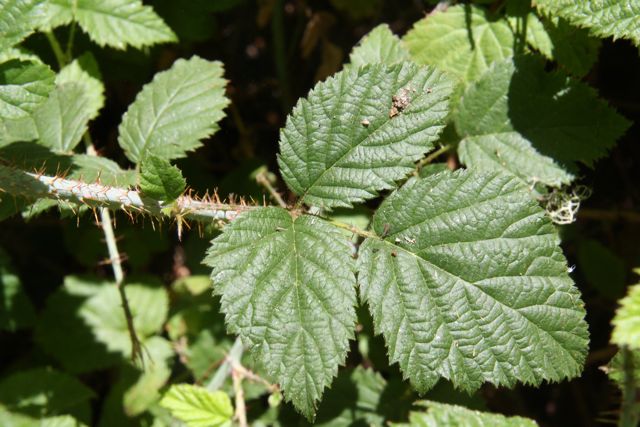
I wrote about the invasive Himalayan blackberry a few weeks ago–but now the native Pacific blackberries (Rubus ursinus) are beginning to ripen, so keep your eyes out for them as well. Superficially, these look similar to their invasive cousins. Both grow in prickly mounds of briars. Both have leaves that generally are in groups of three, and many-segmented berries. But Pacific blackberries are all-around more delicate: their berries and their thorns are both more delicate, and their leaves are a lighter green and a thinner texture. Flip one over, and the Pacific’s leaf will be green below while the Himalayan’s leaf will be white.

If you get a look at the flowers, the distinction gets even easier. Pacific blackberry is the only local member of the Rubus genus to have gender-segregated flowers. What this means is that instead of male stamens and female pistils being in the same bloom, some flowers only pack pistils while others only sport stamens.

And that is why botany is awesome.

Leave a comment

Filed under Edible, Good for gardens, Native, Plant of the day

Plant of the day: scarlet monkey flower

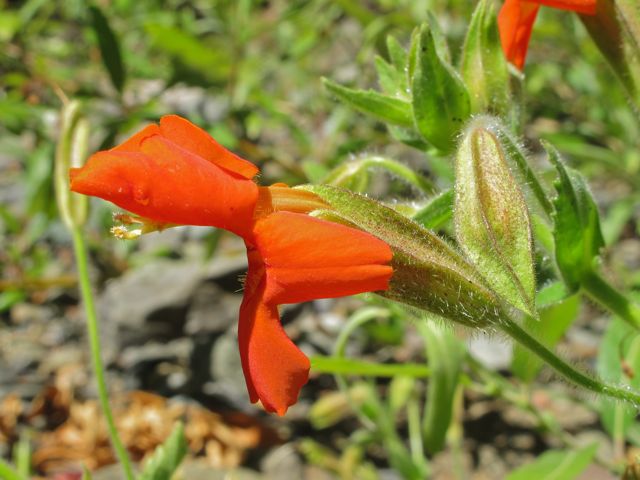
Orange-red flowers grow in the dappled shade of a dry stream bed. This is the scarlet monkey flower, or Mimulus cardinalis–one of the most lovely of this group. With bright green leaves and flashy flowers it is a treat in gardens and wild places alike.

Hummingbirds, butterflies and other insects also love this plant, but deer do not. Native plant gardeners rave about the monkey flowers in general for this reason.

Scarlet monkey flower is usually found near water, and so when you see it you have a strong clue that you’re in a wetland or near a stream (and below 8,000 feet, which is the upper limit of its range). You can see them growing in most parts of California from the northern Sierra to San Diego. Outside of the state, it grows north into Washington state and east as far as New Mexico.

Leave a comment

Filed under Good for gardens, Native, Plant of the day

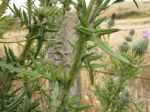
Plant of the day: bull thistle

One of the most common thistles around is bull thistle, an invasive species from Europe. Its showy purple flowers are beloved by bumble bees and other insects, but its spiny leaves are a bane to ranchers.

Bull thistle (Cirsium vulgare) grows most abundantly in coastal grasslands, along the edge of marshes, and in sunny openings in forests, according to the California Invasive Plant Council – but it is found in every state in the country. You can recognize this species because the leaves don’t stop when they meet the stem; instead they run down along it like little spiny wings.

This plant thrives on disturbance; it grows most readily when the soil is disrupted by plowing, logging, digging and so on. Even gopher activity can give it a boost!

Leave a comment

Filed under Invasive, Non-native, Plant of the day

Plant of the day: creeping buttercup

In low wet places, a mat of green leaves and yellow flowers grows. The flowers have five glossy, spreading petals and many stamens. Pale green splotches dot the leaves, which are three-parted and ragged at their ends.

This slideshow requires JavaScript.

This is creeping buttercup, or Ranunculus repens. It’s a mildly invasive plant that is becoming common along trails and roadsides where it can form large patches. Its stem can sprout roots where it touches the ground, enabling it to spread easily.

This flower is a relative of the taller, leggy California buttercup (a native).

Leave a comment

Filed under Invasive, Non-native, Plant of the day