Tag Archives: California

Plant of the day: calypso orchid

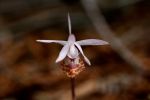
Peeking from the redwood duff, a calypso orchid. Calypso bulbosa, also known as a fairy slipper. This beautiful denizen of the woods is shy but not uncommon. It lifts its nodding head above the forest floor on a smooth purple stem, one or two green leaves lying flat at its base. And what a fearsome-looking flower!

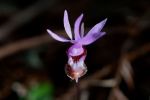
The color can vary from pale pink to deep rose, but around here they are usually lilac-colored. A spikey crown flares upward like a punk-rocker halo. This crown is composed of petals, sepals and bracts all indistinguishable. Beneath, a lilac lobe juts forward, an awning over the burgandy-spotted pouch below. Tucked under the awning are anthers, which are designed to adhere to detach and stick to the backs of foraging insects. It turns out that Calypso orchids are tricksters – their shape suggests to passing insects that they may have nectar, but in fact, they don’t. Yet they depend entirely on this trick for pollination!

A Calypso orchid may live for up to five years (though usually less) and it dies back to its underground corm, or root-like structure, each summer. A new leaf is produced in the fall, and it flowers in the spring. It has a tremendously wide range. You can find it across western and northern United States, Canada, Japan and northern Europe.
Leave a comment

Filed under Native, Plant of the day

Plant of the day: sticky monkey flower

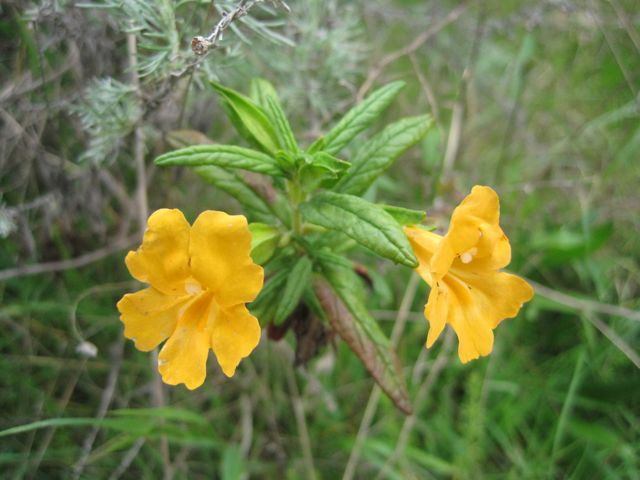
Have you seen those pale orange flowered bushes that are common in the hills of Marin? Yes, the ones with the dark green and the tubular flowers with a flaring rim like a musical instrument. This is Mimulus aurantiacus (aka bush monkey flower or sticky monkey flower). You won’t find it in the Peterson guide, since it’s technically a bush not a wildflower – but the blooms are pretty and if you pick it for a bouquet you’ll learn where it got its name from when your hands come away sticky. It likes to grow in brushy areas and chaparral, flat places and narrow steep ravines.

Leave a comment

Filed under Good for gardens, Native, Plant of the day

Plant of the day: seep-spring monkey flower

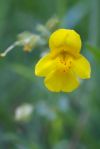
True to its name, this cheerful yellow flower is most often found growing on moist hillsides, along streambanks, and in other wet places. With reddish spots displayed inside it’s splayed lower lip,  Mimulus guttatus (also called common monkey flower) is easy to spot. Its tubular yellow flowers are folded at their opening, like the mouth of a sock puppet. Though joined at the base, they split at their ends into five or six petal-like lobes (depending on whether or not the central lower petal is divided). The plant itself is often dinky (as few as 2 inches high) but it grows up to knee height – three feet if it’s really happy.

There are many other mimulus in the area, but this is the only one that is yellow and has smooth leaves. Tomorrow I’ll write about sticky monkeyflower: the other most common mimulus.

Leave a comment

Filed under Native, Plant of the day

Plant of the day: pussy ears

Here’s another Calochortus to go with yesterday’s star tulip. You can see there is a very strong family resemblance! You also can see where this flower got its name, with such heavily furred ear-shaped petals.

This slideshow requires JavaScript.

Pussy ears (Calochortus tolmiei) is the only pale-colored Calochortus (cream or pinkish) in Marin that is NOT listed as a rare species. It is a beloved woodland sight, growing under mixed the spreading boughs of oaks or in redwood forest or even among the small scrubby trunks of chaparral. Even though it is more common, it’s always a treat because of its delicate and distinctive look. You can tell it’s in the lily family, since its petals are in groups of three. Plus, the three broad petals alternate with very long and very narrow sepals, which is the signature look of  most Calochortus.

Leave a comment

Filed under Native, Plant of the day

Plant of the day: bracken fern

Bracken fern is another one of my longtime favorite plants – and not just because the young, furled tips are tasty in salads or while on the trail. This unpretentious plant is both attractive and hardy. You see it in woodsy understories,  on dry hot hillsides, and everywhere in between. In the autumn, it’s dry leaves add a particular, pleasant scent to the fragrance of the forest. Wildlife uses it for food and nesting material; sometimes I’ve found beaten-down areas in larger patches, where deer have bedded down to sleep.

Distinct from other ferns, its large (up to 2 feet) fronds are broadly triangular, and often have an airy quality to them, with a lot of space between each sub-frond. Underneath, the fertile spores are found in a line hugging the edge of every leaflet. Even when these sori aren’t brown and ripe, you can see them as a raised green rim – another good diagnostic clue. None of the many other ferns in the area has this combination of obtuse outline, frond type, large size, and brown spore rim. Pteridium aquilinum can be found growing throughout most of North America. In fact (according to the USDA plants database) the only state in the US that it isn’t found in is South Dakota, which is odd enough that one has to wonder if it’s a data glitch. Or… maybe there is a legit ecological reason that this is the only state our fern has shunned!

This slideshow requires JavaScript.

Leave a comment

Filed under Edible, Native, Plant of the day

Pumpkin ridge stroll

If you’re an outdoorsy type who somehow has not been up on the Marin Municipal Water District lands yet, I can’t recommend it enough. If you’ve been to Phoenix Lake or the back side of Mt. Tam, you’ve been on part of their 18,000 acres of watershed land without realizing it. I like to go in the Sky Oaks entrance, where you have the choice of walking by one of the many reservoir lakes, heading down a sociable fire road, or cutting off onto one of the many small trails to be (mostly) alone with some spectacular nature. There are 130 miles of trails and fire roads on MMWD land, so you can spend a LOT of time there. Today I went out the Pumpkin Ridge Trail, which passes in and out of live oak forest that is interspersed with meadows. The forest is in sad shape these days because of Sudden Oak Death, so dead branches litter the

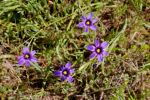
ground. But the understory was still vibrant, with lots of iris and houndstongue. And the meadows are lovely – filled with wildflowers at this time of year. Along the way I embarrassed myself by not being able to remember the Latin names of miniature lupine, blue-eyed grass, or California poppy (which I even wrote about yesterday!). Those are Lupinus bicolor, Sisyrinchium bellum, and Eschscholtzia californica, by the way.

Leave a comment

Filed under TRAIL NOTES

Plant of the day: Chinese houses

Collinsia heterophylla, or Chinese houses, is a pretty little flower with multicolored purple flowers stacked in whorls. Each flower has two bright purple bottom petals that sandwich a third spurlike petal that points toward the ground like the keel on a ship. This petal is actually a pouch, and the reproductive organs (stamens and pistil) are stowed away inside. The two upper petals are a pale lavendar, decorated with a burgandy pattern of dots. On my specimen those formed a line, arching over  the mouth of an inner chamber that – when pried open – proved to be lined with pale hairs.

Collinsia is in the Plantaginaceae family, which didn’t exist back when I was learning my plants. That’s the thing about botany – as science progresses, names are changed to indicate our changing understanding of different species’ relationship to one another. So what now is Plantaginaceae once was Scrophulariaceae, which still exists but just with fewer members. Anyway many of the species found in the Plantaginaceae family are assymmetrical, like this one. Snapdragons are also notable members of the Plantaginaceae, but I’m getting a bit off-topic here.

Chinese houses tend to like open, brushy or wooded slopes in partial shade, according to the guidebook, but I saw it growing on a hot, rocky landslide face that the trail cut across.

Leave a comment

Filed under Native, Plant of the day

Cascade Canyon

I took my dogsitting charges and headed out into the hottest day of the year so far, out onto the Cascade Canyon Open Space preserve in Fairfax. There were lots of flowers in bloom, most of them very common. My list that I came home with had 34 plants on it, and I could only provide full Latin names for three – three! Pepperwood (Umbellularia californica), madrone (Arbutus mensiezii) and Douglas iris (Iris douglasii). It’s true that for many others I could at least come up with the genus name – but still, this is worse than I thought it would be.

There was one plant that I couldn’t identify at all until I keyed it out, and so that is my plant of the day. It turned out to be Chinese houses (Collinsia heterophylla). Read all about it in the next post.

Leave a comment

Filed under TRAIL NOTES