Tag Archives: Flora

The countless blooms of concrete pipe trail

Really this is an unpaved access road, not a trail – but it’s a great spot to see a wide variety of wildflowers right now. In fact, it is the steep road cut that seems to account for much of the diversity. From the weedy forget-me-nots growing along the seep spring near the beginning of the road, you’ll pass through many different combinations of sun, shade and soil. The level road curves around the canyons and hills of the Marin Municipal Water District, and different flowers appear around every curve. I went out with my parents (happy mother’s day mom!) and we saw jewel flower, Chinese houses, Larkspur, linanthus, woodland star, iris, and many many more. There was a dry, rocky hillside with tall sticky monekyflower bushes laden with  blooms, through which a morning glory vine had grown so its large white flowers floated on a sea of orange. In a damp ravine, crimson columbine grew in a garden of other flowers including purple iris and forget-me-nots. When I got home, my plant list had 81 species on it, and 53 of those had been in flower!

This is an easy hike since it’s flat, but you can turn it into a more vigorous outing by connecting up with the network of trails that extends down into Deer Park or up onto the rest of the MMWD property – you could go all the way to the top of Mt. Tam if you wanted to!

To get there, head up the Bolinas-Fairfax road as if you were going to Bon Tempe Lake, but at the turnoff to the lake instead park in one of the limited pullouts on the downhill side of the road. Concrete Pipe Trail starts on the other side of the gate.
Leave a comment

Filed under TRAIL NOTES

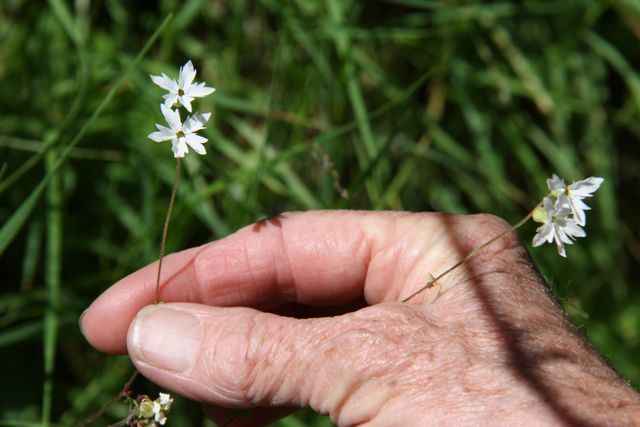
Plant of the day: common woodland star

This delicate flower boasts five raggedy white petals on a long bare stem. Common woodland star (Lithophragma affine) is a member of the Saxifragaeae family, as was yesterdays post.  The woodland star is a little more “typical” of the family, with its elegant white flowers and long, mostly leafless stem. But because of its tendency to sprawl rather than grow upright, I wasn’t sure if my hunch that it was a saxifrage was right until I looked it up. It also lacks the multiplicity of obvious stamens mentioned in the previous post.

There is another very similar species in Marin – the hillside woodland star (Lithophragma heterophyllum). You can most easily distinguish the two because the hillside woodland star has a tendency to sprout little bulbs, or “bulblets,” in the joint where the leaf meets the stem. Also if you look at the back of the flower (the “hypanthium,” you can see that the common woodland star joins the stem gradually whereas hillside woodland star flattens off dramatically at the back, so the stem attaches on to a nearly flat surface like a pencil set on the middle of a plate.

Leave a comment

Filed under Good for gardens, Native, Plant of the day

Plant of the day: flax

This delicate, pale blue flower is a common sight in sunny, grassy areas in the Bay Area. The distinctive form of flax makes it hard to confuse with anything else. Telling one flax from another is very tricky though! To identify Linum bienne versus Linum usitatissimum you need to get out your tweezers and hand lens and see whether the styles (the central female reproductive bits) are fused at the base. If they are not, then you have L. bienne.

Both species look very similar, with delicate petals and the darker veins that streak them being almost lavendar in hue. The five stamens’ anthers are a true, bright blue, and the many needle-like leaves cling closely to the stalk. L. bienne has smaller flowers, about 2cm across instead of 3cm.Sadly, this pretty little flower isn’t native; both species were introduced from the Mediterranean…

Leave a comment

Filed under Non-native, Plant of the day

Plant of the day: sun cups

These showy, low-growing flowers are commonly found nestled in the grass of meadows, pastures and trailsides. Taraxia ovata are distinctive with their simple blossoms supported on long pale stalks above a circular mat of long oval leaves. Four bright yellow petals cup around many pollen-dusted stamen. Below the flowers, four pointed green sepals bend sharply down toward the ground so they are parallel with the stems.

Sun cups are found along the coast of California and Oregon. In many publications they are also known as Camissonia ovata.

Leave a comment

Filed under Native, Plant of the day

Plant of the day: sticky monkey flower

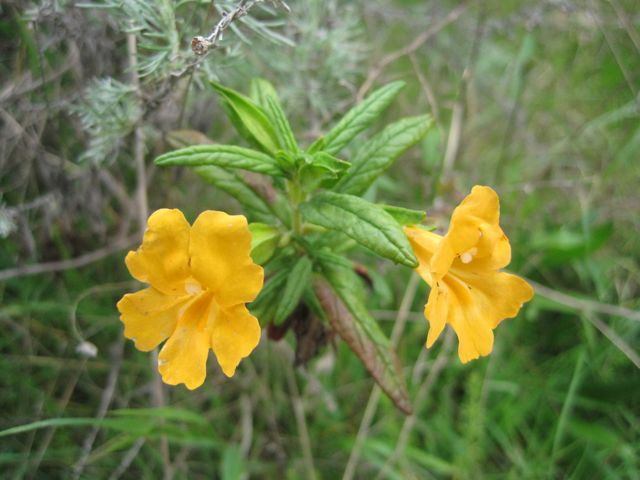
Have you seen those pale orange flowered bushes that are common in the hills of Marin? Yes, the ones with the dark green and the tubular flowers with a flaring rim like a musical instrument. This is Mimulus aurantiacus (aka bush monkey flower or sticky monkey flower). You won’t find it in the Peterson guide, since it’s technically a bush not a wildflower – but the blooms are pretty and if you pick it for a bouquet you’ll learn where it got its name from when your hands come away sticky. It likes to grow in brushy areas and chaparral, flat places and narrow steep ravines.

Leave a comment

Filed under Good for gardens, Native, Plant of the day

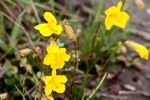
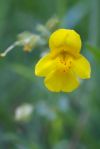
Plant of the day: seep-spring monkey flower

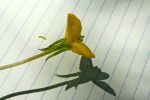
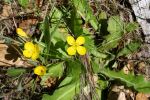
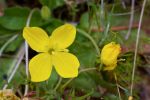
True to its name, this cheerful yellow flower is most often found growing on moist hillsides, along streambanks, and in other wet places. With reddish spots displayed inside it’s splayed lower lip,  Mimulus guttatus (also called common monkey flower) is easy to spot. Its tubular yellow flowers are folded at their opening, like the mouth of a sock puppet. Though joined at the base, they split at their ends into five or six petal-like lobes (depending on whether or not the central lower petal is divided). The plant itself is often dinky (as few as 2 inches high) but it grows up to knee height – three feet if it’s really happy.

There are many other mimulus in the area, but this is the only one that is yellow and has smooth leaves. Tomorrow I’ll write about sticky monkeyflower: the other most common mimulus.

Leave a comment

Filed under Native, Plant of the day

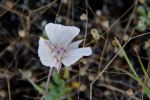
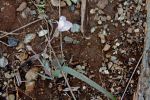
Plant of the day: Oakland star tulip

The mariposa lilies are a treat, every one. I was happy to come across an Oakland star tulip, also known as Oakland mariposa lily (Calochortus umbellatus) on Pine Mountain the other day. It can be distinguished from its more common cousin, pussy ears (calochortus tomeii) because it’s petals are only hairy on the lower half, not all the way up. The rocky gaps between clumps of chaparral along the Pine Mountain fire road are an ideal place to find this low-growing lily, which likes nutrient-poor serpentine soils and rocky slopes. It’s worth noting that it can also be found growing under the trees or shrub canopy on moist hillsides, though. Oakland mariposa lily is listed as a rare plant in California because of its limited distribution – it’s mostly found in the Bay Area.

Leave a comment

Filed under Native, Plant of the day

Plant of the day: bracken fern

Bracken fern is another one of my longtime favorite plants – and not just because the young, furled tips are tasty in salads or while on the trail. This unpretentious plant is both attractive and hardy. You see it in woodsy understories,  on dry hot hillsides, and everywhere in between. In the autumn, it’s dry leaves add a particular, pleasant scent to the fragrance of the forest. Wildlife uses it for food and nesting material; sometimes I’ve found beaten-down areas in larger patches, where deer have bedded down to sleep.

Distinct from other ferns, its large (up to 2 feet) fronds are broadly triangular, and often have an airy quality to them, with a lot of space between each sub-frond. Underneath, the fertile spores are found in a line hugging the edge of every leaflet. Even when these sori aren’t brown and ripe, you can see them as a raised green rim – another good diagnostic clue. None of the many other ferns in the area has this combination of obtuse outline, frond type, large size, and brown spore rim. Pteridium aquilinum can be found growing throughout most of North America. In fact (according to the USDA plants database) the only state in the US that it isn’t found in is South Dakota, which is odd enough that one has to wonder if it’s a data glitch. Or… maybe there is a legit ecological reason that this is the only state our fern has shunned!

This slideshow requires JavaScript.

Leave a comment

Filed under Edible, Native, Plant of the day

Plant of the day: western star flower

These “woodland stars” twinkle along forested trailsides in the springtime. They are like a high-end graphic designer’s version of a flower, with their many delicately pointed pale pink petals and curving yellow-tipped stamen. The blossom is usually displayed singly, rising from the center of a ring of spring-green leaves. Trientalis latifolia is the only one of its kind found in Marin, and usually grows under redwoods or other evergreens. Though it often can be found in wetlands and moist hillsides it can also thrive in drier spots.

This slideshow requires JavaScript.

2 Comments

Filed under Good for gardens, Native, Plant of the day

Pine Mountain, serpentine wonderland

The views are amazing on this high rocky ridge, and so are the plants. Dense stands of chaparral suddenly open onto stony serpentine outcrops supporting those hardy plants that can survive on such nutrient-poor soils. Right now ceanothus and manzanita are in bloom, and there are scattered meadows filled with wildflowers – goldfields, poppies, lupine, falselupine, and many more.

This slideshow requires JavaScript.

Get to Pine Mountain by driving up Bolinas-Fairfax road. The ridge runs northwest from a big turnout – you can walk all the way in to the San Geronimo Valley from here, on a wonderful network of trails and through a lovely rare forest of dwarfed Sargent cypress. There are no roads or houses in this area, and so as you walk often all you see is a tangle of forested ridges and valleys. And when you turn around and head home, you get sweeping views of the bay, the Richmond bridge, and Mt. Tam!

Leave a comment

Filed under TRAIL NOTES