Tag Archives: native plant

Plant of the day: common woodland star

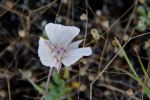
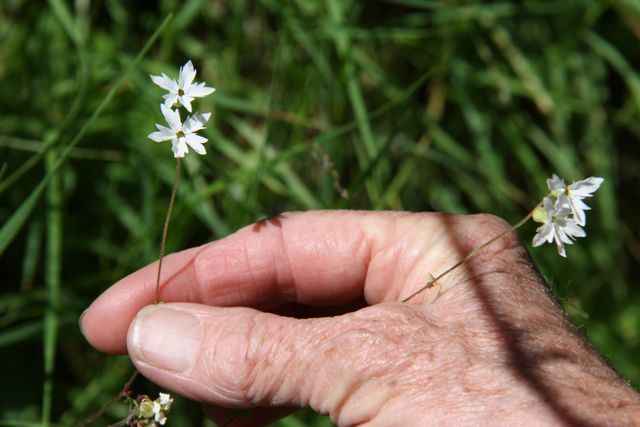
This delicate flower boasts five raggedy white petals on a long bare stem. Common woodland star (Lithophragma affine) is a member of the Saxifragaeae family, as was yesterdays post.  The woodland star is a little more “typical” of the family, with its elegant white flowers and long, mostly leafless stem. But because of its tendency to sprawl rather than grow upright, I wasn’t sure if my hunch that it was a saxifrage was right until I looked it up. It also lacks the multiplicity of obvious stamens mentioned in the previous post.

There is another very similar species in Marin – the hillside woodland star (Lithophragma heterophyllum). You can most easily distinguish the two because the hillside woodland star has a tendency to sprout little bulbs, or “bulblets,” in the joint where the leaf meets the stem. Also if you look at the back of the flower (the “hypanthium,” you can see that the common woodland star joins the stem gradually whereas hillside woodland star flattens off dramatically at the back, so the stem attaches on to a nearly flat surface like a pencil set on the middle of a plate.
Leave a comment

Filed under Good for gardens, Native, Plant of the day

Plant of the day: large-flowered star tulip

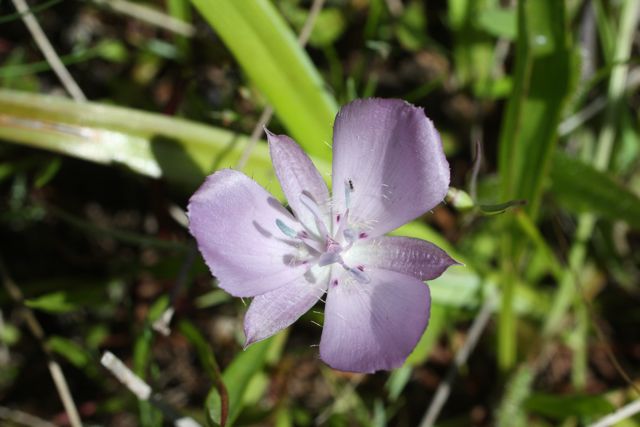
Here is another mariposa lily, this one seen in a low moist meadow near Bon Tempe lake. Calochortus uniflorus, or the large-flowered star tulip. You can tell it from the Oakland star tulip (which I wrote about last week) because it grows in wet meadows instead of on rocky slopes or damp hillsides. Both flowers have delicate, lightly hairy petals. Though the coloring can overlap, the large-flowered star tulip trends more towards purple while the Oakland star tulip is in the white to pale lavender range.

Leave a comment

Filed under Native, Plant of the day

Plant of the day: sun cups

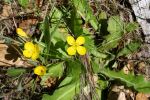
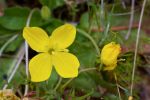
These showy, low-growing flowers are commonly found nestled in the grass of meadows, pastures and trailsides. Taraxia ovata are distinctive with their simple blossoms supported on long pale stalks above a circular mat of long oval leaves. Four bright yellow petals cup around many pollen-dusted stamen. Below the flowers, four pointed green sepals bend sharply down toward the ground so they are parallel with the stems.

Sun cups are found along the coast of California and Oregon. In many publications they are also known as Camissonia ovata.

Leave a comment

Filed under Native, Plant of the day

Plant of the day: spotted coralroot

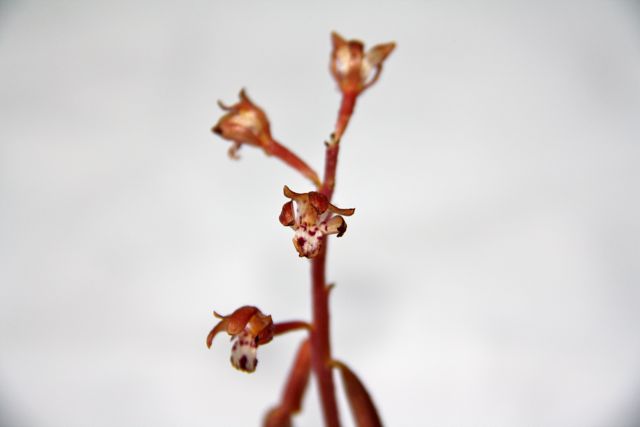
Small, leafless coralroot plants may easily go unnoticed, as they blend in to the forest floor. But sharp-eyed hikers will spot these diminutive orchids growing in the understory, often beneath redwoods. What’s really nifty about Corallorhiza maculata is that they don’t photosynthesize – they don’t have any chlorophyll at all. Instead they depend entirely on mycorrhizal fungi for their food. The fungi, in turn, get much of their nutrients from a symbiotic relationship with nearby trees. Plants that feed on fungi in this way are called “mycotropic.”

In addition to spotted coralroot, striped coralroot also grows in Marin. Unlike the orchid-like flowers of its spotted cousin (which has several brownish petals above a pale tongue with dark burgandy patches) the petals of striped coralroot all look quite similar – and they are (you guessed it) noticeably striped.

Leave a comment

Filed under Native, Plant of the day

Plant of the day: calypso orchid

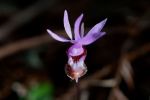
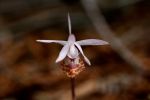
Peeking from the redwood duff, a calypso orchid. Calypso bulbosa, also known as a fairy slipper. This beautiful denizen of the woods is shy but not uncommon. It lifts its nodding head above the forest floor on a smooth purple stem, one or two green leaves lying flat at its base. And what a fearsome-looking flower!

The color can vary from pale pink to deep rose, but around here they are usually lilac-colored. A spikey crown flares upward like a punk-rocker halo. This crown is composed of petals, sepals and bracts all indistinguishable. Beneath, a lilac lobe juts forward, an awning over the burgandy-spotted pouch below. Tucked under the awning are anthers, which are designed to adhere to detach and stick to the backs of foraging insects. It turns out that Calypso orchids are tricksters – their shape suggests to passing insects that they may have nectar, but in fact, they don’t. Yet they depend entirely on this trick for pollination!

A Calypso orchid may live for up to five years (though usually less) and it dies back to its underground corm, or root-like structure, each summer. A new leaf is produced in the fall, and it flowers in the spring. It has a tremendously wide range. You can find it across western and northern United States, Canada, Japan and northern Europe.

Leave a comment

Filed under Native, Plant of the day

Plant of the day: sticky monkey flower

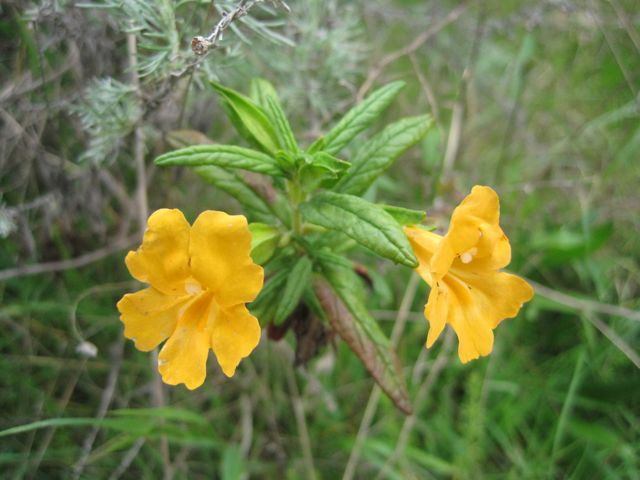
Have you seen those pale orange flowered bushes that are common in the hills of Marin? Yes, the ones with the dark green and the tubular flowers with a flaring rim like a musical instrument. This is Mimulus aurantiacus (aka bush monkey flower or sticky monkey flower). You won’t find it in the Peterson guide, since it’s technically a bush not a wildflower – but the blooms are pretty and if you pick it for a bouquet you’ll learn where it got its name from when your hands come away sticky. It likes to grow in brushy areas and chaparral, flat places and narrow steep ravines.

Leave a comment

Filed under Good for gardens, Native, Plant of the day

Plant of the day: seep-spring monkey flower

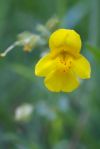
True to its name, this cheerful yellow flower is most often found growing on moist hillsides, along streambanks, and in other wet places. With reddish spots displayed inside it’s splayed lower lip,  Mimulus guttatus (also called common monkey flower) is easy to spot. Its tubular yellow flowers are folded at their opening, like the mouth of a sock puppet. Though joined at the base, they split at their ends into five or six petal-like lobes (depending on whether or not the central lower petal is divided). The plant itself is often dinky (as few as 2 inches high) but it grows up to knee height – three feet if it’s really happy.

There are many other mimulus in the area, but this is the only one that is yellow and has smooth leaves. Tomorrow I’ll write about sticky monkeyflower: the other most common mimulus.

Leave a comment

Filed under Native, Plant of the day

Plant of the day: hillside morning glory

When you see a low-growing morning glory that doesn’t twine or bind, but instead sits demurely on the earth surrounded by a small mat of hairy silvery leaves, you are probably looking at hillside morning glory, or Coast Range false bindweed (Calystegia collina). The photos below are of a sub-species that can often be seen in Marin on hillsides with serpentine soils – Calystegia collina ssp. collina. I saw this specimin on the Pine Mountain trail.

This slideshow requires JavaScript.

One thing that is tricky for a returning botanist like me is that Calystegia was known as Convovulvus back when I was first learning my plants. Yet another pesky name change to keep us on our toes!

Leave a comment

Filed under Native, Plant of the day

Plant of the day: pussy ears

Here’s another Calochortus to go with yesterday’s star tulip. You can see there is a very strong family resemblance! You also can see where this flower got its name, with such heavily furred ear-shaped petals.

This slideshow requires JavaScript.

Pussy ears (Calochortus tolmiei) is the only pale-colored Calochortus (cream or pinkish) in Marin that is NOT listed as a rare species. It is a beloved woodland sight, growing under mixed the spreading boughs of oaks or in redwood forest or even among the small scrubby trunks of chaparral. Even though it is more common, it’s always a treat because of its delicate and distinctive look. You can tell it’s in the lily family, since its petals are in groups of three. Plus, the three broad petals alternate with very long and very narrow sepals, which is the signature look of  most Calochortus.

Leave a comment

Filed under Native, Plant of the day

Plant of the day: Oakland star tulip

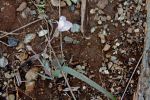
The mariposa lilies are a treat, every one. I was happy to come across an Oakland star tulip, also known as Oakland mariposa lily (Calochortus umbellatus) on Pine Mountain the other day. It can be distinguished from its more common cousin, pussy ears (calochortus tomeii) because it’s petals are only hairy on the lower half, not all the way up. The rocky gaps between clumps of chaparral along the Pine Mountain fire road are an ideal place to find this low-growing lily, which likes nutrient-poor serpentine soils and rocky slopes. It’s worth noting that it can also be found growing under the trees or shrub canopy on moist hillsides, though. Oakland mariposa lily is listed as a rare plant in California because of its limited distribution – it’s mostly found in the Bay Area.

Leave a comment

Filed under Native, Plant of the day