Tag Archives: San Francisco

Plant of the day: buckeye

It’s buckeye season – one of my favorite stages of spring. These spreading trees with their tall, pinkish-white spires of flowers can be seen along roadsides, streamsides, in mixed woodlands and even at the edge of pebbly beaches on Tomales Bay. I’ve seen Aesculus californica growing so close to the water that the lower branches were draped with streamers of dried eelgrass.

This slideshow requires JavaScript.

This lovely tree is unique to California, and can be found across much of the state. It has loads of character, with knobby, gnarled trunks and wide palmately compound leaves. It leafs out during the winter, offering cool shade on hot days into the early summer, and then it goes dormant. In the fall it drops beautiful shiny chestnut-colored nuts (ok, actually they are “capsules” since the hard exterior contains several seeds). I like to gather them and use them for decoration. But don’t eat any! They are toxic, known to depress the nervous system, cause abortions in cattle and be toxic to bees. Native Americans would use extract of the seed topically (for hermerrhoids?!). In tough times the seeds were sometimes eaten (after careful preparation to leach the poison out). Buckeye also provided food in a different way: pouring a ground-up powder of the seed into a stream would stupify fish for easier catching!
Leave a comment

Filed under Good for gardens, Medicinal, Native, Plant of the day, Poisonous

Plant of the day: rough hedge nettle

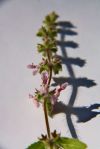
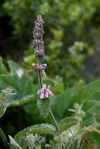
Rough hedge nettle is widespread in the area, and hedge nettles in general are easy to recognize. Though they don’t have the typical smell, hedge nettles are in the mint family! Mints are often hairy and smelly (like some rugged botanist-types that I know?!) and they have a tubular flower that usually is distinctly two-lipped. For the hedge nettles this is certainly the case. But the real giveaway for this family is that they have a square stem. Just roll it between your fingers to see what this means – all mint stems are distinctly four-sided (see the stem close-up below). There are other families that have square stems, but the many local species in the mint family (Lamiaceae) are by far the most common.

Stachys rigida is usually found in dry places—woods, shrublands, or grasslands. There are other hedge nettles (such as S. chamissonis, with its showy purple flowers) that prefer wetlands but our S. rigida is almost always on slopes, in gravel, clay or rocky soil. And, if you want to get technical, you should know that the Marin Flora lists Stachys rigida var. quercitorum as the local variety.

Leave a comment

Filed under Native, Plant of the day

Plant of the day: silverweed cinquefoil

Silver weed cinquefoil

Potentilla anserina

This is sunny little flower almost always grows in wetlands or creeksides, though it can be found elsewhere. The photo shown here was taken on a seemingly-dry trailside, but because it was on a hill I wouldn’t be surprised if it is wetter than it appeared. Potentilla anserina is the most common cinquefoil in the area. In general, cinquefoils have a very distinctive “look,” with five spreading petals and surrounding a central mound of many stamens. The leaves are composed of crinkly, jagged-edged leaflets. Often the leaflets are arranged in many pairs along the stem (as with this silverweed here), but sometimes they are in threes or in a fan shape. Once you’ve seen a few different species the similarities start to jump out at you!

Leave a comment

Filed under Native, Plant of the day

Plant of the day: long beaked stork’s bill

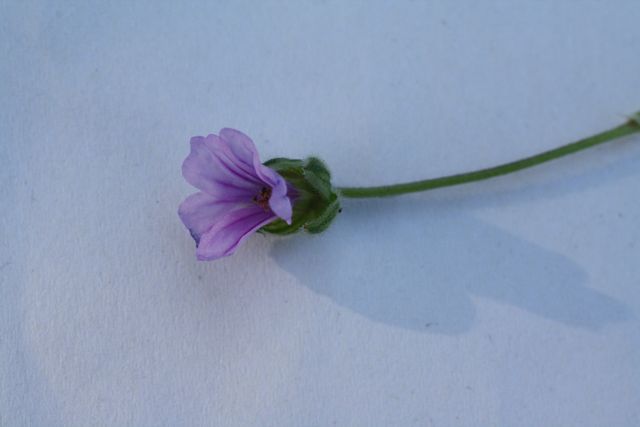
Long beaked stork’s bill is a ubiquitous sight in the fields of the bay area. This invasive little weed and its cousins, other types of stork’s bills, have naturalized across most of California. The long beaked stork’s bill (Erodium botrys) is distinctive because of the particularly long, beak-like seed pod, but also because of its leaf – it is the only one with a long narrow leaf that isn’t actually dissected into separate leaflets.

There are several species of wild geraniums with flowers that look quite a bit like those of stork’s bills – small, pinkish-purple. Again, look to the leaf to know what plant it is. The geraniums (sometimes called crane’s bills) have deeply dissected leaves that are overall roundish in shape. In other words, if you drew a line around the outside of the leaf, ignoring the details, you’d come up with a circle as opposed to the overall tongue-shaped leaves of the stork’s bills. The wild geranium petals are usually notched at the end, giving them a toothed look. Almost all of the wild geraniums are also invasive, with a few exceptions.

Leave a comment

Filed under Invasive, Non-native, Plant of the day

Plant of the day: secund jewelflower

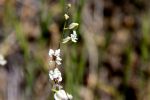
Like a handful of precious jewels scattered on a rocky slope, this flower is easily missed but well worth a closer look. With single flowers spread out on a long, leafless stalk they can blend into the background. Each blossom is gathered at the base into a balloon that reminds me of the bell-shaped skirts at an old-fashioned ball. At the mouth, the four petals crinkle and flare outwards from a purple-tinged mouth. This is Streptanthus glandulosus ssp. Secundus. The ssp means “subspecies” – a lot of times this designation refers to very subtle differences within a species that a casual botanist isn’t interested in. But in this case, it means this flower is white while the others are dark purple. There are several different jewelflowers in the area, distinguished by their distinctive pouchlike shape, but this is the only white one listed in the Marin Flora.

Jewelflowers are in the same family (Brassicaceae) as the common wild mustards and radish weeds that grow all over, but their signature blossoms are different from most members of this group, which have simple four-petalled flowers. Milkmaids are a good example of a classic brassica.

Leave a comment

Filed under Native, Plant of the day

Plant of the day: yerba santa

Beside a rocky trail, a tall spike of leathery green leaves topped by a cluster of white flowers peeks up through the chaparral. This is yerba santa, or Eriodictyon californicum. It is known as a medicinal plant (tea now available at Amazon as well as in the great outdoors), though personally I haven’t been attracted by the descriptions of a bitter, menthol-like taste. Traditionally, the tea was used for colds and other respiratory troubles, though it also has been used to treat maladies as diverse as stomach aches, headaches, bruises, eye troubles, and gonnorhea.

The leaves are often dusted with an unappealing black mold, but without this yerba santa is a handsome plant. The white flowers cluster loosely at the top of the spike of leaves. Each blossom is tubular and flared at the mouth, with petals that taper off into points. If you look close, you’ll see that each flower has two styles (and no, that isn’t sweats and slacks. The style is the shaft of the female reproductive parts).

You commonly find yerba santa on rocky slopes or in chaparral, among the dense scrub of manzanita or ceanothus. It can reproduce by seed, but only does so after a fire or other disturbance of the soil surface. Since fires aren’t common in today’s era of fire suppression, it usually reproduced vegetatively. They can grow a rhizome (rootlike structure) up to eight feet long in a single summer! That rhizome will put up new plants every 8 to 10 inches — an effective way to raise a family indeed.

Leave a comment

Filed under Edible, Native, Plant of the day