Monthly Archives: May 2012

Plant of the day: mule ears

Like stubby sunflowers, these cheerful yellow blossoms have large, open faces. They can be seen ornamenting grassy hillsides as well as woods and brushy areas. Mule ears (Wyethia glabra) is a California endemic that is widespread throughout much of the western part of the state. Each yellow flower head is backed by a large collection of leaves that can be seen peeking out from behind the inflorescence. Narrow-leaved mule ears (Wyethia angustifolia, not endemic) are also common in Marin, but are easy to tell from regular mule ears because they lack these backing “broad and foliacious” bracts.

This is the first member of the Ateraceae family – also known as a “composite” – to appear on this blog, so a note on this type of plant. What looks like a single flower is actually hundreds of smaller flowers grouped together. This amalgamation is easier to mistake for a single bloom than other headlike arrangements because often the outer flowers look like petals, while the inner flowers are smaller and less showy and can look a lot like pistils or stamens. The outer, petal-like flowers are the “ray” flowers and the inner ones are the “disc” flowers. Each is truly an independent flower in and  of itself, each with its own petals and reproductive parts. The entire arrangement is called a “pseudanthia.”
Leave a comment

Filed under Botany basics, Native, Plant of the day

Plant of the day: milk maids

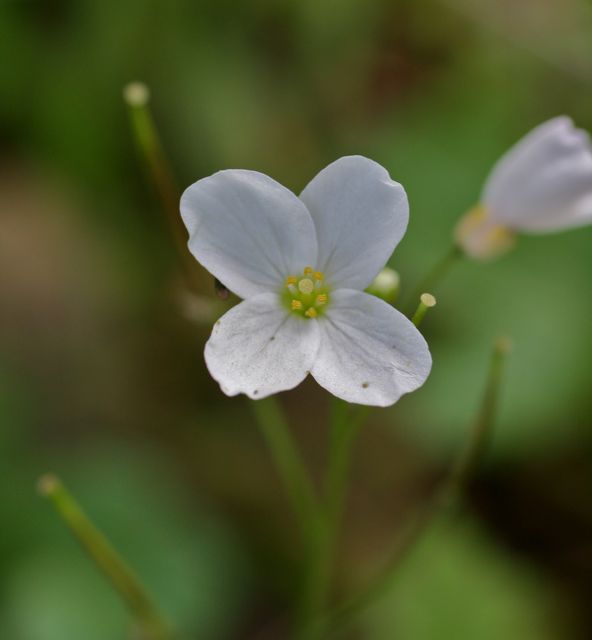
Milk maids are a ubiquitous sight in the spring, with their flowers of four simple white petals alternating sparsely up a stalk. They are one of the first of the year to start blooming, and they can last through May. Wikipedia says the name derives from a hat often worn by milkmaids, but that seems like a stretch since there is nothing bonnet-like about these blooms. Cardamine californica has flowers that are about half an inch across, and grow in most habitat types in the county except the driest. The four petals mark it as a brassica, the same family that houses wild mustard and radish. Many cultivated edibles, like broccoli and kale, are also in the Brassicaceae. Because of the “cross shaped” petals, this family once was called the cruciferae.

This pretty little flower is one of the earliest to bloom, and all parts of the plant (leaves, flowers, and roots) are edible, with a peppery radishlike flavor–they are tastiest before the flowers bloom, according to Judith Larner Lowry’s wonderful book, California Foraging (I admit I haven’t done a careful comparison myself).

Leave a comment

Filed under Native, Plant of the day

Plant of the day: Douglas iris

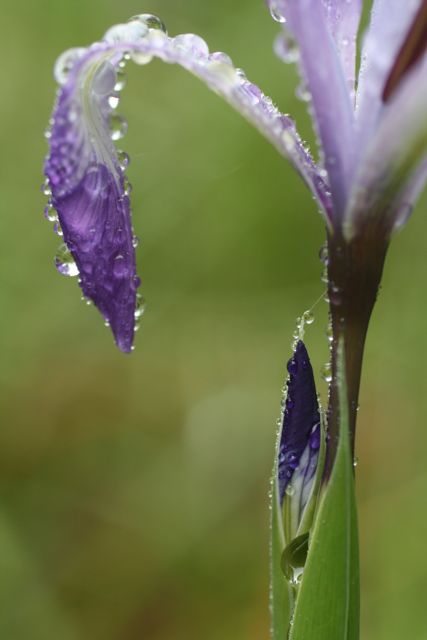
The wild irises of California are a spring delight. You can see them in forest clearings and meadows, sometimes in great green and purple masses. Other times one plant will appear singly, a burst of color against the browns of an understory. With their many variations in color and decoration they are a never-ending visual treat ranging from dark purple to pale yellow.

This slideshow requires JavaScript.

The three largest, lower petals can look like a cross between a watercolor and a stained-glass window, with dark veins blocking out yellows, whites and purples – but with the color fading gently towards the edge of the petal. Above it is what appears to be a paler, less gaudy petal (it’s actually part of the pistil). Sandwiched between the two is the dark purple tongue of the stamen, dusted underneath with pollen, and invisible unless you pry the flower open or look very close. Often you’ll see bees rummaging around and coming out with their legs laden with pollen.

Douglas iris (Iris douglasiana) is the most common wild iris species, but coast iris (Iris longipetala) and ground iris (Iris macrosiphon) are also somewhat common. And keying them is a trick!! Every book or expert gives different suggestions about how to distinguish one from another. The Marin Flora says you can identify a Douglas iris if the pollen is yellow and the surface of the leaf is shinier than the underside and the long purple tube below the flower (the perianth tube) is about 2 centimeters long. But the Flora of Sonoma County suggests two ways to ID the Douglas. First  is if the leaf bases (but not the entire plant!) is reddish. Second is if the perianth tube is less than 3 centimeters long. So take your pick! Once I get a confident ID on another species I’ll post about those as well.

1 Comment

Filed under Good for gardens, Native, Plant of the day

Plant of the day: yerba santa

Beside a rocky trail, a tall spike of leathery green leaves topped by a cluster of white flowers peeks up through the chaparral. This is yerba santa, or Eriodictyon californicum. It is known as a medicinal plant (tea now available at Amazon as well as in the great outdoors), though personally I haven’t been attracted by the descriptions of a bitter, menthol-like taste. Traditionally, the tea was used for colds and other respiratory troubles, though it also has been used to treat maladies as diverse as stomach aches, headaches, bruises, eye troubles, and gonnorhea.

The leaves are often dusted with an unappealing black mold, but without this yerba santa is a handsome plant. The white flowers cluster loosely at the top of the spike of leaves. Each blossom is tubular and flared at the mouth, with petals that taper off into points. If you look close, you’ll see that each flower has two styles (and no, that isn’t sweats and slacks. The style is the shaft of the female reproductive parts).

You commonly find yerba santa on rocky slopes or in chaparral, among the dense scrub of manzanita or ceanothus. It can reproduce by seed, but only does so after a fire or other disturbance of the soil surface. Since fires aren’t common in today’s era of fire suppression, it usually reproduced vegetatively. They can grow a rhizome (rootlike structure) up to eight feet long in a single summer! That rhizome will put up new plants every 8 to 10 inches — an effective way to raise a family indeed.

Leave a comment

Filed under Edible, Native, Plant of the day

Plant of the day: French broom

I remember when I was a kid, and first learned that the pretty yellow-flowered bushes I saw all over were bad for the environment. It was probably my first ecological lesson, and I was heartbroken. Their sunny color had always made me happy when I looked out the window on family drives. How could I have been so wrong?

Since then, Genista monspessulana has only become more common. You can see it filling the understory of forests on Mt. Tam, or spilling over the cement retaining walls along roadsides. This highly invasive plant is native to the Mediterranean and the Azores, and was brought to California in the 1800s — probably as an ornamental for gardens. It really is quite pretty. But it also is what scientists call an “ecosystem disruptor” because it wreaks havoc on the native plant communities. It forms dense stands up to 16 feet tall, under which nothing else can survive. All the delicate flowers, grasses and even hardier shrubs perish in its shadow. Livestock don’t even like to eat it. Broom is like an ecological bulldozer, taking diverse habitats and leaving a barren landscape in which it is the only survivor. A single plant has been found to produce over 30,000 seeds — and the seeds live for decades in the soil, waiting for a disturbance like digging (or pulling a grown plant out by the roots) before they sprout. It also is a fire danger, growing tall and tinder dry. Can you tell how I feel about this plant? It’s a nightmare. If you have it on your land or in your neighborhood, get rid of it!! Quick, before it spreads!

Leave a comment

Filed under Invasive, Plant of the day

Plant of the day: two eyed violet

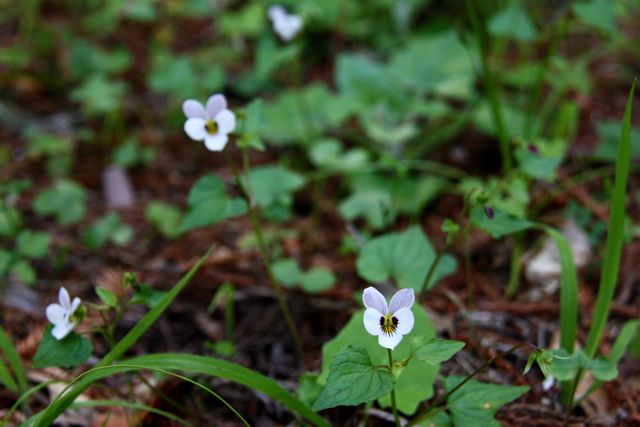
There’s not much that is prettier than a glade filled with violets. They are tougher than they look – two eyed violets like serpentine soil, as well as grassy meadows or rocky hillsides. I saw the ones pictured here growing on the edge of a redwood forest, under some pepperwood trees. Two eyed violets (Viola ocellata) are distinctively named, as they can be distinguished from all other local violets by the two purple spots on their lateral petals. According to the Marin Flora, there is only one other purple violet in the area, and it lacks the paired spots. All the other violets around are yellow.

These little beauties are endemic to the north-western parts of California, and even though they look like a fragile annual they are actually perennials!

Leave a comment

Filed under Good for gardens, Native, Plant of the day

Plant of the day: Pacific blacksnakeroot

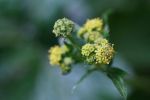
This plant most often presents itself as shiny, three-lobed leaves that grow close to the ground. What is that plant? It is unobtrusive yet distinctive. In the spring it sends up a tall spindly stalk, which splits into branches, each topped with a small head of greenish-yellow flowers. It is Sanicula crassicaulis, also known as Pacific blacksnakeroot, Pacific sanicle, or gamble weed.

A similar species, Coast blacksnakeroot is also common in Marin, but it has yellower flowers and some subtle differences in the fruit.

Leave a comment

Filed under Native, Plant of the day

Plant of the day: crimson columbine

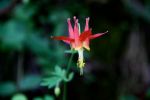
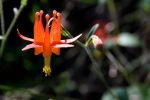
Crimson columbine is a bizarre confection of a flower. With its bright red turrets and awnings, and a dangling bouquet of long yellow stamens, Aquilegia formosa is one of the most sculptural flowers around. It looks like it was designed by Frank Lloyd Wright just to grow in the gardens of the Marin Civic Center – though it doesn’t, as far as I know. Believe it or not, this extravagant bloom is in the same family (Ranunculaceae) as the simple buttercup!

These columbine prefer moist spots and stream banks, where you can find their flaming blossoms high above an airy nest of deeply lobed leaves. In general, the plants grow one to three feet tall, and they are found in all the western states. I saw the beauties photographed here on the Concrete Pipe Trail on the Marin Municipal Water District lands. This is an unpaved access road with a steep bank running along one side for much of its length, and it’s a great spot for seeing a diverse collection of spring flowers.

2 Comments

Filed under Good for gardens, Native, Plant of the day

Plant of the day: harlequin lotus

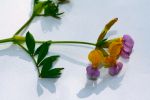
Low, gaudy patches of yellow and purple are splashed across the grass of a wet meadow. This is Lotus formosissiumus, which has numerous common names including harlequin lotus, bicolored lotus, coast lotus or (if you’re in the mood for a bit of a tongue-twister) seaside bird’s foot trefoil. I find harlequin lotus the most descriptive, though coast lotus is also a good monniker since it’s range doesn’t go very far inland.

With it’s typical two-lipped flowers it’s clearly in the pea family. But what coloring! The upper lips are a rich, bright yellow, and the lower lips are a flashy pinkish purple that can, in some plants, fade out towards white with age. The Peterson guide says it grows 1 to 2 feet tall, but I have never seen one more than 5 or so inches high, and other books don’t mention height as a diagnostic trait.

Leave a comment

Filed under Native, Plant of the day

The countless blooms of concrete pipe trail

Really this is an unpaved access road, not a trail – but it’s a great spot to see a wide variety of wildflowers right now. In fact, it is the steep road cut that seems to account for much of the diversity. From the weedy forget-me-nots growing along the seep spring near the beginning of the road, you’ll pass through many different combinations of sun, shade and soil. The level road curves around the canyons and hills of the Marin Municipal Water District, and different flowers appear around every curve. I went out with my parents (happy mother’s day mom!) and we saw jewel flower, Chinese houses, Larkspur, linanthus, woodland star, iris, and many many more. There was a dry, rocky hillside with tall sticky monekyflower bushes laden with  blooms, through which a morning glory vine had grown so its large white flowers floated on a sea of orange. In a damp ravine, crimson columbine grew in a garden of other flowers including purple iris and forget-me-nots. When I got home, my plant list had 81 species on it, and 53 of those had been in flower!

This is an easy hike since it’s flat, but you can turn it into a more vigorous outing by connecting up with the network of trails that extends down into Deer Park or up onto the rest of the MMWD property – you could go all the way to the top of Mt. Tam if you wanted to!

To get there, head up the Bolinas-Fairfax road as if you were going to Bon Tempe Lake, but at the turnoff to the lake instead park in one of the limited pullouts on the downhill side of the road. Concrete Pipe Trail starts on the other side of the gate.

Leave a comment

Filed under TRAIL NOTES