Monthly Archives: September 2012

Plant of the day: leather oak

Oaks are generally thought of as tall, graceful trees. But you can also find them in the sea of waist-high bushes known as chaparral. Leather oak (Quercus durata var. durata) is a common sight on serpentine soils in this area.

This slideshow requires JavaScript.

Leather oak can grow to around nine feet tall, but I have mainly noticed them growing much closer to the ground. Look close to spot acorns or clusters of catkin-like flowers among the small, grayish green leaves. The leaves of this species are dull, dusted with a pale fuzz (paler on the top than on the bottom). They also are concavely curled towards the ground–you could flip one over and use it for a little spoon, if they didn’t have a tendency to be spiny.

As with all acorns, the nut of the leather oak is edible once its bitter tannins have been leached out. Acorns were historically a major food source for local Native American tribes, and still are a major part of the food chain for wildlife. People generally remove tannins by soaking the nut in water (or a running stream). But some tribes would plant the acorn in a bog and wait until it sprouted in the spring–a system which apparently got rid of most tannins but preserved more nutrients than the water method.

Acorns can be eaten whole, or ground into a floury powder for cooking. Roasted acorns can be used as a coffee substitute.
Leave a comment

Filed under Edible, Native, Plant of the day

Plant of the day: coyote brush

Small white flowers are beginning to bud and bloom on a sweet-smelling bush of the chaparral. This is coyote brush, or Baccharis pilularis. For some reason that I can’t put my finger on, I find this a particularly charming plant. Its small leaves are scalloped at the edges and rough (and sometimes sticky) to the touch. On hot days, you can tell it’s nearby just from the resinous, pleasant smell.

This slideshow requires JavaScript.

Coyote brush blooms in late summer and early fall, and bears its male and female flowers on separate plants (the botanical word for this is “dioecious”, as opposed to most plants which are “monoecious” and have their male and female parts on the same plant, usually in the same flower).

You can find coyote brush growing from Baja California to Tillamook County, Oregon; from coastal scrub to foothill forests. Generally its an upright shrub, but along the coast it can also grow in a prostrate form that once was (but no longer is) considered a different species.

1 Comment

Filed under Native, Plant of the day

Plant of the day: pampas grass

Cortaderia jubata

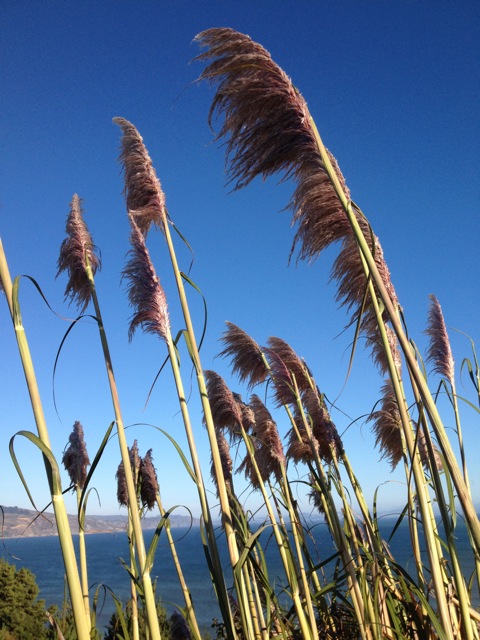
People who don’t know better think that pampas grass is beautiful–and in most ways, it is. The flowers of this gigantic grass are showy plumes that wave in the wind like horses’ manes or pennants. The leaves are long and trailing, and as wide as a large man’s finger. The whole plant, including the lofty bloom, can be up to 20 feet tall.

But this striking plant is also a noxious invasive, imported from Argentina and the Andes. It grows quickly in disturbed areas like cliff faces and road cuts, and forms large patches that crowd out smaller or slower growing native species.

There are actually two species that are commonly called pampas grass–Cortaderia jubata and C. selloana. Both thrive along the coast, but jubata (sometimes also called jubata grass) is restricted to coastal areas, while selloana also grows farther inland. Jubata plumes are purple or lilac, tending towards white as they age. This species can also be distinguished from its cousin because it holds its plumes quite high above the mound of leaves.

Both species of pampas grass bear their male and female flowers on separate plants (the botanical word for this is “dioecious,” as opposed to most plants which are “monoecious” and have their male and female parts on the same plant, often in the same flower). But while C. jubata reproduces asexually and lives for ten years or more, C. selloana can only reproduce if another plant of the opposite sex is nearby.

3 Comments

Filed under Invasive, Non-native, Plant of the day

Plant of the day: wax myrtle

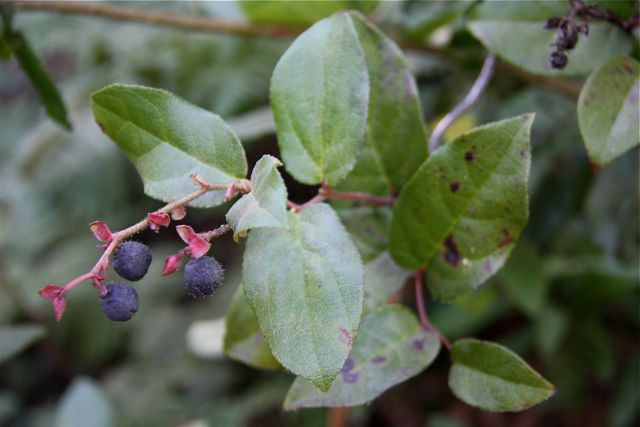
The berries of the California wax myrtle look like they are made from grains of purple wax, all pressed together into a ball. You can see them now, growing close to the stem in the Bishop pine forests of Point Reyes (and elsewhere). This small tree (Morella californica) has long, narrow leaves with pointy tips.

This slideshow requires JavaScript.

Both the coating and the pulp of the berries contain wax, which can be gleaned by boiling them. The wax is said to make a pleasant-smelling candle if enough is collected. The berries, while not toxic, are not said to be tasty either (I admit I’ve never tried them). They also can be used to make a purple dye.

Leave a comment

Filed under Native, Plant of the day

Plant of the day: salal

Gaultheria shallon

Salal is a familiar companion of the forest underbrush from Alaska to Santa Barbara. It is unadorned for most of the year, a simple shrub with largish (~4 inch) leathery leaves that dance up alternate sides of a slightly zig-zagged stem. In between the large veins, the leaves are traced with an intricate lacey pattern somewhat like the crease on the palm of a hand.

Small bell-shaped flowers of pinkish white appear at the tips of the stems in the early summer, and by now the dark purple fruit has ripened. Each berry is lightly hairy, and they are fairly sparse on the plant. Though edible, I have found them to be bland the few times I’ve tasted them. The leaves can be made into “a pleasant tea“, and poultices made of the leaves were traditionally applied to cuts, burns and sores. The fruit or leaves were also used to make dyes (of purple or yellow).

Leave a comment

Filed under Edible, Native, Plant of the day

Plant of the day: naked lady

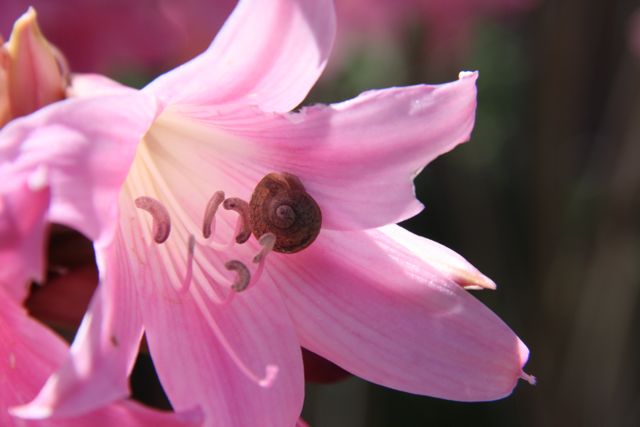
Amaryllis belladonnaTall, garish pink lilies are blooming in the dry grass of hillsides and fencelines. These are naked ladies (also known as pink ladies, Latin name Amaryllis belladonna), which are one of the classic sights of late summer in California. Their name comes from the fact that they don’t flower until after their lush mound of spring leaves have died back and disappeared. Then each single blossom rises on a long naked stalk.

The large horn-shaped blossoms have six pointed petals, six stamens topped with crescent-shaped anthers, and a delicate scent. This non-native lily was planted widely by early settlers, and patches of the flower on remote hillsides can be a clue that a garden or homestead once stood there. They are hardy, handling transplanting well and spreading locally so that eventually a few scattered plants can grow into a dense and colorful patch. Luckily it doesn’t spread widely and so it remains a colorful novelty and not a full-blown invasive species…

3 Comments

Filed under Non-native, Plant of the day

Plant of the day: fivefinger cinquefoil

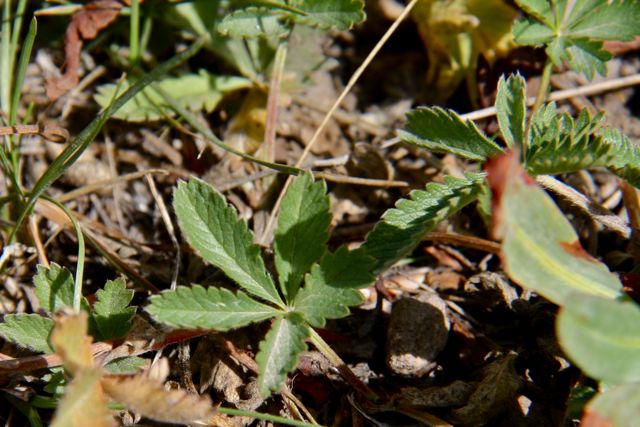
Here in a moist mountain meadow I find a little yellow flower with five petals surrounding many stamens. Five jagged-edged leaves spread like a palm at the end of their stalk (and the term for this leaf arrangement is, indeed, “palmate”). This is fivefinger cinquefoil, or Potentilla gracilis.

The flower, plus the deeply creased, jagged leaves, are the signature of most Potentilla species. But unlike our lowland silverweed cinquefoil, which I wrote about a few months ago, the fivefinger cinquefoil can’t be found at sea level (though it does have quite a wide range, growing as low as 400 feet in elevation and up to nearly 12,000 feet). Look at that post, here, to see the similarities and differences between the leaves.

It’s also called northwest cinquefoil and slender cinquefoil. Native American tribes used the roots medicinally (either pounded or as a poultice) to treat aches and pains.

Note the fan-shaped “palmate” pattern of leaves

Leave a comment

Filed under Native, Plant of the day

Plant of the day: primrose monkeyflower

Mimulus primuloides

On a mossy lake shore, a small yellow flower gapes its red-spotted tongue towards passing insects. It stands only a few inches tall, balancing a single bloom on a thread-thin, leafless stalk. A rosette of green leaves surrounds it at the base. This is primrose monkeyflower (Mimulus primuloides), which only likes to grow above 2,000 feet in elevation.

At first glance, this little yellow monkeyflowers of the alpine country look a lot like those of the lowlands–but look close! Even though we are used to seeing Mimulus guttatis around here, there are many other species with bright yellow blossoms that are dotted with red… But this is the only one (that I know of) to bear a single flower on a leafless stem.

1 Comment

Filed under Native, Plant of the day