Category Archives: Edible

Plant of the day: sand verbena

Abronia_latifolia1Heads of little yellow flowers decorate the dunes. This is sand verbena, or Abronia latifolia. Its prostrate stems are sprawled like sunbathers across the sand, raising their leaves and blossoms like a lazy wave. The flowers are some of the showier native dune blooms, and have a lemon-verbena scent. The succulent, scalloped leaves are pretty in their own right–especially when lightly dusted with sand.

You can find this little flower on the dunes and strand, and in coastal scrub, from Santa Barbara to Washington State. Its long, stout roots are edible and somewhat sweet. They were usually harvested in the fall by coastal tribes.

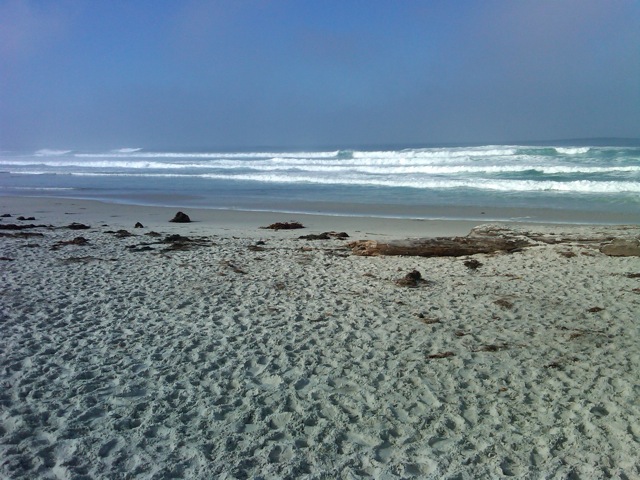
I saw spotted this verbena on the white sands of Asilomar during EcoFarm–a great conference, and a lovely state park and beach to visit at any time! Asilomar1

Leave a comment

Filed under Edible, Native, Plant of the day

Plant of the day: hound’s tongue

Blue-purple blossoms are scattered among velvety leaves that rise from the ground like the perked ears of some alert subterranean beast. Right now, the young leaves are a beautiful palette of color–pale red veins spread across soft greenish purple. As they mature, the leaves deepen into pure emerald.

This slideshow requires JavaScript.

This is hound’s tongue, or Cynoglossum grande, a distinctive forest companion in the spring–often seen growing in oak woodlands, sometimes alongside yesterday’s plant, Indian warrior. Once you learn to recognize them, even the leaves are hard to mistake for anything else. Hound’s tongue flowers are simple yet pretty, ranging in color from rich blue to pink to (very occasionally) white. Each petal buckles up along the inner rim, forming a raised ring of humped white bumps around the pistil and stamens.

Indigenous Californians roasted the root as food, and grated it as medicine to treat stomach aches, burns, and venereal disease.

Leave a comment

Filed under Edible, Good for gardens, Medicinal, Native

Plant of the day: licorice fern

Notice the long, tapering tips on the fronds

Notice the long, tapering tips on the fronds

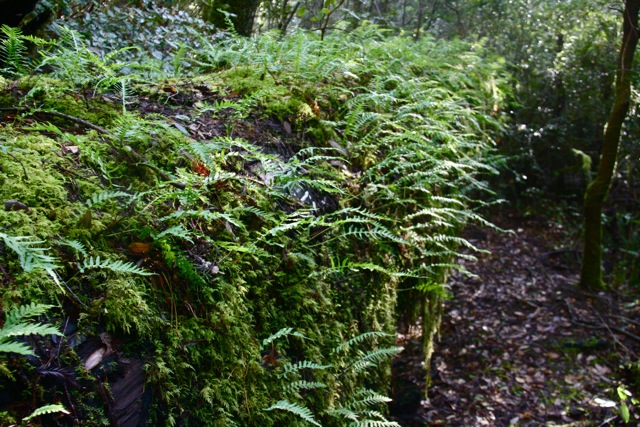
A fallen log is decked with soft green ferns. This is licorice fern (Polypodium glycyrrhiza)–a confusingly close relative of the much more common California polypody. Licorice fern can be identified by the tapering, pointy tips on its fronds and–at least according to one guide, Plants of the San Francisco Bay Region–the veins on the fronds are translucent (while California polypody veins are opaque and the leaf tips are rounded). As far as I can tell, both of these two polypody species have rhizomes that taste like a tart licorice–but I’ve only done my taste-tests haphazardly, and so might be wrong.

Native Americans chewed the tasty rhizomes for flavor, and also used it to treat colds and coughs, and venereal disease. Polypodium_glycyrrhiza1

Leave a comment

Filed under Edible, Medicinal, Native

Plant of the day: sourgrass

Oxalis_pes-capre1You’ll see it nodding its lemony-yellow flowers along sidewalks and wild trails. Most little kids will recognize the clover-like leaves and smooth green stem. This is sourgrass (Oxalis pes-capre), an invasive with a pleasantly tart and tasty flavor.

Also known as Bermuda buttercup, buttercup oxalis, and yellow oxalis, this little plant was introduced as an ornamental from South Africa and now is found throughout coastal California, as well as in Arizona and Florida. The flowers, stems and leaves are all edible and make a nice trailside snack, or addition to a salad.

Leave a comment

Filed under Edible, Invasive, Non-native, Plant of the day

Plant of the day: canyon live oak

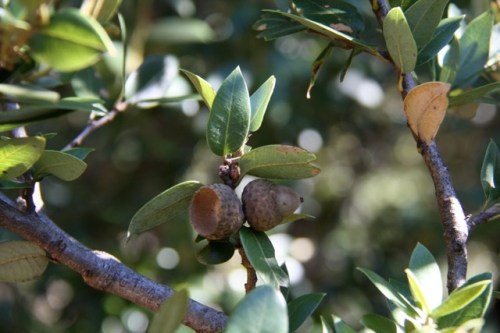
Quercus_chrysolepis1True to its name, canyon live oak (Quercus chrysolepis)  is often found clinging to ravine walls and steep hillsides. This beautiful and abundant tree is most easily identified by the golden-colored fuzz that coats the concave underside of young leaves–giving rise to one of it’s other common names, goldencup oak. In chaparral it can be low low and shrubby, but in more open country it grows into a graceful tree.

Canyon live oak has particularly hard wood for an oak, and its third common name is maul oak as it historically was used to make axles, tool handles, mauls, wagon tongues, plow beams, ship frames, and wheels. Wedges made from canyon live oak were used to split redwood into railroad ties. As with all oaks, its acorns were a favorite food of Native Americans. Once the bitter tannins had been leached out, it can be made into flour for cakes, breads and stews. In the southern coast range, it is a main habitat for spotted owls; myriad other species live in the oak forests, thriving on the abundant nourishment provided by the acorns. Reptiles and amphibians live in trunk cavities, birds nest among the branches, black-tailed deer browse on the leaves and mountain lions prowl through the underbrush.

Quercus_chrysolepis2

Leave a comment

Filed under Edible, Native, Plant of the day, Poisonous

Plant of the day: tan oak

Notholithocarpus_densiflorus1

Notholithocarpus densiflorus

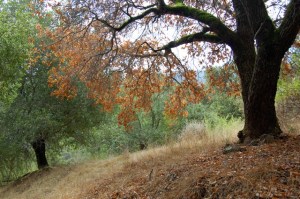
The beautiful tree is dying.

From Big Sur to Brookings, entire groves have browned and fallen. Single snags stand in forests like wisps of smoke, like ghosts.

Sudden Oak Death is old news these days – but how does news of a plague become old? The beautiful tree is dying, and eventually it will be gone. With it, a piece of California will be gone as well.

There is a reason the Kashaya-Pomo tribe called the tan oak Chishkale, or “beautiful tree”. Its bountiful harvest of acorns was one of the best foods around. The Kashaya and other native people soaked and beat the nuts into breads and cakes, gruel and soup. During a flu, they sucked acorns like cough drops. For celebration, strung acorns were twirled in the air to make music.
Notholithocarpus_densiflorus2Chishkale has been a generous neighbor to humans and non-humans alike. Northern flying squirrels, dusky footed woodrats and black salamanders are just a few of the myriad creatures that call its roots and limbs home. Their nutrient-packed nuts are a key fuel driving the engine of the ecosystem here in the coastal hills where it lives; deer, squirrels, woodpeckers and jays all dine on the bitter fruit. They were a favorite snack for grizzlies, before the bears were driven from the state. And when feral pigs arrived, acorns became a rooting prize for the hogs as well.

Other creatures eat the creatures that eat the acorns, and when fruit and flesh decay, still more creatures dine on that. Their offal enriches the soil, from which more plants rise. Without them, the engine will falter – and then, because nature eternally adapts, it will change. But something precious will be gone for good.

So, if you aren’t from around here, go outside now. Go and spend time with the tanoaks while groves still live. While they still stand in crowds or pairs and or singly among other trees on a hillside.

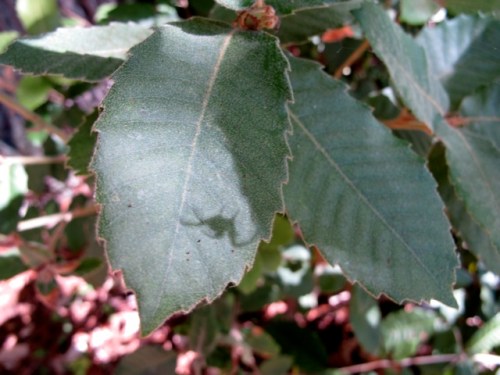
Ideally, do this in late summer, when the acorns have fallen and you can see how thick they are on the ground. Find somewhere that the trees grow closely. In places the acorns crunch under your feet like gravel. Notice how dark green the leaves are: serrated like a bread knife, with undersides coated with a soft beige fuzz.

Leave the trail; you are on a brown carpet of leaf and twig. The air smells uniquely dusty and a little soft, thick with the down from the leaves. Sunlight filters down in shifting patches, and squirrels and jays chatter and call. Sometimes a raven swoops through with a heavy push of wings, a dignified awk awk. With a breeze, you may notice that the sound these particular branches make in the wind is like all branches in all wind, and also like no other branches on the planet.

If it is a warm day maybe you will want to find a nice tree, an old one with a broad trunk, and take a nap at its base. When you wake up, you may think of how long your companion has been in this spot, of what it has stood witness to. And mourn for a minute that soon it – and all of its kin – will be gone.Notholithocarpus_densiflorus3
Leave a comment

Filed under Edible, Plant of the day

Plant of the day: threecorner leek

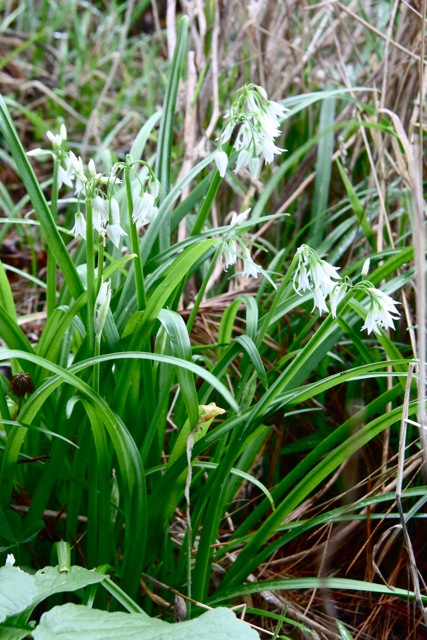
Allium_triquetrum2Is this little bloom early or late? We’re at the time of the year when it can be hard to tell. Threecorner leek (Allium triquetrum, also known as white flowered onion) is a pretty little weed that can cover entire meadows in the spring. The nodding white blossoms have six pointed petals, each decorated with a single green vein, and usually grow in clusters at the end of a leafless stalk.  The fleshy stem is triangular in cross-section, giving rise to its name. The rest of its name comes from its mild garlicky flavor and smell.

The flowers, leaves and bulb of the threecorner leek are all edible–you can add the leaves and flowers to a salad or eat them along the trail. Older leaves and the small bulbs are best cooked.

Allium_triquetrum1

Threecorner leek is native to Europe and Africa.

1 Comment

Filed under Edible, Non-native, Plant of the day

“Plant” of the day: rockweed

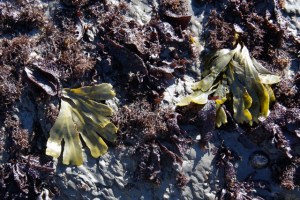
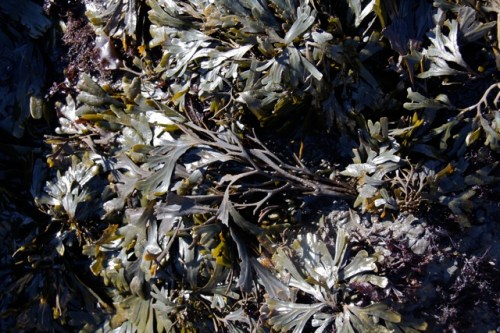
Lacy mounds of flat, greenish-brown leaves stand out in the cacophony of intertidal life. This is rockweed (Fucus gardneri), another brown alga that is widespread from Alaska to California. The mature tips  puff up and act as a float–and as the nursery where sperm and eggs develop before being released to find one another in the water. These tips are edible, and were called “Indian popcorn” by settler because local tribes liked to eat them dried. Other sources recommend eating them young (either fresh or blanched); but always in moderation.

Other names for rockweed include bladderwrack and popweed.  It has several lookalikes (F. spiralis, Hesperophycus californicus and Pelvetiopsis limitata), but rockweed can be identified by the central midrib running down each hairless, mitten-shaped leaf.

Leave a comment

Filed under Edible, Plant of the day

“Plant” of the day: bull kelp

Long, thick pieces of brownish-green hose have washed up on a steep and rocky beach. As any beachgoer knows, this is bull kelp (Nereocystis luetkeana)–a seaweed that can grow up to 60 feet long. When I was a kid, my friends and I would pretend we were cowboys, using the long “ropes” for lassoes. In Alaska, Native Americans used them as lines for deep sea fishing.

This slideshow requires JavaScript.

Bull kelp looks very plantlike, but it is actually a brown algae and in an entirely different kingdom. In the deep water where it grows, it anchors itself to the bottom with a root-like “holdfast” while the rest of the plant stretches toward the surface, buoyed by an air-filled pocket that grows at its upper end. Sometimes you’ll find the holdfast still gripping tightly to a rock that has washed up along with the plant. More often, you find the upper part–a rubbery length of stem topped by the bulbous float (which looks a lot like a turkey baster…)

This huge algae is an annual, meaning it grows from a tiny spore and lives its entire life span in only one year. Sometimes it can grow up to 10 inches in a single day! Otters, fish, sea urchins, crabs and other sea creatures live in the long ribbon-like leaves that grow from the top of the plant. You can buy edible bull kelp dried at the health food store or hop in a boat to harvest your own (it’s better fresh than after it’s been uprooted and washed up ashore). The leaves are eaten dried, and once washed and peeled the rubbery stalk can be pickled, or used in relish in the same way as cucumbers or tomatoes.

Leave a comment

Filed under Edible, Native, Plant of the day

Plant of the day: saltgrass

From far away, the edges of the marsh appear to be covered in a herringbone pattern of green and brown. This is actually a carpet of low-growing saltgrass (Distichlis spicata). Bunched into mounds or swept smooth by the outgoing tide, this is a beautiful and distinctive plant of the salty intertidal places. The leaves are flattened and create a dramatic geometric pattern as they alternate up the stem: wedge-shaped leaves offset by the space that they define. The effect of a single stalk is nice, but usually it is magnified by the thousand since this creeping, rhizome-forming grass tends to grow in dense colonies.

Saltgrass can stand being submerged in sea water and so it will often be one of the only plants growing along the tideline. I’ve sat along the shore of Tomales Bay and watched as the water creeps in or out, clambering farther up each leaf blade with each incoming wavelet. It’s a beautiful sight–and happens a lot faster than you might think!

Native tribes of California made a seasoning from the plant, threshing it to harvest the dusky-green salt crystals that coalesce on the leaves (and reputedly have a flavor rather like that of dill pickles).

1 Comment

Filed under Edible, Native, Plant of the day