Category Archives: Edible

Plant of the day: leather oak

Oaks are generally thought of as tall, graceful trees. But you can also find them in the sea of waist-high bushes known as chaparral. Leather oak (Quercus durata var. durata) is a common sight on serpentine soils in this area.

This slideshow requires JavaScript.

Leather oak can grow to around nine feet tall, but I have mainly noticed them growing much closer to the ground. Look close to spot acorns or clusters of catkin-like flowers among the small, grayish green leaves. The leaves of this species are dull, dusted with a pale fuzz (paler on the top than on the bottom). They also are concavely curled towards the ground–you could flip one over and use it for a little spoon, if they didn’t have a tendency to be spiny.

As with all acorns, the nut of the leather oak is edible once its bitter tannins have been leached out. Acorns were historically a major food source for local Native American tribes, and still are a major part of the food chain for wildlife. People generally remove tannins by soaking the nut in water (or a running stream). But some tribes would plant the acorn in a bog and wait until it sprouted in the spring–a system which apparently got rid of most tannins but preserved more nutrients than the water method.

Acorns can be eaten whole, or ground into a floury powder for cooking. Roasted acorns can be used as a coffee substitute.
Leave a comment

Filed under Edible, Native, Plant of the day

Plant of the day: salal

Gaultheria shallon

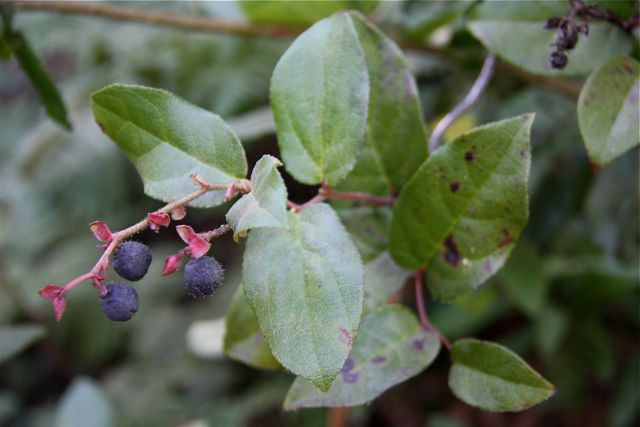
Salal is a familiar companion of the forest underbrush from Alaska to Santa Barbara. It is unadorned for most of the year, a simple shrub with largish (~4 inch) leathery leaves that dance up alternate sides of a slightly zig-zagged stem. In between the large veins, the leaves are traced with an intricate lacey pattern somewhat like the crease on the palm of a hand.

Small bell-shaped flowers of pinkish white appear at the tips of the stems in the early summer, and by now the dark purple fruit has ripened. Each berry is lightly hairy, and they are fairly sparse on the plant. Though edible, I have found them to be bland the few times I’ve tasted them. The leaves can be made into “a pleasant tea“, and poultices made of the leaves were traditionally applied to cuts, burns and sores. The fruit or leaves were also used to make dyes (of purple or yellow).

Leave a comment

Filed under Edible, Native, Plant of the day

Plant of the day: hayfield tarweed

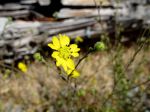
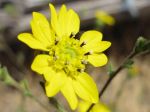
A pungent odor wafts across the flower-filled summer meadow. The smell is coming from the abundant yellow daisy-like flowers that are scattered everywhere. This is hayfield tarweed, or Hemizonia congesta. They look pretty, with three-lobed ray flowers encircling a soft yellow center. But if you pick one up you’ll get a sticky souvenir: this plant is incredibly resinous, and the smell and the stickiness will follow you until you can scrub off. Low-slung dogs will come back from hikes needing a bath, and the fragrance (strong but not unpleasant) lingers on fur and clothes.

Hayfield tarweed can be either white or yellow, and there are a number of other species of tarweed as well (though they are in several different genuses, and vary a fair amount in the way they look). The seeds of the Hemizonia and Madia tarweeds are edible–they were among the many types of seeds that Native American tribes collected and ground into flour. One miner described watching the Sierra Miwoks harvest in 1851: “During the months of August and September we often saw Indians coming and going. It was the time of their harvest; they came to our flats to gather all kinds of seeds, even hayseeds. It is the Indian woman who does this work; she has a big hamper or very open basket, of very fine reeds, and coated with a starch made of powdered seeds and warm water. She holds this hamper with one hand under the grass in seed; then with a sort of fan also made of reed… she pulls the grass over her hamper; the seeds, thanks to the shake given by the fan, are detached and fall.” (excerpt from California Grasslands, edited by Stromberg et al)

Leave a comment

Filed under Edible, Native, Plant of the day

Plant of the day: American speedwell

A little spring-fed stream is densely filled with the abundant deep green leaves of a low-growing plant. Petite blue-purple flowers bloom here and there in the foliage. This is American speedwell, or Veronica americana. A splayed pair of stamens surrounded by four small petals (the bottom one sometimes slightly smaller than the other three) are characteristic of the many species of speedwells.

American speedwell (also called brooklime) is native to temperate parts of North America and Asia. This plant loves to grow in slow-moving water, where its fleshy stems grow into a sprawling tangle. It is tart but edible, and high in Vitamin C.

Leave a comment

Filed under Edible, Native, Plant of the day

Plant of the day: golden chinquapin

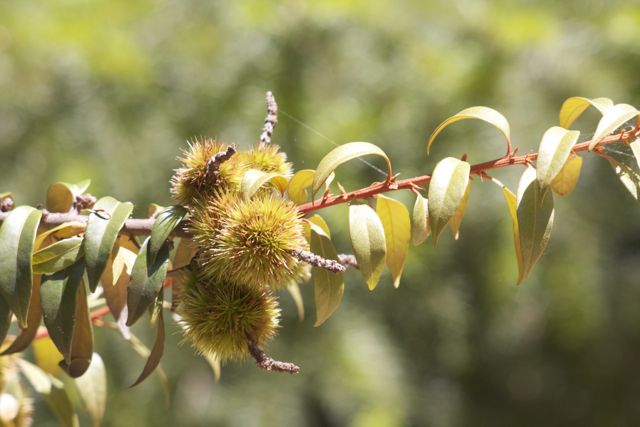
Golden chinquapin with nut

In the scrubby underbrush of dry hillsides is a shrub with velvety golden down on the underside of its shiny green leaves. This is the aptly named golden chinquapin (Chrysolepsis chrysophylla), which is a member of the oak family. It’s nuts, which are covered with a spiky golden husk, ripen in the summer time. The nuts are sweet-tasting and can be eaten raw or cooked; they were a common food for local tribes. If you plan to collect them, I recommend taking thick gardening gloves though–the spines are SHARP!!

Golden chinquapin is mostly found in coastal counties in California, but it does grow in scattered inland locations as well. It’s native to California, Oregon and southern Washington, where its range moves inland (and the plant gets larger). In our area it usually appears as a shrub, but don’t be fooled if you see a tree that fits the same description. The more widespread variety of this species is a tree that can grow up to 60 feet tall!

Leave a comment

Filed under Edible, Good for gardens, Native, Plant of the day

Plant of the day: coffeeberry

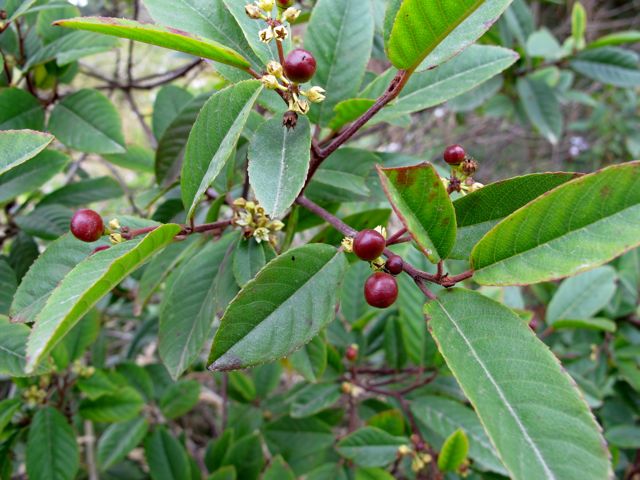
Frangula californica

Reddish berries are nestled among the dusky green leaves of coffeeberry (Frangula californica), a tremendously attractive shrub of dry hillsides, canyons and chaparral. Its stems are often reddish also, and the slightly shiny leaves dance up the twigs on alternating sides. In places it can look like a small tree, but more often I have seen it as a medium-sized shrub.

Coffeeberry is an important food for wildlife–mainly birds, but deer will eat it when tastier stuff isn’t around. Critters from pigeons to black bears (and deer too) enjoy the berries, and woodrats will eat limited amounts of the coffee-bean-like seeds inside. I’ve never tried the fruits, but apparently they are sweet and tasty, and were eaten by Native Americans. The bark has a laxative effect, and once was exported for medicinal use.

Unfortunately this pretty little native is vulnerable to Sudden Oak Death…

Leave a comment

Filed under Edible, Native, Plant of the day

Plant of the day: blue elderberry

Clusters of grayish-blue fruits hang from the branches of a small tree. Blue elderberry (Sambucus nigra) is a beautiful plant with arching branches. Its shaggy bark is wrapped around with furrows in older plants. The leaves are a fresh green and paired; each pinnate leaf actually looks like several leaves, since it is composed of 3–9 little leaflets.

Elderberry has a rich history of being used in cuisine, crafts, and medicine–but it must be approached with caution since the green parts of the plant and the unripe berries are quite toxic. The roots are the most toxic of all. But ripe berries make a delicious syrup, jam or wine, and the plant has long been cherished by traditional cultures. Petals can be eaten raw, made into a tea, or used to flavor pancakes. Some have even dipped the entire flower head in batter and fried it! Elderberry syrup is said to be an effective treatment for the flu; you can buy bottles of it at most health food stores. Native Americans used the branches for baskets, flutes and arrow shafts, and the fruit was a main food source.

Before the fruit is ripe, you can tell blue elderberry from its cousin, red elderberry, by the shape of the flower head. Blue elderberry has a flat-topped cluster, whereas red elderberry flowers are arranged in a pyramidal or roundish shape.

Notice the flower head is flat, not cone-shaped

Leave a comment

Filed under Edible, Good for gardens, Medicinal, Native, Plant of the day, Poisonous

Plant of the day: white clover

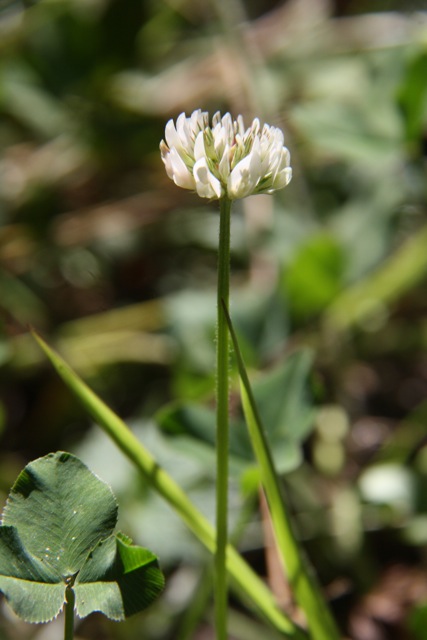
White heads of flowers dot the unmowed ball field like cotton balls scattered freely. But look close and the blooms are not at all cottony; this is a clover, each head a cluster of dozens of small pea-type flowers. The leaves are distinctively bisected with a faint crescent line that looks like a watermark, or the pattern left behind on paper that was soaked and then dried.

Everpresent in lawns and weedy berms, white (Trifolium repens) clover is one of the most common (and dare I say overlooked) plants around. Rare, shy, or temperamental flowers are a treat to find and behold–but I also like to take the time to get to know the species that are so common that they are easy to ignore. This little European invader is certainly one of those. But it turns out that not only is it a favorite snack for livestock, but humans can eat it too! Young leaves can be used in salads or soups, or it can be cooked like spinach. Dried flowers and seed pods have been ground into a high-protein flour that can be used on its own or as a garnish. The plant can be boiled for a tea, either just because its tasty or as a traditional Cherokee treatment for fever. Roots can be cooked and eaten, and evidently the leaves give baked goods a vanilla-like flavor. Who knew.

Trifolium repens

Leave a comment

Filed under Edible, Medicinal, Non-native, Plant of the day

Plant of the day: wood rose

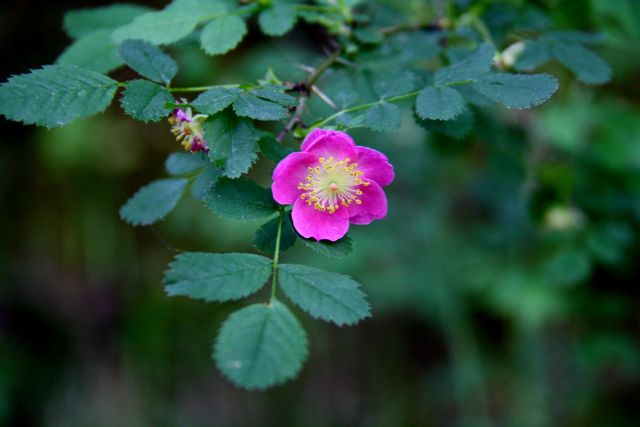
Rosa sp.

In spring, the native roses bloom with graceful pink blossoms. In the summer, they are decked with clusters of red fruit. And year-round, the elegant bushes are lush with small round leaves. A wild rose is a treat in any season or any setting, whether forest or garden. Telling the different species apart can be tricky (the local key requires fruit which isn’t helpful in spring). But at this time of year, the wood rose–Rosa gymnocarpa–stands out because it loses its sepals as its fruit begins to ripen; other species retain the sepals (and sometimes the dried remains of the stamens too) on the ends of the fruit. One of its other common names is “bald hip rose”.

Though technically edible, the small red hips are packed full of seeds that are nestled inside a dense layer of hair that grows on the inside of the fleshy shell. Not exactly succulent, they have a tart, good-for-you, vitamin-C kind of tang. I read that the seeds are a good source of Vitamin E. The petals also can be eaten, and both petal and hip can be steeped for a tea. Historically, leaves were sometimes chewed as a remedy for bee stings, while the soaked bark was a wash for sore eyes.

See how the end of the fruit is smooth?

Leave a comment

Filed under Edible, Good for gardens, Medicinal, Native, Plant of the day

Plant of the day: chicory

This tough, blue-eyed plant is a rugged survivor (aka, a weed). Chicory (Cichorium intybus) thrives on the edges of human activity: roadsides and empty lots. It was originally native to Europe, but now it is so well established across North America that it often is described as “naturalized”.

Chicory also has a long relationship with people as a food. It’s roots–roasted, toasted and ground–are a renowned coffee substitute. They also can be cooked and eaten like parsnips. The bitter leaves are used in salads or spaghetti; they are less bitter in the wintertime. Because chicory plants have plenty of inulin (a type of starch that diabetics can’t digest) they are a recommended food for people trying to limit their glucose.

Their pretty blue flowers are light sensitive, opening at dawn and closing by the afternoon.

Leave a comment

Filed under Edible, Non-native, Plant of the day