Category Archives: Edible

Plant of the day: pickleweed

The pickleweed is in bloom, but you probably won’t notice.

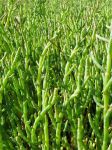
First, you would have to notice the plant itself. Sarcocornia pacifica is a fleshy, low-growing plant of the salt marshes. It is named for its leafless, segmented succulent stems, which resemble tiny pickles. Or, little green fingers. I think it’s an adorable plant, but it is undeniably unobtrusive. Often people just see it as something to step on while they are getting to the water, the beach or the view…
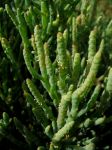
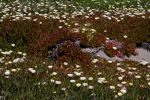
To see the flowers, you have to look even closer. The blooms themselves are simply tiny white threads emerging from the green wall of the plant; you can barely see them with the naked eye (click on the middle picture to get an idea).

I’ve never nibbled on it, but pickleweed (also called Virginia glasswort) is edible, with a mild salty flavor. Not surprising, since it often grows in a dense mat along the wet edges of marshes. Regularly drenched by the tide,  it has the ability to absorb large amounts of saltwater.

1 Comment

Filed under Edible, Native, Plant of the day

Plant of the day: Pacific blackberry

So you thought a blackberry was always a blackberry, huh? Well, no. Or rather, there are a few different kinds of blackberry, so you have to look close.

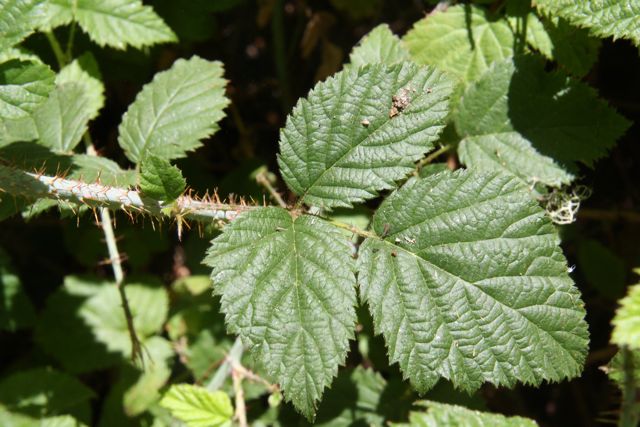
I wrote about the invasive Himalayan blackberry a few weeks ago–but now the native Pacific blackberries (Rubus ursinus) are beginning to ripen, so keep your eyes out for them as well. Superficially, these look similar to their invasive cousins. Both grow in prickly mounds of briars. Both have leaves that generally are in groups of three, and many-segmented berries. But Pacific blackberries are all-around more delicate: their berries and their thorns are both more delicate, and their leaves are a lighter green and a thinner texture. Flip one over, and the Pacific’s leaf will be green below while the Himalayan’s leaf will be white.

If you get a look at the flowers, the distinction gets even easier. Pacific blackberry is the only local member of the Rubus genus to have gender-segregated flowers. What this means is that instead of male stamens and female pistils being in the same bloom, some flowers only pack pistils while others only sport stamens.

And that is why botany is awesome.

Leave a comment

Filed under Edible, Good for gardens, Native, Plant of the day

Plant of the day: fennel

It tastes great in salads, but fennel (Foeniculum vulgare) is an unfortunate weed in California. It grows avidly along roadsides and in other disturbed places. This plant grows up to ten feet tall, with feathery leaves and yellow umbrella-shaped umbels of flowers.

This slideshow requires JavaScript.

The leaves and the seeds have a distinctive licorice flavor, which is likely why the plant came to the Americas in the first place. It’s been used as a spice and a medicinal plant for centuries, and is thought to have escaped into the wild time after time.

Fennel is an invasive species, and takes over areas by forming dense stands where nothing else can grow. This isn’t just because the plants are so numerous that there is no room for any others. They also exude chemicals that actually prevent their competitors from growing!


Check out the above video for an musical animated interpretation of why fennel is a problem…
 

Leave a comment

Filed under Edible, Invasive, Non-native, Plant of the day

Plant of the day: canyon gooseberry

This gooseberry is a prickly delight. From its elegant branches to its troublesome little berries, Ribes menziesii has a lot of character. The berries are edible–and yummy!–but you have to get past the spines to enjoy them. There’s no easy way to do this; you can try peeling with a pocket knife or just chewing carefully. I’ve also tried popping them with my teeth first, before chomping down. This seems to work the best, but you’re still bound to get prickled a few times.

This slideshow requires JavaScript.

Overall this plant is better for looking at than for eating, especially in spring and summer. The thorny branches sport scalloped green leaves on gracefully arching branches, and in the spring it puts out masses of small lantern-shaped flowers that bees love.

Gooseberries are a type of currant, and some of the local wild species (spreading gooseberry, flowering currant) are spineless–as are their store-bought cousins. In addition to the canyon gooseberry featured here, there are some other spiny species around as well (California gooseberry and Victor’s gooseberry). You can tell them apart because the first has smooth, hairless leaves and the second has shorter spines on the fruit that are all about the same length.

Leave a comment

Filed under Edible, Good for gardens, Native, Plant of the day

Plant of the day: western rasperry

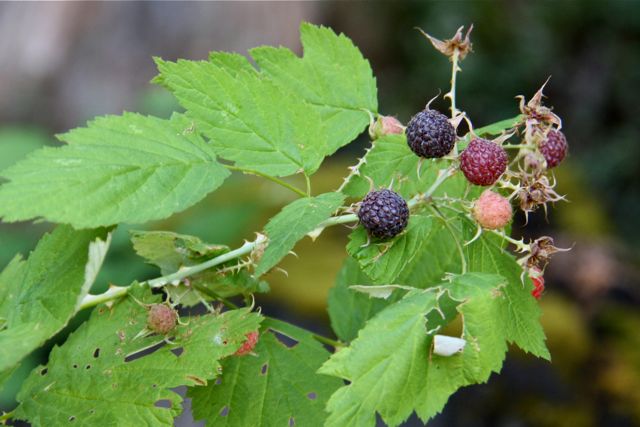
A sprawling pale-stemmed bush is decked with dark purple raspberries. Warmed in the sun, they have a mild, rich sweetness. These tasty fruits are smaller, leaner, and much darker than their plump commercial cousins. I’ve always preferred the wild version!

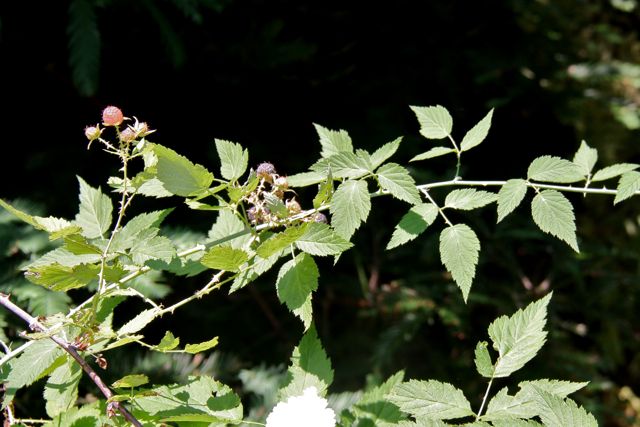
There are many listed names for Rubus leucodermis  (western raspberry, white stemmed raspberry and whitebark raspberry) but I’ve always just called this “wild raspberry” since it’s the only native one around. It’s in the same genus as Himalayan blackberry, but though the plants are similar they are easy to tell apart even when not in fruit. Western raspberry is a delicate shrub with slim branches that have a glaucous coating which you can rub off with a finger. The leaves of both species are three parted, but blackberries’ are much thicker and darker.

Western raspberry is one of my very favorite California berries, but you won’t see it growing in Marin. Sonoma County? Yep. Santa Cruz? Yep. Even down to San Diego and up into Alaska. But for some reason it doesn’t like the San Francisco bay – there’s no record of it  in SF, Marin, the East Bay, or the Peninsula.

Leave a comment

Filed under Edible, Good for gardens, Native, Plant of the day

Plant of the day: Himalayan blackberry

In ditches and along river banks, the berries are beginning to ripen. Great green mounds of shrubs – all leaves and thorny branches – are speckled with dark purple fruit. Younger berries are still green or red, and most bushes still have flowers on them as well.

This is the Himalayan blackberry (Rubus armeniacus), one of the most common berries around. It is also one of the only non-native invasive berries in the area. Though it’s delicious in pies, smoothies and endless other treats, this shrub can be a nasty problem for native habitats: I’ve seen it smother entire fields, leaving no space for native plants and the animals that depend on them. Usually you’ll see it in disturbed places and on poor soils. Despite the name, the bush originally came from western Europe and there is “no evidence” that it came from the Himalayas.

One nifty thing about this “fruit” is that it’s actually a bunch of small fruits – each little nub on the berry is called a “drupelet” in botany-speak.

Leave a comment

Filed under Edible, Invasive, Non-native, Plant of the day

Plant of the day: salsify

With a spiky green sheath of bracts surrounding several layers of purple petal-like flowers, salsify (Trapopogon porrifolius) is a beautiful and slightly cruel looking plant. The inner flowers of the head are dusted with yellow pollen that is the perfect ornament on the dark purple petals. Each of the large-ish, showy flowers is actually many flowers, since this is a member of the Asteraceae family. Once the flower has gone to seed, it produces a big dandelion poof that can be a few inches across.

This slideshow requires JavaScript.

This plant is also called oyster-root, and it was introduced from Europe where the carrot-like root is eaten; the flavor is described as similar to oyster or artichoke. Here in California it is an escaped ornamental, and likes to grow in dry grassy areas. You usually will see it in disturbed places, not too far from town.

.

Leave a comment

Filed under Edible, Non-native, Plant of the day

Plant of the day: thimbleberry

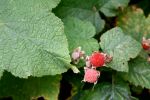
Berry season is upon us! Thimbleberries are a great trailside treat – the red berries are so delicate that picking a large quantity can be hard. But that delicacy is also what makes them so fun to eat. To me they taste like a little dollop of jam, served up right there on the bush. The fruit just dissolves in your mouth like it was already cooked.

Thimbleberries are distinguished by their large, soft, maple-shaped leaves. In the spring they sport large white flowers: many stamens gather around a yellow center. By early summer their bright red raspberry-like fruits have begun to ripen. You can find them in most parts of California, from the Sierras to the sea, and also across much of North America.

Thimbleberries (Rubus parviflorus) are in the Rosaceae family, and are closely related to blackberries, raspberries and salmonberries – all of which are in the Rubus genus as well. What a tasty clan!

Leave a comment

Filed under Edible, Good for gardens, Native, Plant of the day

Plant of the day: huckleberry

Vaccinium ovatum

One of my favorite Fourth of July memories is eating my great-aunt Martha’s huckleberry pie when I was a kid. We’d gather at the family campground by a little river, and eat California delicacies like abalone, venison, and this wonderful pie. Huckleberries are a wild-tasting fruit, tart but sweet. They taste of pine forest and long days with picking buckets. The little fruits hold their texture even when cooked, they  pop in your mouth with a satisfying burst: perfect when blended with sugar and a flaky crust.

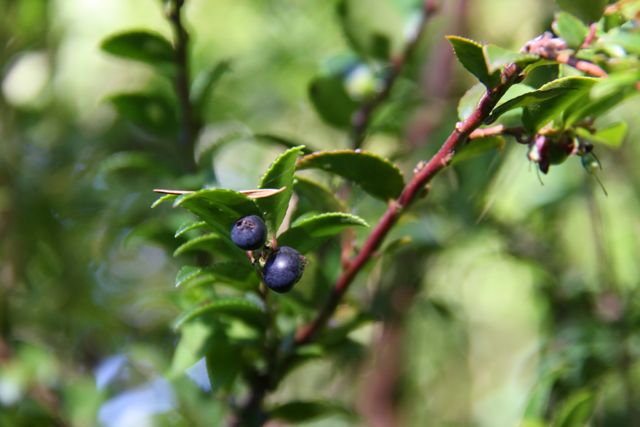
Huckleberries (Vaccinium ovatum) grow all along the west coast – from Canada to Alaska – but not many people cook with them often since they are so small that picking enough for a pie takes a long time. Look for them  in forests and clearings, often on slopes. The shrubs are attractive, with dense shiny foliage of small oval leaves. White lantern-shaped flowers give rise to small, round, dark purple fruit that looks like a small blueberry.

2 Comments

Filed under Edible, Good for gardens, Native, Plant of the day

Plant of the day: ice plant

On a trip to the ocean, I wade through a thick reddish-green mat of rubbery plants to get to the beach. The ankle-high leaves are spiky and break off under my feet with a crunch. Large yellow flowers are scattered across this green carpet, each with hundreds of skinny petals surrounding a nest of pollen-dusted stamens. This is Carpobrotus edulis, one of several kinds of iceplant in the area. None are native.

The fruit of Carpobrotus edulis, as its name suggests, was traditionally eaten back in its original territory of South Africa. It was deliberately brought to California, planted to bind coastal soils together and help stop erosion. It does seem to be successful at that job – you can see it growing on beaches and even in colorful tapestries drooping over the edge of cliffs. However, it’s another good intention gone wrong since it has turned out to be highly invasive; an “ecological bulldozer,” along the lines of broom, that wreaks havoc on the delicate dune ecosystem. All the species of ice plant look at least somewhat similar, though not all of them are closely related (there are five species in four different genera, with the two types of Carpobrotus being the most common around here, as far as I can tell).

3 Comments

Filed under Edible, Non-native, Plant of the day