Category Archives: Edible

Plant of the day: selfheal

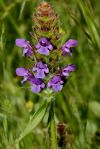
These small sturdy towers of purple flowers are usually found in meadows and wet places. Though it only grows to be about five inches tall, it’s a hardy and versatile little plant – Prunella vulgaris is found in every state in the continental US as well as in Europe, Asia and many parts of Canada.

As the name suggests, this is also a traditional medicinal plant that has been used in teas, in stews and for compresses.The square stem and two-lipped flower reveals this flower as a member of the mint family.

Leave a comment

Filed under Edible, Medicinal, Native, Plant of the day

Plant of the day: wild radish

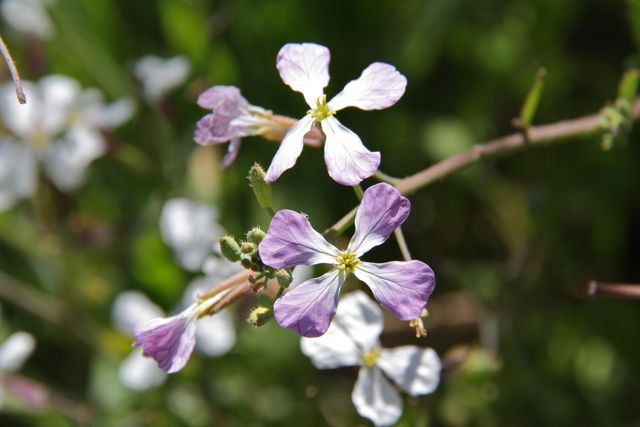
Masses of delicate easter-colored flowers fill fields and hillsides, standing as tall as your waist or even shoulder. These pale yellow, purple, and white flowers are wild radish, or Raphanus sativus. You can see a fantastic showing of them along the first part of the Pierce Point trail on the Point Reyes Penninsula.

These flowers also taste good—take a trailside nibble or add flowers and pods to a salad for a spicy radish taste. And there are those four simple petals again! That’s right, the wild radish is in the Brassicaceae, or mustard, family that I wrote about last week.

According to the Marin Flora, the local wild radish is actually a hybrid between R. sativus and its cousin, R. raphanistrum.

Leave a comment

Filed under Edible, Invasive, Non-native, Plant of the day

Plant of the day: yerba santa

Beside a rocky trail, a tall spike of leathery green leaves topped by a cluster of white flowers peeks up through the chaparral. This is yerba santa, or Eriodictyon californicum. It is known as a medicinal plant (tea now available at Amazon as well as in the great outdoors), though personally I haven’t been attracted by the descriptions of a bitter, menthol-like taste. Traditionally, the tea was used for colds and other respiratory troubles, though it also has been used to treat maladies as diverse as stomach aches, headaches, bruises, eye troubles, and gonnorhea.

The leaves are often dusted with an unappealing black mold, but without this yerba santa is a handsome plant. The white flowers cluster loosely at the top of the spike of leaves. Each blossom is tubular and flared at the mouth, with petals that taper off into points. If you look close, you’ll see that each flower has two styles (and no, that isn’t sweats and slacks. The style is the shaft of the female reproductive parts).

You commonly find yerba santa on rocky slopes or in chaparral, among the dense scrub of manzanita or ceanothus. It can reproduce by seed, but only does so after a fire or other disturbance of the soil surface. Since fires aren’t common in today’s era of fire suppression, it usually reproduced vegetatively. They can grow a rhizome (rootlike structure) up to eight feet long in a single summer! That rhizome will put up new plants every 8 to 10 inches — an effective way to raise a family indeed.

Leave a comment

Filed under Edible, Native, Plant of the day

Plant of the day: woodland strawberry

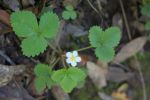
A happy sight for many a hiker, our native strawberry peeks from the edges of shrubs and woodlands. Not as tasty or as luscious as a storebought berry, this tiny fruit is better recognized for its good looks. Pretty white flowers with yellow centers are accented by a few dark green, serrated leaves. As spring moves into summer, the flowers give way to fruit, which are quickly nibbled by insects, rodents and other critters.

Fragaria vesca can be found across most of California. Marin is also home to the beach strawberry, that grows close to the coast – mostly in sandy places. In the northern and eastern parts of the state you also might see the very similar Fragaria virginiana, or mountain strawberry. And if the plant has yellow blooms instead of white, you may be looking at a non-native mock strawberry. This looks very similar to Fragaria species, but is actually in an entirely different genus!


Leave a comment

Filed under Edible, Good for gardens, Native, Plant of the day

Plant of the day: bracken fern

Bracken fern is another one of my longtime favorite plants – and not just because the young, furled tips are tasty in salads or while on the trail. This unpretentious plant is both attractive and hardy. You see it in woodsy understories,  on dry hot hillsides, and everywhere in between. In the autumn, it’s dry leaves add a particular, pleasant scent to the fragrance of the forest. Wildlife uses it for food and nesting material; sometimes I’ve found beaten-down areas in larger patches, where deer have bedded down to sleep.

Distinct from other ferns, its large (up to 2 feet) fronds are broadly triangular, and often have an airy quality to them, with a lot of space between each sub-frond. Underneath, the fertile spores are found in a line hugging the edge of every leaflet. Even when these sori aren’t brown and ripe, you can see them as a raised green rim – another good diagnostic clue. None of the many other ferns in the area has this combination of obtuse outline, frond type, large size, and brown spore rim. Pteridium aquilinum can be found growing throughout most of North America. In fact (according to the USDA plants database) the only state in the US that it isn’t found in is South Dakota, which is odd enough that one has to wonder if it’s a data glitch. Or… maybe there is a legit ecological reason that this is the only state our fern has shunned!

This slideshow requires JavaScript.

Leave a comment

Filed under Edible, Native, Plant of the day

Plant of the day: miner’s lettuce

This slideshow requires JavaScript.

This unassuming little plant is common in moist areas and in forest understories. Claytonia perfoliata also doubles as a tasty trailside snack, with a pleasantly plump and crisp leaf. The taste is mild and green, somewhere between spinach and lettuce. Native Americans and early western settlers ate it regularly, but now it is more of a novelty nibble.

Leave a comment

Filed under Edible, Native, Plant of the day