Category Archives: Invasive

Plant of the day: long beaked stork’s bill

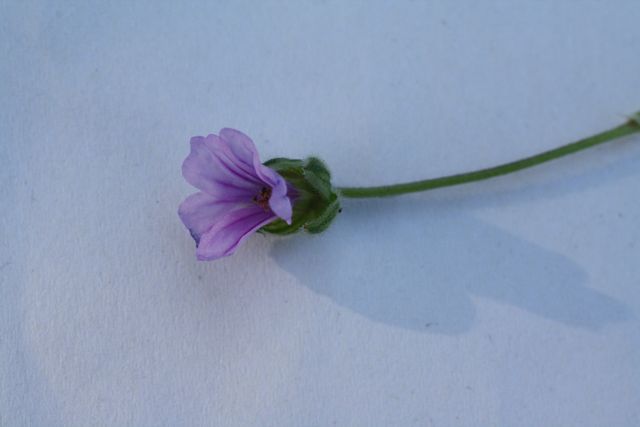
Long beaked stork’s bill is a ubiquitous sight in the fields of the bay area. This invasive little weed and its cousins, other types of stork’s bills, have naturalized across most of California. The long beaked stork’s bill (Erodium botrys) is distinctive because of the particularly long, beak-like seed pod, but also because of its leaf – it is the only one with a long narrow leaf that isn’t actually dissected into separate leaflets.

There are several species of wild geraniums with flowers that look quite a bit like those of stork’s bills – small, pinkish-purple. Again, look to the leaf to know what plant it is. The geraniums (sometimes called crane’s bills) have deeply dissected leaves that are overall roundish in shape. In other words, if you drew a line around the outside of the leaf, ignoring the details, you’d come up with a circle as opposed to the overall tongue-shaped leaves of the stork’s bills. The wild geranium petals are usually notched at the end, giving them a toothed look. Almost all of the wild geraniums are also invasive, with a few exceptions.
Leave a comment

Filed under Invasive, Non-native, Plant of the day

Plant of the day: foxglove

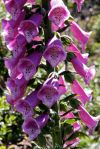
Tall spikes of white or purple flowers are bursting like flares across Marin. This is the season for foxglove, another striking-looking invasive. Native to all parts of Europe, it has now colonized much of North America, where it appears to prefer the coastal areas to the heartland. You can find it in from Alaska to Mexico, and on much of the east coast as well. Digitalis purpurea can grow to be taller than a full-grown person and is quick to colonize areas that have been disturbed such as road sides, logging or building sites.

Foxglove is also highly toxic so don’t eat it!! Small amounts have been known to be fatal. Some of its other names give you a clue that this is a bad idea: Witches’ Gloves, Dead Men’s Bells, Bloody Fingers, and Fairy’s Glove just name a few. Yet in its noteworthy history, Digitalis was also used as a medicinal plant by herbalists. They were on to something: extracts from the plant are now used pharmaceutically to treat congestive heart failure. As much as I appreciate folk remedies, this is one I’m glad the scientific establishment has gotten involved with; messing around with a plant that supposedly killed some kids who drank the water from a vase containing foxgloves seems like a bad idea!

Leave a comment

Filed under Invasive, Non-native, Plant of the day, Poisonous

Plant of the day: French broom

I remember when I was a kid, and first learned that the pretty yellow-flowered bushes I saw all over were bad for the environment. It was probably my first ecological lesson, and I was heartbroken. Their sunny color had always made me happy when I looked out the window on family drives. How could I have been so wrong?

Since then, Genista monspessulana has only become more common. You can see it filling the understory of forests on Mt. Tam, or spilling over the cement retaining walls along roadsides. This highly invasive plant is native to the Mediterranean and the Azores, and was brought to California in the 1800s — probably as an ornamental for gardens. It really is quite pretty. But it also is what scientists call an “ecosystem disruptor” because it wreaks havoc on the native plant communities. It forms dense stands up to 16 feet tall, under which nothing else can survive. All the delicate flowers, grasses and even hardier shrubs perish in its shadow. Livestock don’t even like to eat it. Broom is like an ecological bulldozer, taking diverse habitats and leaving a barren landscape in which it is the only survivor. A single plant has been found to produce over 30,000 seeds — and the seeds live for decades in the soil, waiting for a disturbance like digging (or pulling a grown plant out by the roots) before they sprout. It also is a fire danger, growing tall and tinder dry. Can you tell how I feel about this plant? It’s a nightmare. If you have it on your land or in your neighborhood, get rid of it!! Quick, before it spreads!

Leave a comment

Filed under Invasive, Plant of the day